All Offline Activities Like Work, Study, Exercise, and Leisure Now at Home as a 'Complex Cultural Space'
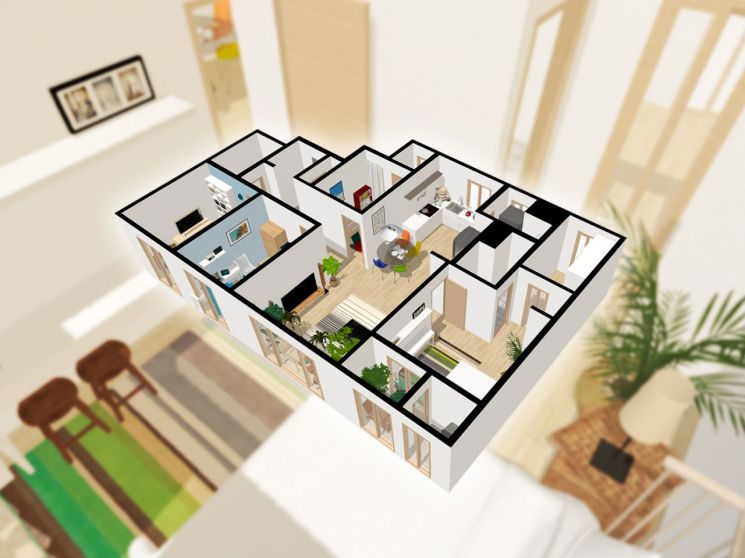
[Asia Economy Reporter Kim Jonghwa] With various reasons such as surpassing $30,000 in national income, the increase in single-person households, and IKEA's entry into the domestic market, interest in homes has steadily increased over the past few years, transforming the concept of a home from a residential space to a 'complex cultural space.' Eating and sleeping are basic, but as all activities previously conducted offline?work, study, exercise, leisure?are now happening at home, the concept of home is being newly defined.
Professor Kim Nando of Seoul National University's Department of Consumer Studies, who has predicted annual trends, named this phenomenon of the home being reborn as a new 'multifunctional space' as the 'layered home' in his book Trend Korea 2021.
This change in perception can also be seen in the trend of home-related programs called 'Jipbang' (home broadcasting). Beyond programs like Save Me, Holmes, which find customized homes reflecting residents' preferences and lifestyles, there is a growing number of Jipbang programs dealing with various uses of the home, such as Butler's Choice, Shinbakhan Organization, and There Is No Our Home in Seoul.
As homes provide more diverse functions, consumers focus not only on decorating their homes beautifully but also on efficiently 'organizing' every corner of the home to make the best use of each function. This is why interest in 3D interior services that accurately assist with spatial simulation based on the floor plans of the homes people actually live in is increasing.
Evolving 3D Interior Services, Selectable According to Interior Situations
In fact, the number of subscribers to 'Urbanbase,' a provider of 3D interior services, from January to October this year increased by about 320% compared to the same period last year. The demand for 3D interior services can also be confirmed through social data. According to Naver Data Lab, the search index for the keyword 'interior simulation' from January to October this year increased by about 117% compared to the same period last year.
Existing services capable of spatial simulation often required separate installation and had many professional features, making the entry barrier high for the general public. Recently, web-based 3D interior services with easy access and user-friendly interfaces have been increasing. Since the difficulty level varies by service, users can choose a service that fits their interior situation, such as furniture arrangement, partial interior, or remodeling.
Urbanbase is ideal for those who want to simulate interiors as simply as possible. It holds 3D floor plan data for 95% of domestic apartments, allowing users to load a 3D model of their actual living space in just a few seconds and perform interior design, which is its greatest advantage.
Unlike most 3D interior services that only offer English versions, Urbanbase is a domestic service available in Korean, and all its features are free, which is another special advantage. However, it only supports apartment floor plans, so there are limitations for residents of houses, villas, or one-room studios.
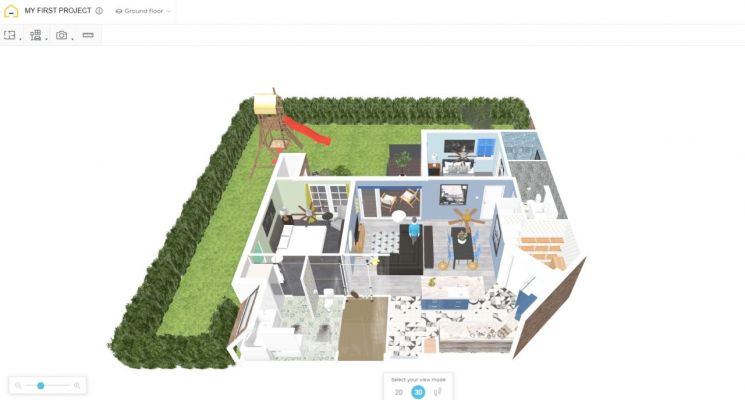
If you want more detailed spatial simulation before partial interior work or remodeling, overseas services such as Floorplanner, HomeByMe, and Planner 5D are recommended. Floorplanner allows you to input the sizes of walls, doors, and windows directly, which are then automatically converted into a 3D space, and you can adjust and arrange the sizes of furniture and interior accessories in detail. However, furniture placement is difficult directly in 3D mode, so you need to arrange in 2D floor plans first and then switch to 3D mode, which can be inconvenient.
HomeByMe has most of the same features as Floorplanner but allows adding multiple floors, making it suitable for residents of multi-level homes. However, since the screen moves based on a person’s perspective, it is difficult to explore the 3D space from a first-person viewpoint.
Planner 5D also supports adding floors. Its 3D manipulation is very intuitive and natural, and it can be linked with a mobile application, allowing users to check their designed space in real-time across PC and smartphone. On the downside, the furniture available for free placement is very limited.
Hajinwoo, CEO of Urbanbase, said, "As homes become multi spaces, how efficiently the given space is organized will become people's main concern," adding, "Since 3D interior services are becoming more diverse, just like previewing music or videos, a culture of simulating interiors in various ways before actual interior work to minimize failures will naturally take root."
© The Asia Business Daily(www.asiae.co.kr). All rights reserved.
!["The Woman Who Threw Herself into the Water Clutching a Stolen Dior Bag"...A Grotesque Success Story That Shakes the Korean Psyche [Slate]](https://cwcontent.asiae.co.kr/asiaresize/183/2026021902243444107_1771435474.jpg)

















