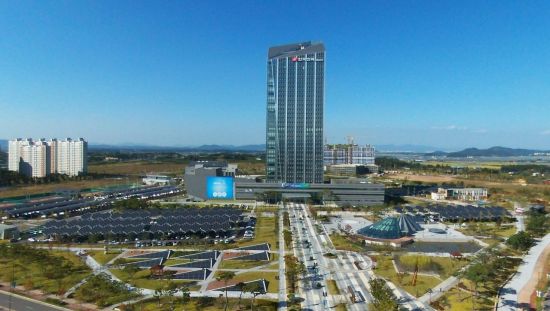
 Jeollanam-do Naju Korea Electric Power Corporation Headquarters. (Photo by Korea Electric Power Corporation)
[Asia Economy Reporter Moon Chaeseok] There is growing support for the argument that the new electricity rate system, which Korea Electric Power Corporation (KEPCO) is likely to announce this year, should apply a 'fuel cost linkage system' that reflects costs.
On the 12th, KEPCO announced that its cumulative operating profit for the first to third quarters increased by 914.7% to 3.1526 trillion won. Net profit turned positive at 1.5077 trillion won.
During this period, the average nuclear power utilization rate was 73.8%, down 0.7 percentage points from the previous year.
KEPCO explained that international fuel prices have a greater impact on performance than the nuclear power utilization rate.
Since most raw materials are imported from overseas, it is true that volatility in performance inevitably increases depending on oil prices.
KEPCO spent 23.7252 trillion won on fuel and power purchase costs up to the third quarter of this year, about 3.9 trillion won less than last year.
These costs are influenced by international fuel prices and account for about 60% of total operating expenses.
The fuel cost linkage system has the characteristic of reflecting increases or decreases in fuel costs due to international price fluctuations in electricity rates.
It is also a mechanism to inform customers in advance of variable rates next month, encouraging rational electricity consumption and energy saving.
It was introduced in 2011 but abolished in May 2014 due to growing concerns about inflation.
On the 11th, KEPCO President Kim Jong-gap said at a National Assembly forum, "Most advanced countries separately impose a 'climate change response fee' on electricity rates and operate a fuel cost linkage system that periodically reflects fuel cost fluctuations in electricity rates," adding, "the 3rd Basic Energy Plan includes the content that 'a rate system should be established that flexibly and timely reflects cost fluctuation factors such as raw material costs and external costs.'"
© The Asia Business Daily(www.asiae.co.kr). All rights reserved.
















