Over 23,000 Cases Annually "1 in 10 Couples"
Multicultural Births Account for 6% of Total
Likely Impact on Declining Birth Rates
Concerns Over Marriage Polarization and Labor Issues

[Asia Economy Reporter Lee Gwan-ju, Intern Reporter Lee Jun-hyung] The approximately 23,000 international marriages that occur annually are almost not happening this year. Births in multicultural families, which account for about 6% of total births in South Korea, are also expected to decline significantly. There are forecasts that the decrease in international marriages will bring various social repercussions, while some analyses suggest it is only a temporary phenomenon.
According to the Ministry of Gender Equality and Family and international marriage brokerage agencies on the 13th, due to the impact of the novel coronavirus infection (COVID-19), the number of international marriages concluded this year is virtually at a 'zero' level. Professor Seol Dong-hoon of the Sociology Department at Jeonbuk National University, who is conducting research related to international marriages, said, "It appears that international marriages are hardly taking place this year."
The reports from brokerage agencies are similar. As of last September, there were a total of 353 registered brokerage agencies, of which 59 closed this year. A representative from company A in Hwaseong, Gyeonggi Province said, "Last year, we brokered about three couples per month, around 40 couples annually, but since February this year, business has effectively stopped." Company B in Jongno-gu, Seoul also stated, "We have received inquiries, but since the COVID-19 outbreak, we have not been able to finalize a single contract."
However, since international marriages occur in various forms beyond brokerage agencies, the official number of international marriages will only be confirmed when Statistics Korea releases data in November next year. Nevertheless, given the clear sharp decline in international marriages this year, it seems difficult to avoid social repercussions. Marriages between Koreans and foreigners numbered 20,603 in 2017, 22,698 in 2018, and 23,643 last year. The proportion of international marriages in total domestic marriages increased from 8.5% to 9.7% to 11.1%. Last year, one out of every ten marriages in South Korea was an international marriage.
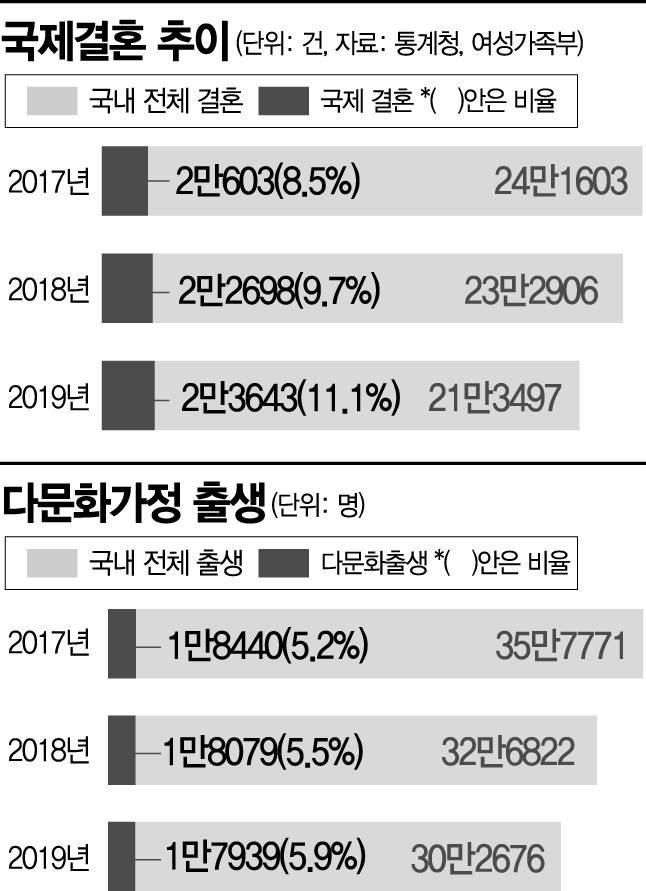
The decrease in international marriages is also expected to affect the number of newborns. Nearly 20,000 children are born annually in multicultural families. Due to the overall trend of declining births, the number of newborns in multicultural families decreased slightly from 18,079 in 2018 to 17,939 in 2019, a drop of about 0.8%. However, compared to the 7.4% decrease in total domestic births during the same period, this is a relatively low level. Some view this phenomenon as a 'population pillar.' The proportion of births from multicultural families accounted for 5.9% of the total last year.
Concerns about marriage polarization also exist. Jang Han-up, director of the Multicultural Research Institute at Ewha Womans University, pointed out, "While birth rates are important, the inability of socially vulnerable groups or rural residents who find it difficult to marry to form families can become a social problem." Jang also said, "Many migrant women seek work to support their families back home," adding, "There may also be labor issues such as rising wages or job shortages in industries where many migrant women are employed." As of last year, marriages between Korean men and foreign women accounted for 69.3% of all international marriages.
There is also analysis that the decrease in international marriages will be a short-term phenomenon. Professor Seol said, "As long as the causes driving international marriages exist, the external environment of COVID-19 will only have a temporary effect," and predicted, "Once COVID-19 subsides, postponed international marriages may occur all at once, causing a sharp increase in the number of marriages."
© The Asia Business Daily(www.asiae.co.kr). All rights reserved.

















