Development of an Integrated Diagnostic Platform for Airborne Virus Collection and Detection
Rapid and Selective Detection of Airborne Viruses Using a Disposable Collection Kit
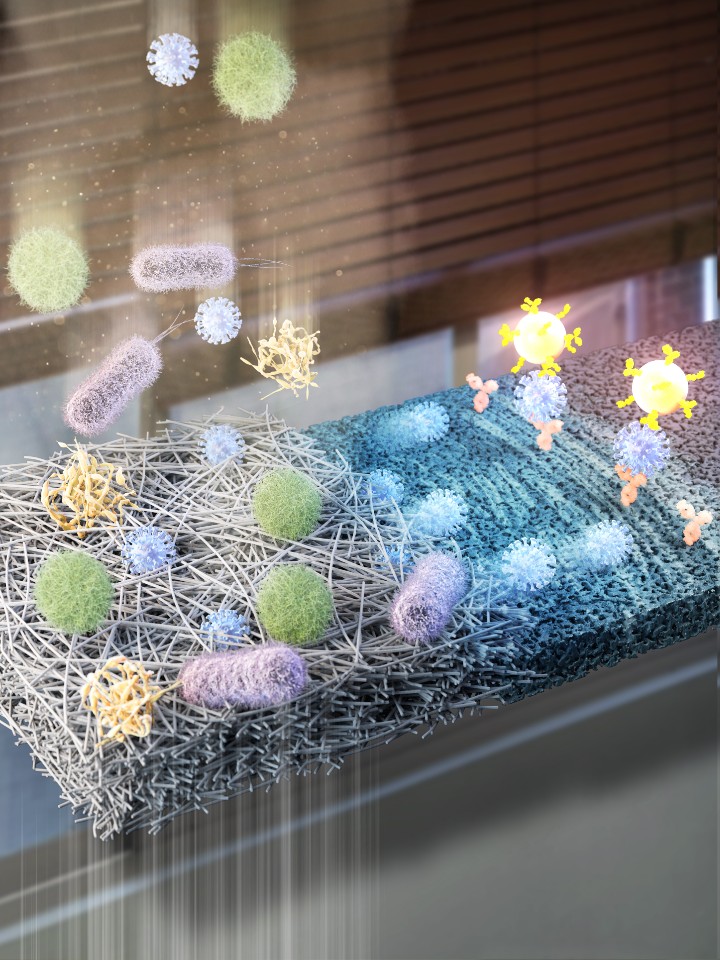
[Asia Economy Reporter Junho Hwang] A technology capable of capturing specific viruses contained in indoor air and detecting them within 50 minutes has been developed. It is expected to be a useful technology for detecting viruses floating indoors, such as the novel coronavirus infection (COVID-19).
Dr. Lee Jun-seok's research team at the Molecular Recognition Research Center of the Korea Institute of Science and Technology (KIST), in collaboration with Professor Kim Min-gon of the Department of Chemistry at Gwangju Institute of Science and Technology and Professor Song Chang-seon of the Department of Veterinary Medicine at Konkuk University, announced on the 12th that they have developed an integrated diagnostic platform that can capture and detect airborne viruses on-site. This research achievement was published as a cover paper in the latest issue of ACS Sensors.
Detecting Viruses in Indoor Air Within 50 Minutes
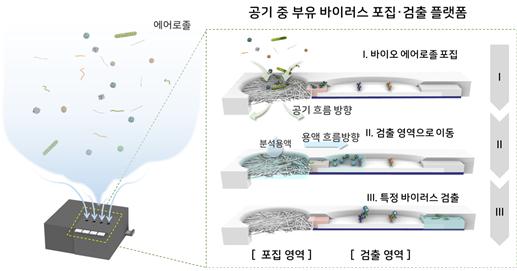
The research team developed a virus detection kit similar in form to a pregnancy test kit. Without separate washing or separation, the kit can determine the presence of airborne viruses on-site within a maximum of 50 minutes through 10 to 30 minutes of collection and 20 minutes of analysis within a single kit.
This kit collects and concentrates airborne viruses onto a porous pad made of glass fibers using an air sampler, then moves them to the detection area by capillary action. The viruses that move are detected by binding with infrared-emitting nanoparticles attached to antibodies that react only to specific viruses.
In particular, this kit can selectively detect the desired virus even in environments where multiple viruses coexist. If designed to insert four or more diagnostic kits simultaneously, it can detect multiple types of viruses at the same time.
Applicable to COVID-19 as Well

To validate the kit, the research team established an artificial airborne virus composition system where external factors could be controlled and conducted experiments under consistent conditions. As a result, they were able to capture influenza viruses dispersed in a large space and concentrate them to over one million times within the porous pad. Additionally, viruses attached to the pad surface were recovered and moved to the detection area with about 82% efficiency through surface pretreatment and optimization of the analysis solution for analysis.
Dr. Lee Jun-seok of KIST stated, “This platform, which allows on-site collection and immediate analysis, can be applied as an indoor air pollution monitoring system by diagnosing biological hazards floating in the air, such as COVID-19, on-site.”
© The Asia Business Daily(www.asiae.co.kr). All rights reserved.



















