- Targeting 25% Global Market Share in Electric Compressor Sector by 2025
- Responding to Global Environmental Regulations with Heat Pump System Using R744 (Carbon Dioxide) Refrigerant
Hanon Systems is expanding its leadership as a global leading company in the field of thermal energy management, recognized as a core technology for future vehicles, based on differentiated product competitiveness. Hanon Systems began research on future vehicle-related technologies such as electric vehicles and hydrogen vehicles in the early 2000s and has accumulated capabilities over 20 years. The company plans to contribute to advancing the era of widespread adoption of future vehicles based on its long experience and unique technological prowess.
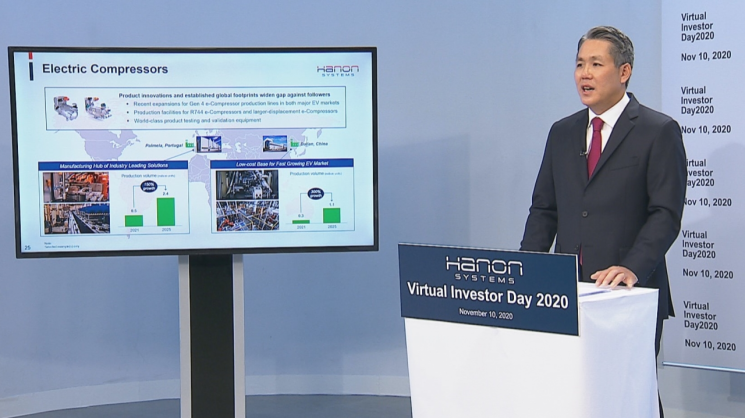
On the 10th, Hanon Systems held a ‘Virtual Investor Day’ online, presenting ▲establishing a leading market position for core eco-friendly vehicle product lineups ▲securing technological leadership through strengthened future vehicle R&D ▲responding to environmental regulations at key bases and enhancing future vehicle parts production capabilities. In particular, Hanon Systems’ core product lineup, which significantly improves the chronic issue of reduced driving range in winter for electric vehicles, attracted much attention.
The compressor is an air conditioning product that compresses low-temperature, low-pressure refrigerant into high-temperature, high-pressure refrigerant. The electric compressor used in electric vehicles operates independently even when the engine is off, improving energy efficiency. In 2011, Hanon Systems succeeded in developing its own electric compressor and, while holding the global market share No. 1, announced a goal to expand annual production of electric compressors to 4.4 million units by 2025 and increase its global market share to 25%. By 2025, production is planned to reach about 2.6 million units annually at the Pamela plant in Portugal and 1.1 million units at the Dalian plant in China, which are 2.6 times and 3.7 times the current production volumes, respectively. The electric compressors produced at these two plants are expected to account for more than 70% of Hanon Systems’ total electric compressor production.
Additionally, an ultra-high voltage (800V) and large-capacity (over 40cc) electric compressor is scheduled to be installed as a heat pump system on Hyundai Motor’s dedicated electric vehicle platform, E-GMP, next year. This electric compressor is the world’s first to meet both conditions of withstanding the absolute high voltage required for rapid charging of electric vehicles and supplying a large amount of refrigerant for cooling at once.
Hanon Systems is also accelerating the development and supply of electric compressors with a single-digit GWP (Global Warming Potential) to respond to global environmental regulations soon to be implemented in Europe, China, and other regions. Electric compressors for R744 (carbon dioxide) refrigerant, which has a GWP of 1, are already being supplied to global automakers, and electric compressors for gas injection and R290 (propane) refrigerants are under development. The heat pump system equipped with R744, a climate-neutral refrigerant, improves the driving range of electric vehicles by up to 50% in cold weather compared to existing systems.
Since acquiring Han & Company in 2015, Hanon Systems has focused its capabilities on strengthening future vehicle responsiveness by investing 1.374 trillion KRW in R&D over five years and about 246 billion KRW up to the third quarter of this year. Last year, it also acquired Magna’s hydraulic control business division for 1.2 billion USD (approximately 1.35 trillion KRW), strengthening its electronic components product lineup and diversifying its customer base. The company intends to continue fostering new automotive thermal management technologies and lead the provision of integrated thermal energy management solutions optimized for future vehicles.
Meanwhile, despite the ongoing COVID-19 crisis, Hanon Systems recorded sales of 1.9014 trillion KRW and operating profit of 119.6 billion KRW in the third quarter, increasing sales by 2.2% and operating profit by 11.8% compared to the same period last year. Among these, the proportion related to electric vehicles is 19%.
© The Asia Business Daily(www.asiae.co.kr). All rights reserved.

















