Korea Real Estate Board Weekly Apartment Price Trend for 2nd Week of November
Seoul Jeonse Price Increase Rate Expands for 3 Consecutive Weeks...Uncertainty
Sales Market Also Unstable...Government Additional Measures 'Unclear'
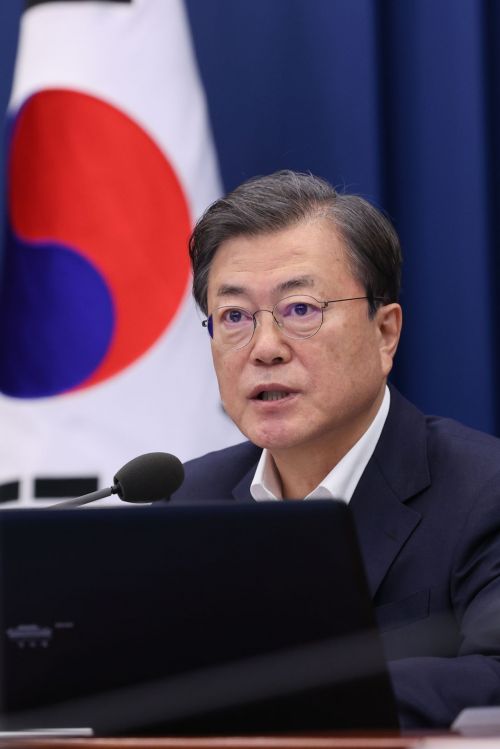 President Moon Jae-in is presiding over the senior secretaries and aides meeting at the Blue House on the 9th. (Photo by Yonhap News)
[Asia Economy Reporter Moon Jiwon] The rate of increase in apartment jeonse prices in Seoul and the metropolitan area expanded further compared to last week. Seoul has seen a rise for 72 consecutive weeks, and the metropolitan area for 66 consecutive weeks. Amid the government's failure to find an appropriate solution, concerns are rising that the jeonse crisis caused by the new lease law and low interest rates is spreading, increasing the suffering of ordinary citizens.
According to the weekly apartment price trend for the second week of November announced by the Korea Real Estate Board on the 12th, as of the 9th, Seoul's apartment jeonse prices rose by 0.14%, an increase from the previous week's 0.12%. The recent rise rates in Seoul were 0.08% → 0.10% → 0.12% → 0.14%, showing an increase in the rate of rise for three consecutive weeks.
The Korea Real Estate Board explained, "Due to the shortage of available properties for transaction caused by factors such as waiting demand for subscription and strengthened residency requirements, jeonse prices rose mainly in complexes with favorable living conditions such as good school districts and proximity to subway stations."
In the Gangnam area, the overall atmosphere is one of continued shortage of listings. Seocho-gu (0.22%), Gangnam-gu (0.21%), Songpa-gu (0.21%), and Gangdong-gu (0.20%) all saw relatively significant increases in jeonse prices, and Dongjak-gu (0.19%), Mapo-gu (0.19%), Gwanak-gu (0.17%), and Geumcheon-gu (0.14%) also continued to rise.
In the metropolitan area (0.23% → 0.25%), provinces (0.23% → 0.29%), and the five major metropolitan cities (0.27% → 0.33%), the rate of increase in jeonse prices also expanded in most regions nationwide. The jeonse crisis that started in Seoul is spreading across the country.
In particular, Incheon rose by 0.61% this week, up from 0.48% last week, making the jeonse market more unstable. Yeonsu-gu (1.83%) rose especially sharply, and Jung-gu (0.53%), Namdong-gu (0.49%), and Seo-gu (0.45%) also showed unstable trends.
In Gyeonggi-do, the jeonse price increase rate slightly decreased from 0.24% to 0.23%, but Goyang Deogyang-gu (0.44%), Gwangmyeong-si (0.39%), Uijeongbu-si (0.39%), Yangju-si (0.37%), and Goyang Ilsandong-gu (0.36%) saw significant rises.
Sejong also maintained a high rise rate above 1%, although it dropped from 1.26% to 1.16%. The Korea Real Estate Board explained, "Jeonse prices rose along with sales prices mainly in major complexes within the Happy City and Jochiwon-eup, but overall, the rate of increase narrowed compared to last week."
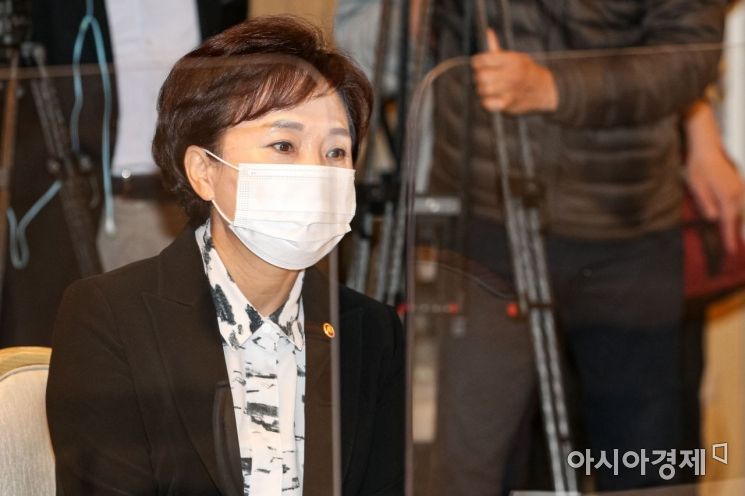 Minister of Land, Infrastructure and Transport Kim Hyun-mi is attending the '9th Real Estate Market Inspection Meeting of Related Ministers' held at the Government Seoul Office in Jongno-gu, Seoul on October 28. Photo by Kang Jin-hyung aymsdream@
As jeonse prices rise sharply, the sales market, which seemed to be stabilizing, is gradually becoming unstable.
Apartment sales prices in the metropolitan area (0.15% → 0.15%), Seoul (0.02% → 0.02%), Gyeonggi (0.23% → 0.23%), and Sejong (0.25% → 0.25%) showed the same rate of increase as the previous week, but the rise rates expanded in provinces (0.19% → 0.27%), the five major metropolitan cities (0.29% → 0.39%), and eight provinces (0.10% → 0.16%), increasing the nationwide average rise.
In Seoul, high-priced complexes in the Gangnam area, burdened by increased property taxes, are seeing price adjustments downward due to cautious sentiment, while other areas are experiencing stronger rises mainly in subway station areas and mid-to-low priced complexes.
In fact, Gangnam, Seocho, and Songpa-gu (0.00%) showed a stable trend as listings accumulated, and Gangdong-gu (0.01%) only rose slightly. However, areas with concentrated mid-to-low priced complexes such as Jungnang-gu (0.04%), Gangbuk-gu (0.04%), Gwanak-gu (0.03%), Nowon-gu (0.03%), and Guro-gu (0.02%) showed clear price increases.
In Gyeonggi-do, Gimpo-si (1.91%), benefiting from its status as a non-regulated area, saw concentrated buying demand, with significant rises mainly around Pungmu and Sau-dong subway station areas and newly built complexes in Hangang New Town. Paju-si (0.47%), Goyang Deogyang-gu (0.38%), and Namyangju-si (0.29%) also showed upward trends, while Yeoju-si (-0.03%) and Icheon-si (-0.03%) declined due to the impact of new housing supply.
Busan (0.56%), which has recently seen a strong upward trend, continued to have rising expectations due to development benefits. Suyeong-gu (1.13%), Haeundae-gu (1.09%), Yeonje-gu (0.88%), Nam-gu (0.81%), and Busanjin-gu (0.81%) all rose significantly.
Daegu (0.39%) also showed a growing upward trend centered on Suseong-gu (1.11%). Sejong, which saw a rapid rise in housing prices due to the administrative capital relocation issue, rose by 0.25%, the same as last week. Since Lee Nak-yeon, leader of the Democratic Party of Korea, announced plans to fully relocate the National Assembly to Sejong the day before, there is analysis that the upward trend may intensify further.
© The Asia Business Daily(www.asiae.co.kr). All rights reserved.
![User Who Sold Erroneously Deposited Bitcoins to Repay Debt and Fund Entertainment... What Did the Supreme Court Decide in 2021? [Legal Issue Check]](https://cwcontent.asiae.co.kr/asiaresize/183/2026020910431234020_1770601391.png)

















