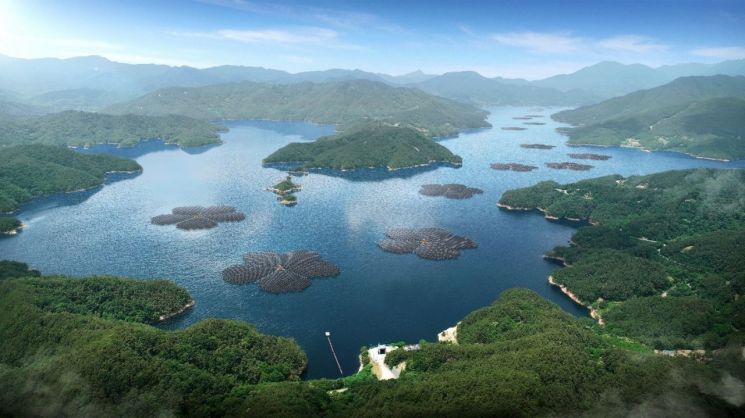
[Asia Economy Reporter Park So-yeon] Hanwha Q CELLS is constructing a floating solar power plant at Hapcheon Dam in Gyeongnam. It is the largest in the world by scale installed on a dam and also the largest floating solar power plant in South Korea with completed permits.
On the 12th, Hanwha Q CELLS announced that it had won the contract from Korea Water Resources Corporation to build a 41-megawatt (MW) floating solar power plant in Hapcheon, Gyeongnam, and plans to start construction within this year.
The floating solar power plant combines onshore solar technology with floating structure technology, constructing the solar power plant on structures floating on water. Floating solar power plants efficiently utilize idle water surfaces, making effective use of national land, and have advantages such as less shadow impact compared to onshore solar and cooling effects on the modules, resulting in about 10% higher power generation.
The Hapcheon Dam floating solar power plant will produce electricity sufficient for about 60,000 people annually for household use, which exceeds the population of Hapcheon-gun at 44,434. Hanwha Q CELLS will build this floating solar power plant with a design inspired by the plum blossom, the county flower of Hapcheon-gun. This emphasizes the symbolism of Hapcheon-gun, where the plant is located, and also considers future use as a renewable energy tour and tourist attraction.
The Hapcheon Dam floating solar power plant has also undergone environmental stability verification. The Korea Environment Institute conducted monitoring four times at the Hapcheon Lake solar demonstration site and concluded that the solar power facilities are unlikely to have negative environmental impacts. The institute investigated water quality and aquatic ecology and reported no significant differences between water areas affected by the power facilities and those not affected, with most items below standard levels.
Hanwha Q CELLS plans to install the Q.PEAK DUO Poseidon, a floating solar-specific module, at this floating solar power plant. Produced with eco-friendly materials, the Q.PEAK DUO Poseidon is a product specialized for high temperature and high humidity environments, applying internal test standards exceeding KS certification requirements, including exposure tests for over 3,000 hours at 85 degrees Celsius and 85% relative humidity.
According to a floating solar report published last year by the World Bank Group, installing floating solar power plants on 1% of the global reservoir surface area would result in a facility capacity of 404 gigawatts (GW). This capacity could replace 404 coal-fired power plants (based on 1GW-class plants).
In terms of annual power generation, about 521 terawatt-hours (TWh) of electricity could be produced. This is a massive amount, equivalent to 16% of Europe's total electricity consumption of 3,446 TWh in 2019, and nearly matches South Korea's annual electricity consumption of 553 TWh in 2019, the world's sixth-largest electricity consumer. The World Bank expects floating solar to become the third pillar of solar power generation, following onshore and building solar power.
Kim Hee-chul, President of Hanwha Q CELLS, said, "Floating solar power generation, which produces eco-friendly electricity by utilizing idle water surfaces, is the optimal solution to make use of limited national land," and added, "We will construct the Hapcheon Dam floating solar power plant with a world-recognized high-quality solution."
© The Asia Business Daily(www.asiae.co.kr). All rights reserved.
















