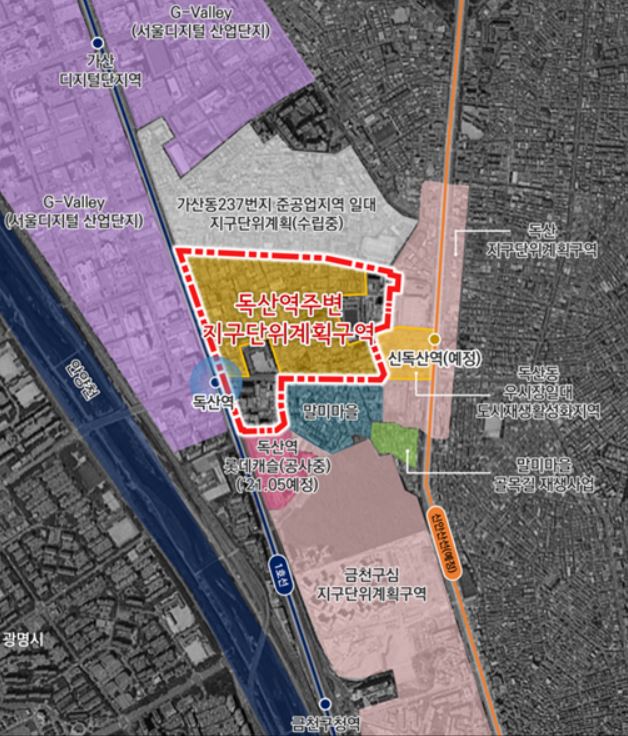
[Asia Economy Reporter Yuri Kim] The area around Doksan Station in Geumcheon-gu, Seoul, is signaling change. While inducing knowledge industry centers around the station to revitalize the local economy, it also aims to improve the residential environment by preventing factories and livestock-related facilities from entering densely residential areas.
On the 11th, Seoul City held the 16th Urban and Architectural Joint Committee meeting and announced on the 12th that it had approved a revised version of the 'Doksan Station Area District Unit Planning Zone and Plan Decision' for the area around 1001 Doksan-dong.
The target area is a semi-industrial zone of 317,235㎡ between Doksan Station and Siheung-daero. It is a station area adjacent to Doksan Station on Subway Line 1 and the new Sindoksan Station on the Shinansan Line, scheduled to open in 2024. However, the area is experiencing urban environmental deterioration due to the mixed functions of industrial and residential facilities and odors from livestock byproducts caused by the Doksan Livestock Market.
This district unit plan includes establishing building use plans to revitalize the local economy, strengthen regional centrality, and create a culturally specialized street (Beotkkot-ro 18-gil) around the Doksan station area in line with the development direction of the city's basic plan (living zone plan). It also aims to improve the residential environment by prohibiting industrial facilities such as factories and livestock-related facilities within densely residential areas.
A special planning zone (one site) will be designated around Doksan Station to induce knowledge industry centers to strengthen the functions of the semi-industrial area. The plan encourages leading complex development in the station area and prioritizes the supply of insufficient living SOC facilities such as cultural facilities within the region.
By securing linkage with major projects under the urban regeneration activation plan for the Doksan-dong livestock market area, the plan establishes coexistence between industry and residence, urban environment improvement, and a specialized street plan that encourages street activation and art and culture-related uses such as performance halls and workshops for the cultural street creation project.
A Seoul city official said, "With this district unit plan decision around Doksan Station, we expect local economic revitalization and residential environment improvement in the Doksan Station area."
Meanwhile, the committee also approved a revised version of the 'Cheonho District Unit Plan Decision' on the same day. The target area includes Cheonho-dong, Seongnae-dong, Gil-dong, and Dunchon-dong along Cheonho-daero. The city explained that redevelopment was promoted due to the need for systematic management responding to surrounding development projects such as strengthening the Cheonho-Gil-dong regional center and redevelopment promotion projects.
This district unit plan mainly covers matters related to the establishment (change) of long-term unexecuted urban planning facilities such as the creation of parcel division lines along Jinhwangdo-ro, building density plans (adjustment of floor area ratio system and height plans), and matters related to special planning zones (changing A1 special planning zone to a special planning possible zone, maintaining C3 special planning zone).
A city official said, "With this district unit plan change, we expect it to be an opportunity to strengthen the function as a regional center, centered on the station area along Cheonho-daero, along with the maintenance of management plans that meet changing conditions."
© The Asia Business Daily(www.asiae.co.kr). All rights reserved.

















