First Observation of 'Cage Formation' Where Glass Particles Clump Together
Contributing to Enhanced Understanding and Applications of Glass

[Asia Economy Reporter Junho Hwang] The movement of glass particles at the critical point where commonly seen glass transitions from a liquid to a solid glass has been captured for the first time. This research provides a clue to understanding the movement of glass particles and is expected to contribute to the development of new materials that impart novel properties to glass in the future.
Steve Granick, head of the Advanced Soft Matter Research Group at the Institute for Basic Science, and senior researcher Bo Lee, in collaboration with the French National Centre for Scientific Research, have for the first time identified the movement of glass particles at the critical point where liquid turns into solid glass. The related research results were published on the 12th in the international journal Nature.
Confirmation of Cage Formation in Glass
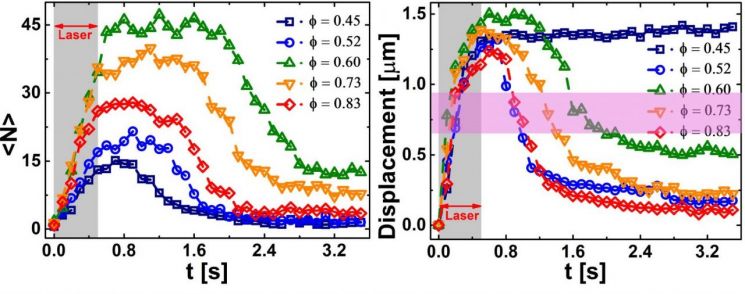
Glass is solid but has the property of increasing viscosity from a certain critical temperature. This is known to be because glass particles form a 'cage' by being surrounded by neighboring particles, preventing movement. However, until now, there have been no cases of actually observing cage formation. In this situation, the research team stimulated individual glass particles and for the first time observed the phenomenon of increased particle mobility and collective movement at the critical point.
The research team developed a femtosecond laser (a laser that compresses energy to increase intensity and emits light for one quadrillionth of a second) strong and focused enough to stimulate colloidal glass particles sized 1 to 100 μm. They then stimulated a single glass particle and analyzed the pattern of movement spreading to surrounding particles.
Glass Particles Move Like an Army at the Critical Point

Experimental results showed that glass particles moved the farthest at the critical point. The research team explained that they have for the first time identified that particles are in a state where they can move easily, that is, a deformable state at the critical point.
Bo Lee, the first author and senior researcher, explained, "The principle of cage formation in glass, a material important to advanced industries, has long been unknown, but by using a laser to flick a single particle in the glass system, we were able to capture changes in the movement of glass particles."
The research team also discovered that glass particles exhibit collective movement characteristic of cage formation. They observed that particles, which previously moved continuously and individually, move collectively like an army at the critical point.
The research team evaluated, "This study overturns the conventional notion that glass transition occurs gradually and reveals that the way particles move fundamentally changes at the critical point." They added, "This enables a fundamental understanding of glass and is expected to make it possible to develop new materials that impart novel properties to glass in the future."
© The Asia Business Daily(www.asiae.co.kr). All rights reserved.



















