Field Workers Not Feeling Policy Effects
"Expected Sales Growth but Fell into Deficit, Focused Only on Short-Term Risk Resolution"
Experts Call for 'Policy Refinement'
"Korean New Deal Focused Only on Service Sector... Manufacturing Creates Quality Jobs"
"Need to Match with 4th Industrial Revolution and Grow Ecosystem"
Calls to Strengthen Vocational Training and Workforce Development Policies
Demand for Long-Term Growth Support for SMEs and Mid-Sized Companies
[Asia Economy Reporter Moon Chaeseok] #Company A attended the Manufacturing Renaissance Roundtable meeting hosted by the government in November last year. This event was organized to review the progress of each industry regarding the Manufacturing Renaissance vision announced by President Moon Jae-in in June and to hear opinions from companies. At this meeting, Company A proposed to the government that "support for overseas clinical trials and tax incentives for companies are necessary." However, even after a year, the company has not received any response from the government.
#Company B, which also participated in the same event, saw its operating loss on a consolidated basis increase threefold from 1.56 billion KRW in the first half of last year to 4.64 billion KRW in the first half of this year due to the impact of the novel coronavirus disease (COVID-19). The company had expected sales and added value expansion following the announcement of the Manufacturing Renaissance policy, but instead fell into a deficit trap. A representative of the company confessed, "We have been focused on resolving short-term risks throughout last year and this year," adding, "We have not received any concrete policy support since the Manufacturing Renaissance announcement."
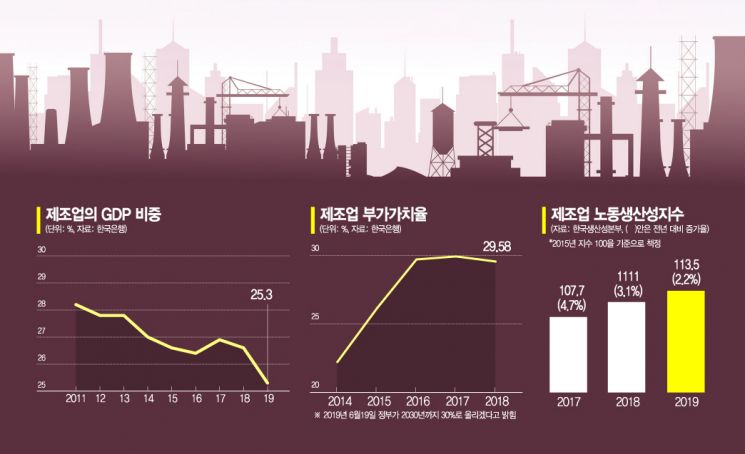
With the third quarter gross domestic product (GDP) growth rate at 1.9%, marking positive growth since COVID-19, the importance of manufacturing is reemerging. The manufacturing growth rate increased by 7.6%, boosting the country's economy that had been faltering since the pandemic. For this reason, even President Moon has stepped forward to emphasize the importance of manufacturing.
Hollow 'Manufacturing Renaissance'
However, companies do not feel the effects of government policies. They unanimously stated that they do not feel the economic recovery in their daily lives. On the 10th, company representatives who spoke to Asia Economy said that the government's Manufacturing Renaissance policy, which aims to become one of the world's top four manufacturing powers in 10 years, has not produced significant results over the past year. Companies gave a fundamental response to the government's manufacturing policy, saying it is meaningful only in confirming the government's will to create growth momentum for manufacturing, which is being overshadowed by advanced industries.
Experts unanimously agree that manufacturing promotion policies should be implemented alongside high value-added service industries to offset their fluctuations. The problem is that although the government has presented a '10-year manufacturing plan,' corporate response has not been strong. It has been pointed out that instead of reflecting businesses that companies are doing well or urgent needs into policies, the government repeatedly demands companies to comply with various agendas it deems necessary. A representative example is labor reform. Companies consistently say that 'labor reform is manufacturing promotion,' but the government imposes obligations on companies such as complying with the 52-hour workweek system, minimum wage increases, and fulfilling win-win cooperation between primary and subcontracting firms.
"Manufacturing Creates Quality Jobs... Policy Needs Refinement"
Professor Kim Sangbong of Hansung University’s Department of Economics said, "The Korean New Deal policy is overly focused on supporting the service industry, but manufacturing actually creates quality jobs." He added, "We need to foster a manufacturing ecosystem that matches the Fourth Industrial Revolution, including machinery, ships, robotic arms, and automobiles," warning, "If manufacturing is not properly developed, only low-paying jobs of 200,000 to 300,000 KRW per month will be created, which contradicts the government's labor reform intentions."
There are also calls to refine growth strategies for small and medium-sized enterprises (SMEs) with technological capabilities. Strengthening vocational training and workforce development policies is advised. The goal is to prevent skilled labor from leaving and to promote the long-term growth of SMEs and mid-sized companies. Recently, the government has been trying to match the technologies of excellent SMEs (supply companies) lacking capital with large corporations (demand companies) through 'solidarity and cooperation industrial strategies,' but the details are vague. It remains at the level of declarations such as "We will create success cases in bio, semiconductors, and batteries."
Professor Kim Taegi of Dankook University’s Department of Economics said, "Policies to increase the commercialization rate of SMEs and mid-sized companies are not unhelpful in revitalizing manufacturing, but there is a risk that support may become concentrated in specific industries like semiconductors and bio." He diagnosed, "This could potentially slow the growth of promising companies in other sectors." He added, "Because of these issues, there are calls to revitalize the 'manufacturing infrastructure' itself," emphasizing, "If professional workforce development and labor-management cooperation do not work well, skilled workers will leave SMEs, and the manufacturing infrastructure will collapse."
© The Asia Business Daily(www.asiae.co.kr). All rights reserved.