Munjung Siyeong Phase 1 Passes Safety Inspection
Garaksangyong Phase 1 Also Holds Union Establishment Meeting
2004-Built Munjung Raemian Project Briefing
"Reconstruction Regulations, High Floor Area Ratio Lead to Early Remodeling"
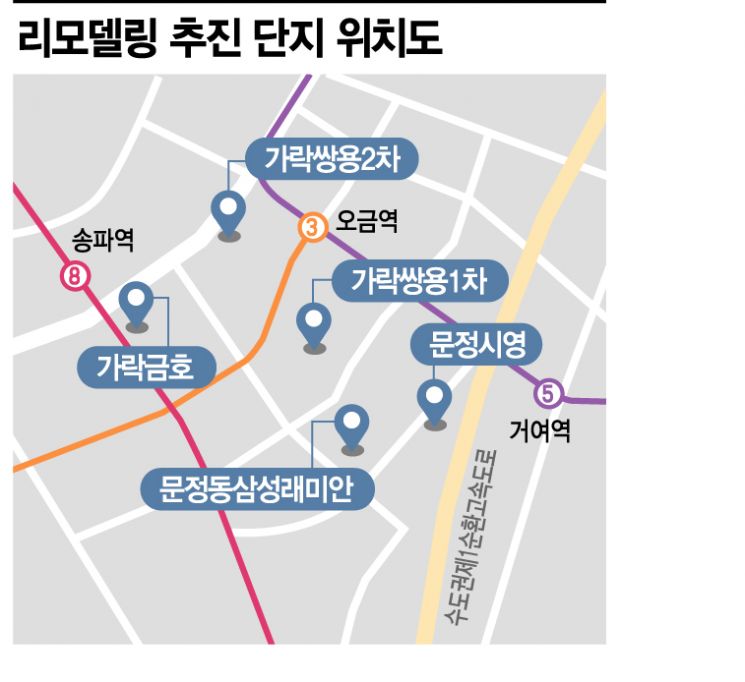
[Asia Economy Reporter Lim On-yu] The remodeling wave is gaining momentum in mid-rise apartment complexes around Songpa-gu, Seoul. Following Munjeong Sijeong, a Seoul-type remodeling pilot complex in Munjeong-dong, passing the first safety inspection, Garak Ssangyong 1st in Garak-dong successfully held a general meeting to establish a union. Due to high floor area ratios and various regulations blocking reconstruction, complexes built in the 2000s have joined the remodeling trend early.
According to the maintenance industry on the 9th, Munjeong Sijeong recently passed the first remodeling safety inspection with a grade B. If the grade is B or higher, vertical extension to increase floors is possible, and if the grade is C or higher, horizontal or separate building extensions to expand the area per household or build separate buildings are allowed. Munjeong Sijeong, completed in 1989 and now in its 32nd year, is a mid-rise complex with 1 basement floor to 14 floors above ground and 1,316 households. It plans to increase the number of households by about 200 through horizontal and separate building remodeling. After remodeling, it will be transformed into a total of 1,512 households from basement level 3 to 18 floors above ground.
This apartment complex is progressing the fastest among the seven Seoul-type remodeling pilot complexes. In 2016, Seoul selected seven complexes as remodeling pilot sites, including Munjeong Sijeong, nearby Munjeong Geonyeong, Namsan Town in Sindang-dong, Jung-gu, Gil-dong Woosung 2nd in Gangdong-gu, and Woosung 1, 2, and 3rd in Sindorim-dong, Guro-gu. Munjeong Geonyeong also applied for the first safety inspection last September. Seoul-type remodeling pilot complexes receive partial remodeling cost and administrative procedure support from the Seoul city government in exchange for opening community facilities such as daycare centers and senior centers to local residents.
Garak Ssangyong 1st, located a 15-minute walk from Munjeong Sijeong, is expected to accelerate remodeling projects in Munjeong-dong and Garak-dong areas after successfully holding a union establishment general meeting at COEX in Samseong-dong, Seoul, on the 7th. Completed in 1996, Garak Ssangyong 1st plans to increase the number of households by about 300 from the existing 2,064 through remodeling. In August, it achieved a consent rate of 71%, exceeding the 66.67% required for union establishment. A representative of the Garak Ssangyong 1st remodeling promotion committee said, "We plan to apply for union establishment at Songpa-gu Office within this month and select a construction company early next year."
Garak Geumho Apartment in Garak-dong and Munjeong Raemian in Munjeong-dong also held remodeling project briefing sessions for residents last month. Although Munjeong Raemian, built in 2004, is relatively less aged, it is pushing for remodeling early considering strengthened reconstruction regulations such as the excess profit recovery system, safety inspections, and high floor area ratios. The allowable remodeling age limit is 15 years after completion, which is half that of reconstruction. A representative of the Munjeong Raemian remodeling preparation committee said, "Since the complex underwent bedrock excavation work, vertical extension is expected to be possible," adding, "As reconstruction is ongoing in nearby complexes such as Hyundai 1st and Garak Plaza, Munjeong Raemian also believes it must increase its value through remodeling."
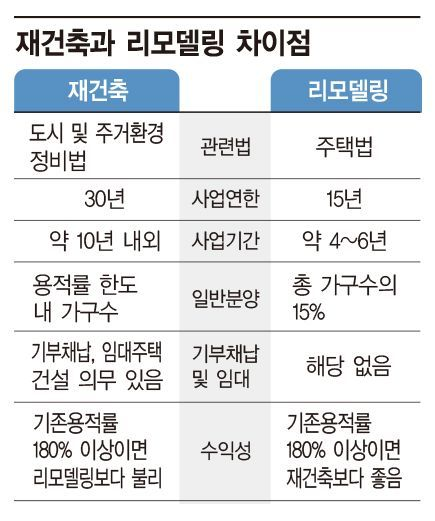
Remodeling has the advantage of faster project speed compared to reconstruction because it retains the building's framework while adding extensions. The residential environment improves, rapidly increasing the complex's value. Due to strengthened reconstruction regulations, many aging mid-rise complexes in Seoul are shifting to remodeling. However, the increase in the number of households is limited compared to reconstruction, and in Woosung 9th in Gaepo-dong, Gangnam-gu, where remodeling is underway, low floor height has become a controversy. The decision on whether to allow the demolition of load-bearing walls for vertical extension has not been made for years, posing an obstacle to remodeling projects. Whether load-bearing wall demolition is permitted is directly related to floor plan diversification and critically affects profitability. A construction industry official said, "As reconstruction regulations tighten, more complexes are turning to remodeling, but the key is project feasibility," adding, "If load-bearing wall demolition and vertical extension become possible, competition among major construction companies for remodeling contracts will intensify."
© The Asia Business Daily(www.asiae.co.kr). All rights reserved.


















