Last Year, 567 School Zone Traffic Accidents Recorded, Highest Number
Drivers Say "Blaming Only Defendants Is Excessive," "Hard to Control Young Children"
Experts Say "Strengthening Driver Punishment Alone Cannot Prevent School Zone Accidents"
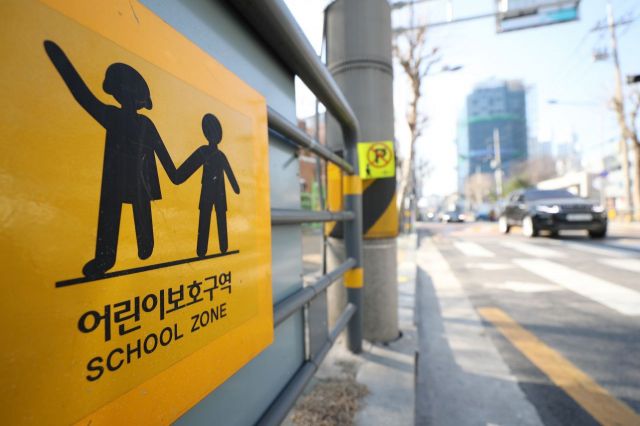 On the morning of March 24, a traffic safety sign for a school zone was installed in front of an elementary school in Seongdong-gu, Seoul. Photo by Yonhap News
[Asia Economy Reporter Kim Suwan] The conflict surrounding the accident involving the late Kim Minsik, which triggered the 'Minsik Act,' has reignited as the court ruled that the perpetrator's insurance company must pay 90% of the compensation to Kim's parents. Some critics argue that the circumstances, such as the victim suddenly running out from behind a vehicle waiting at a crosswalk to make a left turn, were not considered, intensifying public criticism. Experts pointed out that strengthening driver penalties alone is insufficient to prevent all accidents occurring in school zones (Seukuljon).
According to the legal community, recently Judge Lee Jeonga of the Civil Division 7, Cheonan Branch of Daejeon District Court, ruled partially in favor of the plaintiff in a damages claim lawsuit filed by Kim's bereaved family against the perpetrator's insurance company, ordering the insurer to pay over 570 million won to the family.
During the trial, the perpetrator's insurance company argued that the accident occurred because Kim suddenly ran out between vehicles stopped in the opposite lane, and that the defendant's liability should be limited to within 80%.
However, the court stated in its ruling, "According to the recognized facts, the deceased died due to the operation of the defendant's vehicle, so the defendant, as the insurer, is liable to compensate the deceased and the plaintiffs for the damages caused by this accident."
On the other hand, among drivers, there are claims that the fault is not solely on the perpetrator driver. The perpetrator has already been criminally punished in the first and second trials, and since the cause of the accident was complex, the scope of damages is considered excessive.
The Minsik Act was proposed after Kim (then 9 years old) died in a traffic accident in a school zone in Asan, Chungnam, in September 2019, and has been in effect since March 25. The law stipulates that if a driver violates the duty of safe driving in a school zone or drives over 30 km/h and causes a traffic accident resulting in a child's death, they face life imprisonment or imprisonment of three years or more; if injury is caused, fines ranging from 5 million to 30 million won or imprisonment from 1 to 15 years apply.
Even before its enforcement, the Minsik Act sparked debate over the severity of penalties for drivers. In April, a petition titled "Request to amend the Minsik Act" was posted on the Blue House's public petition board, garnering over 350,000 signatures.
Additionally, various online community boards expressed concerns about the Minsik Act. Most opinions stated that even if drivers obey traffic laws in school zones, it is practically difficult to avoid children suddenly running out.
Meanwhile, some argue that criticism of the Minsik Act is unjust, as child traffic accidents in school zones have continued to increase even after the law's enactment.
According to data submitted by the Road Traffic Authority to Park Chandae, a member of the National Assembly's Education Committee from the Democratic Party, in July, a total of 1,961 traffic accidents occurred in school zones over the past four years.
By year, there were 480 cases in 2016, 479 in 2017, 435 in 2018, and a sharp increase to 567 cases last year. Notably, 25 children died and 2,059 were injured in traffic accidents occurring in school zones.
By violation type: △ speeding 14 cases △ crossing the center line 20 cases △ signal violation 334 cases △ failure to maintain safe distance 7 cases △ failure to fulfill safe driving duty 450 cases △ violation of intersection traffic rules 13 cases △ violation of pedestrian protection duty 796 cases. Driver negligence such as failure to exercise caution still accounts for a significant portion of accident causes.
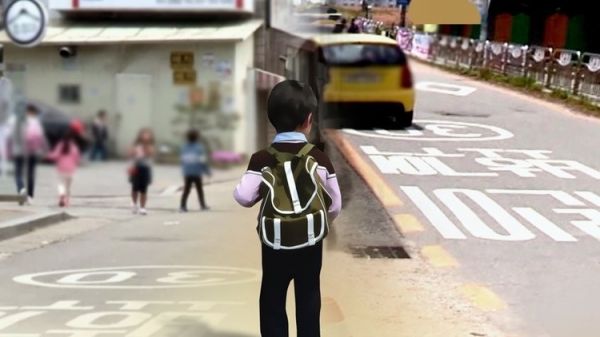 A man in his 50s who was prosecuted under the so-called 'Minsik Act,' which strengthens penalties for traffic accidents in school zones, was acquitted. The prosecution argued that Mr. A failed to fulfill his duty of care as a driver, such as paying attention to the front, causing the accident, but the court's judgment was different. Photo by Yonhap News
Meanwhile, regarding accidents caused by pedestrian fault, which most drivers worry about, various legal interpretations have emerged, including acquittals.
Since the law's enactment, criticism has been raised that drivers who observe the speed limit and exercise due care can still be punished under the Minsik Act.
In April, an elementary school student was hit by a passenger car in a school zone in Jeonju, Jeonbuk, but the court judged that the driver was traveling at the speed limit of 30 km/h or less and that the accident was a side collision, making it highly likely that the driver could not have seen the child in time.
Ultimately, Mr. A (57), who was charged with violating the Act on the Aggravated Punishment of Specific Crimes (injury in a school zone), was acquitted.
Experts pointed out that causes of child traffic accidents include not only driver negligence but also various environmental factors.
Park, who conducted a survey on traffic accidents in school zones, emphasized, "Strengthening driver penalties alone is insufficient to prevent all accidents occurring in school zones," and urged, "Systematic measures such as expanding speed bumps near school zones, applying road anti-slip treatments, increasing traffic signals around schools, and strengthening children's traffic safety education must be implemented."
While understanding drivers' difficulties, there is also a view that concessions are necessary for children's safety. Traffic accident specialist lawyer Jeong Gyeongil advised in an interview with YTN Radio's 'Wise Radio Life,' "In reality, many children suddenly run out, so drivers find this very challenging. However, since school zones are generally not very long, about 300 meters, if drivers think of it as taking 1 to 2 minutes longer than usual, accidents can be sufficiently prevented."
© The Asia Business Daily(www.asiae.co.kr). All rights reserved.
![User Who Sold Erroneously Deposited Bitcoins to Repay Debt and Fund Entertainment... What Did the Supreme Court Decide in 2021? [Legal Issue Check]](https://cwcontent.asiae.co.kr/asiaresize/183/2026020910431234020_1770601391.png)

















