Health Authorities Urge Caution Against 'Sharing Food'
Office Workers Avoid 'Stews and Other Shared Dishes'
Experts Warn "Risk of Consuming Food Together"
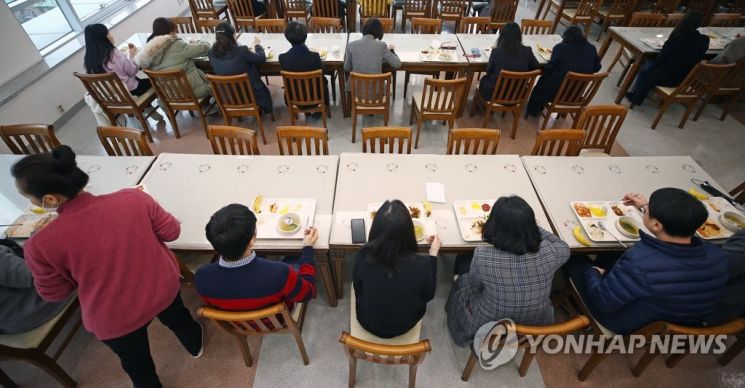 Due to COVID-19, the lunch culture among office workers is changing. To prevent infectious diseases such as COVID-19, people are avoiding shared dishes like stews. The photo shows employees of the Daegu Metropolitan Office of Education in Suseong-gu, Daegu, eating lunch silently without sitting face-to-face. Photo by Yonhap News
[Asia Economy Reporter Seulgi Kim] "People tend to avoid stew-like dishes. It feels uncomfortable, and the fear of COVID-19 infection is also a concern."
As the novel coronavirus disease (COVID-19) situation prolongs, health authorities are emphasizing individual compliance with quarantine rules, and it seems that office workers' lunch culture is also changing. This is due to the perception that sharing one dish among several people increases the risk of COVID-19 infection through droplets.
Recently, health authorities have urged people to refrain from sharing food during indoor gatherings. On May 24, Kwon Jun-wook, Deputy Director of the Central Disease Control Headquarters, emphasized at a regular COVID-19 briefing, "We must refrain from physical contact and actions that generate droplets, and avoid sharing food."
The government has also started promoting improvements in dining culture, such as 'serving stew and side dishes individually' at restaurants. On June 9, Park Byung-hong, Director of Food Industry Policy at the Ministry of Agriculture, Food and Rural Affairs, stated at the 21st Food Safety Policy Committee meeting held at the Government Seoul Office in Gwanghwamun, Seoul, chaired by Prime Minister Jeong Sye-kyun, "Eating stew or side dishes together or multiple people using the same spoon are dining habits that need to be changed from a quarantine perspective due to COVID-19."
Given this situation, voices calling for improvement in lunch culture among office workers are growing louder.
Choi Kyung-min (29, pseudonym), a second-year office worker, said, "There was a perception that sharing one menu among several people shortens meal time, so even if it felt uncomfortable, I couldn't order an individual menu. Especially for lower-ranking employees, they tend to be more cautious of their superiors or higher-ranking colleagues. Since COVID-19 infection through droplets is actually occurring, I hope the culture of eating separately becomes established in workplaces as well."
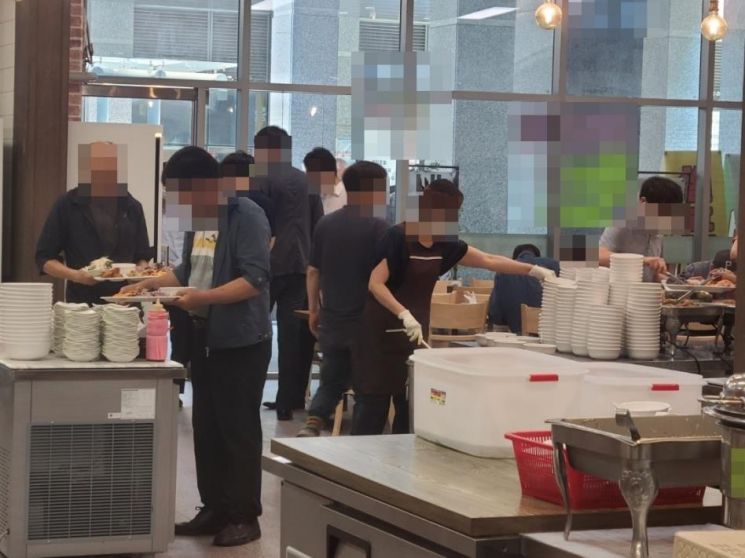
A public opinion survey also showed negative reactions toward sharing stew together. Market research company Embrain Trend Monitor conducted a survey in May targeting 1,000 male and female office workers aged 19 to 59 nationwide regarding 'lunch time,' and more than half of respondents (53%) answered, "I tend to avoid menus like stew that are eaten together."
The tendency to avoid shared menus was also reflected in office workers' lunch choices. According to the survey, the menus office workers originally enjoyed were kimchi stew (52.7%, multiple responses allowed) and jajangmyeon (black bean noodles) (50.1%), followed by jjamppong (spicy seafood noodle soup) (42.4%), pork cutlet (40.9%), hamburgers (38.6%), and stir-fried pork (36.6%).
However, since the outbreak of COVID-19, preference for shared foods like kimchi stew has weakened. More than half of respondents (53.0%) said they avoid stew menus, and one in two office workers (48.8%) said that when they do eat shared stew menus, they tend to use a new spoon to serve themselves.
This phenomenon was particularly prominent among middle-aged and older adults who are accustomed to sharing food. According to the survey, 48% of respondents in their 20s said they avoid shared menus, but the figures rose to 52.8% and 61.2% among those in their 40s and 50s, respectively.
Park Seung-chul (55, pseudonym), a department head-level office worker, said, "In the past, we used to choose dishes like steamed or stew dishes for company dinners. But these days, because of COVID-19, it feels uncomfortable, so we choose restaurants where each person gets their own tray or can serve themselves individually." He added, "The perception that sharing food creates 'jeong' (affection) has long become a thing of the past."
Experts suggest that it is necessary to change longstanding behaviors and cultural practices, including dining culture.
Professor Kim Woo-joo, an infectious disease specialist at Korea University Guro Hospital, said, "Eating food together with others increases the possibility of COVID-19 infection. In the COVID-19 era, we should refrain from cultures of eating together. It won't be easy to change the cultures or behaviors we have practiced so far, but everyone must make an effort."
© The Asia Business Daily(www.asiae.co.kr). All rights reserved.


















