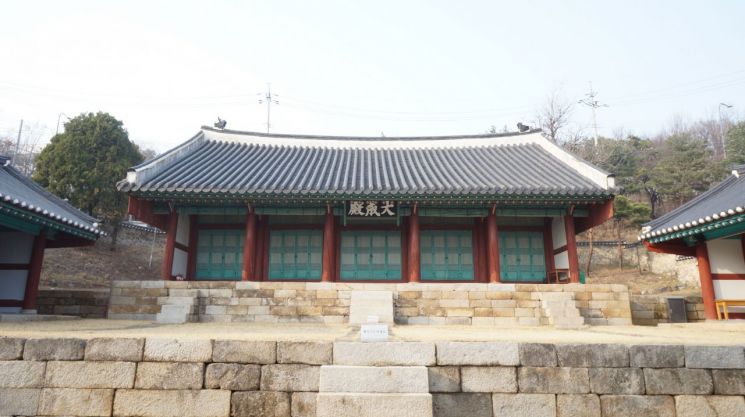
[Asia Economy (Suwon) = Reporter Lee Young-gyu] The Daeseongjeon (大成殿) of Suwon Hyanggyo is expected to be designated as a national treasure within this year at the earliest.
The Suwon City in Gyeonggi Province announced on the 6th that the Cultural Heritage Administration has announced the preliminary designation of the Daeseongjeon of Suwon Hyanggyo, located in Gyodong, Paldal-gu, as a treasure. The Cultural Heritage Administration will finalize the treasure designation after a 30-day notice period and review by the Cultural Heritage Committee.
If designated, the Daeseongjeon of Suwon Hyanggyo will become the 12th treasure in the Suwon area.
Suwon Hyanggyo was established in front of Hwasan, which was the town center (邑治, the central space of a local district) of Suwon at the end of the 13th century. In 1789, when the Suwon town center was relocated to the foot of Paldal Mountain, Suwon Hyanggyo was also relocated to its current location. It was rebuilt in 1795 (the 19th year of King Jeongjo's reign) by order of King Jeongjo.
The Daeseongjeon of Suwon Hyanggyo, preliminarily designated as a treasure, is a building reconstructed in 1795 with 20 kan (bays) under King Jeongjo's royal command. The construction process is detailed in historical documents such as the "Hwaseong Seongyeok Uigwe" (The Royal Protocol of the Construction of Hwaseong Fortress).
It is a wooden structure with a front width of 5 kan and a side width of 3 kan, featuring a double-eaved (two layers of rafters) gable roof (a roof with two sloping sides).
The Daeseongjeon of Suwon Hyanggyo is one of the largest existing Joseon Dynasty hyanggyo Daeseongjeon buildings, alongside Seoul Munmyo, Naju Hyanggyo, Sangju Hyanggyo, Jeju Hyanggyo, and Daejeong Hyanggyo Daeseongjeon. It is the largest hyanggyo Daeseongjeon in Gyeonggi Province.
Based on the overall framework construction methods, the woodworking techniques of major components, and design techniques, it is evaluated as an important architectural structure that can clarify the official construction technology of the late Joseon period and the technical evolution in Korean architectural history.
Daeseongjeon refers to the shrine hall enshrining the memorial tablets of Confucius. The Daeseongjeon of Suwon Hyanggyo houses the memorial tablets of Confucius and 25 other sages.
A Cultural Heritage Administration official stated, "Officially led government construction of hyanggyo buildings during the Joseon Dynasty was rare. From site preparation to the foundation, wooden framework, roof, and detailed design, skilled craftsmen from across the country processed high-quality materials with great skill to complete the building. It has historical, artistic, and academic significance, making it worthy of treasure designation," explaining the reasons for the preliminary designation.
Hyanggyo were local educational institutions during the Goryeo and Joseon periods, serving as spaces for memorial rites honoring Confucius and Confucian sages, as well as educational spaces for nurturing talent. Suwon Hyanggyo is a unique case relocated along with the construction of the new Suwon town center, and it is a hyanggyo that faithfully observes formalities appropriate to the city's status, which was promoted to Hwaseong Yusubu along with the construction of Suwon Hwaseong Fortress. It was designated as Gyeonggi Province Cultural Heritage Material No. 1 in 1983.
Lee Sang-su, Director of the Cultural Arts Division of Suwon City, said, "Following the treasure designation of Hwaryeongjeon Unhangak, Bokdogak, and Iancheong in August last year, I am pleased that the Daeseongjeon of Suwon Hyanggyo, related to King Jeongjo, can also be honored. We will strive to widely promote the value and excellence of not only Suwon Hwaseong but also Suwon Hyanggyo."
© The Asia Business Daily(www.asiae.co.kr). All rights reserved.

















