Outstanding Corporate Loans of Top 5 Domestic Banks Reach 576.29 Trillion KRW by End of October
Increase of 55 Trillion KRW Since January
Banking Sector's Total Corporate Loan Growth Expected to Surpass 100 Trillion KRW This Year
[Asia Economy Reporter Park Sun-mi] The scale of corporate loans in the banking sector is breaking record highs every month. Due to the spread of the novel coronavirus infection (COVID-19), the increase in loans to small and medium-sized enterprises (SMEs) is expected to continue for the time being, raising red flags for risk management in the banking sector.
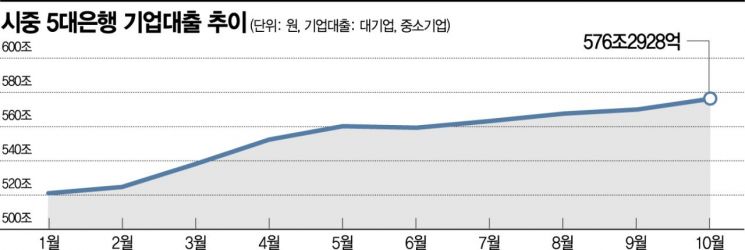
According to the banking sector on the 4th, the outstanding balance of corporate loans at the five major commercial banks?KB Kookmin, NH Nonghyup, Shinhan, Woori, and Hana?stood at 576.2928 trillion won as of the end of last month. This is the largest scale ever, surging by about 55 trillion won compared to 521.0664 trillion won in January this year.
The scale of corporate loans in banks has maintained an upward trend every month, swelling to an all-time high. This reflects the reality that companies are relying on bank loans due to deteriorating financial conditions amid the spread of COVID-19 and economic uncertainties. In particular, loans to SMEs, including small office/home office (SOHO) loans, are noticeably increasing compared to large corporations. For example, at Bank A, corporate loans to large companies decreased by 290 billion won month-on-month in October, but SME loans, including SOHO loans, increased by 790 billion won, driving overall corporate loan growth.
Since corporate loans at the five major commercial banks increased by more than 6 trillion won in October alone, the total increase in corporate loans across the banking sector this year is likely to have already exceeded 100 trillion won as of last month. According to the Bank of Korea, the increase in corporate loans from January to September this year was 97.1 trillion won, marking a record high. This figure is 1.5 times higher than the previous record of 64.3 trillion won during the 2008 global financial crisis.
Upward Trend in Banking Sector Corporate Loans
Significant Increase in SME Loans Due to COVID-19
Rising Risk of Zombie Companies... Burden on Banking Sector
Unlike the banking sector’s management of total personal credit loans?such as reducing limits and raising interest rates to address financial authorities’ concerns over “Yeongkkeul” (borrowing to the limit) and “Debt Investment”?which limits monthly increases to around 2 trillion won, banks remain aggressive in corporate lending. The authorities’ pressure to actively support small business owners and SMEs affected by the spread of COVID-19 has also played a role.
The second financial support program for small business owners has surpassed 2 trillion won in support. According to the Financial Services Commission’s “Financial Risk Response Team Meeting” held the day before, since the second small business support program’s limit was raised from 10 million won to 20 million won on September 23 and restructured to allow overlapping benefits, 2.35 trillion won has been provided. Banks supported small business owners with loans under the government’s “ultra-low interest rate (1.5%) financial support package” launched in March and have been operating the second program since May.
The problem lies in the prolonged COVID-19 pandemic, with no signs of improvement in companies’ financial conditions. Despite massive capital injections, corporate performance remains negative.
The Bank of Korea forecasts a sharp increase in zombie companies this year due to the COVID-19 shock. Even when narrowing the scope to externally audited companies (external audit companies), the proportion of companies with an interest coverage ratio below 100% is expected to surge from 14.8% last year to 21.4% this year. This means that one out of five externally audited companies is so unprofitable that it cannot even cover interest expenses. Hana Financial Management Research Institute predicted that the loan size of zombie companies would increase from 105 trillion won in 2018 to 116 trillion won in 2019 and 176 trillion won in 2020.
A banking official expressed concern, saying, “Although we are holding up well amid the COVID-19 situation due to increases in household and corporate loans, we must keep open the possibility that the risk of corporate loan defaults will be borne after the COVID-19 financial support measures end in March next year due to the deterioration of companies’ financial soundness.”
© The Asia Business Daily(www.asiae.co.kr). All rights reserved.

















