Whoever Wins Faces Three Months of Tension
Amid COVID Resurgence and Delays in Stimulus Measures
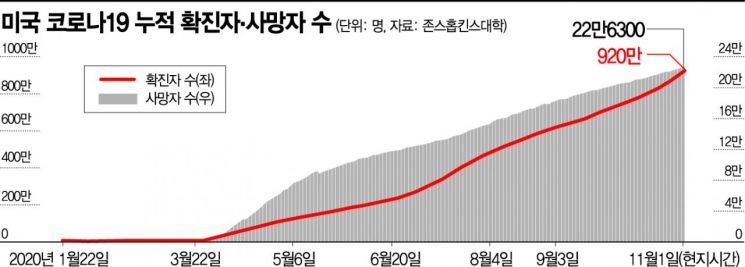
[Asia Economy Reporter Kwon Jae-hee] There are growing forecasts that the U.S. economy will face an even greater crisis after the presidential election. Concerns over election disputes have made the prospect of a gap until the presidential inauguration in January inevitable, regardless of who wins, gaining credibility. The recent sharp rise in COVID-19 cases in the U.S. is also cited as a factor contributing to economic contraction.
On the 2nd (local time), The Washington Post (WP) analyzed that the U.S. economy will face severe tension for about three months from after the election until the presidential inauguration on January 20. This period is when the winning presidential candidate plans the transition of power, but this year, with the COVID-19 pandemic and the approaching winter that could worsen it, several industries may experience a downturn, the report said.
The complicated political calculations surrounding the election are also cited as factors making it difficult to proceed with additional economic stimulus measures. Even if President Trump wins re-election, if the Democrats win the Senate election, the Congress reviewing the stimulus bill will be in a lame-duck session, making it difficult to gain political momentum. If President Trump fails to win re-election, the Republican side is expected to use this as a card to pressure the Democrats, leading to a political deadlock.
The additional stimulus package hinted at by President Trump is expected to exceed $2 trillion (approximately 2.271 trillion KRW).
WP specifically predicted that industries such as restaurants, hotels, and airlines will be hit hard. With winter approaching, when people's movement decreases, and the COVID-19 pandemic causing people to refrain from going out, a survey found that 40% of restaurants nationwide will suspend operations until March without additional government support. Also, it has been confirmed that 40 million travel-related jobs have disappeared due to COVID-19, and without additional federal financial input, another 1 million jobs are expected to vanish by the end of this year. Major airlines have already announced tens of thousands of unpaid leave plans since the federal government's support program expired last September. Furthermore, starting mid-December, millions are expected to begin exhausting unemployment benefits, making the economic outlook even darker.
Michael Strain, an economic expert at the American Enterprise Institute, a U.S. think tank, analyzed, "All signs indicate that Washington is heading toward the worst of the worst scenarios."
As COVID-19 cases surge, major economic indicators are also faltering. On the 28th (local time), amid the resurgence of COVID-19, the Dow Jones Industrial Average fell 3.43% from the previous trading day, and the S&P 500 dropped 3.53%, marking the largest decline since March when the pandemic was at its peak.
Industries hit by COVID-19 are waiting only for additional government stimulus, but even that is expected to be difficult. President Donald Trump hinted at additional stimulus measures, saying, "After the election, we will get the greatest relief package you have ever seen," but this is also expected to be challenging. President Trump and Democratic House Speaker Nancy Pelosi have clashed over the stimulus package. While both sides agree on direct financial support to American households, they have not reached an agreement on debt relief for businesses and support for state governments.
Beth Ann Bovino, Chief U.S. Economist at S&P Global, said, "Whoever becomes president will face a difficult reality," adding, "The U.S. economy is not heading deeper into recession, but the signs of recovery are not very positive either."
John Lettieri, CEO of the Economic Innovation Group, analyzed, "If Senate Republicans currently find it difficult to reach an agreement with the White House, it signals that it will be impossible even after the election," adding, "This will inflict even more fatal damage on an already unstable economy."
© The Asia Business Daily(www.asiae.co.kr). All rights reserved.

















