Yongsan-gu, First Discovery of Documents on Kim Du-han's Detention at US 7th Infantry Division Detention Center... Kim Du-han and 16 Others Tried by US Military Government for Assault and Murder in Jeong Jin-ryong Gang Case... Detained at Yongsan US 7th Infantry Division Detention Center Until Prison Designation... Yongsan-gu to Publish Yongsan Base History Book in December Containing New Materials Including Kim Du-han's Detention Records
[Asia Economy Reporter Park Jong-il] On April 20, 1947, an incident occurred in which right-wing terrorist members of the Korean Democratic Youth League (Korean Democratic Youth), including Kim Du-han (1918?1972), who was residing at the old Donghonwon Temple (東本願寺) on Namsan, assaulted and murdered the opposing faction led by Jeong Jin-ryong. This was not merely a simple act of violence but a political armed clash between left and right factions.
According to newspaper articles at the time, the U.S. Counterintelligence Corps (CIC), which led anti-North intelligence, information gathering, and political surveillance during the U.S. military government period, reported the incident to the Capital Police Agency, and Chief Jang Taek-sang appears to have personally directed the investigation. One corpse and ten injured persons were found at the scene.
As a result of this incident, Kim Du-han was arrested and tried. As is well known, he was sentenced to death by the U.S. military government and transferred from the U.S. 7th Infantry Division detention center in Yongsan, Seoul, to Daejeon Prison.
Yongsan District Office (District Mayor Seong Jang-hyun) has for the first time discovered documents confirming Kim Du-han’s imprisonment at the U.S. 7th Infantry Division detention center.
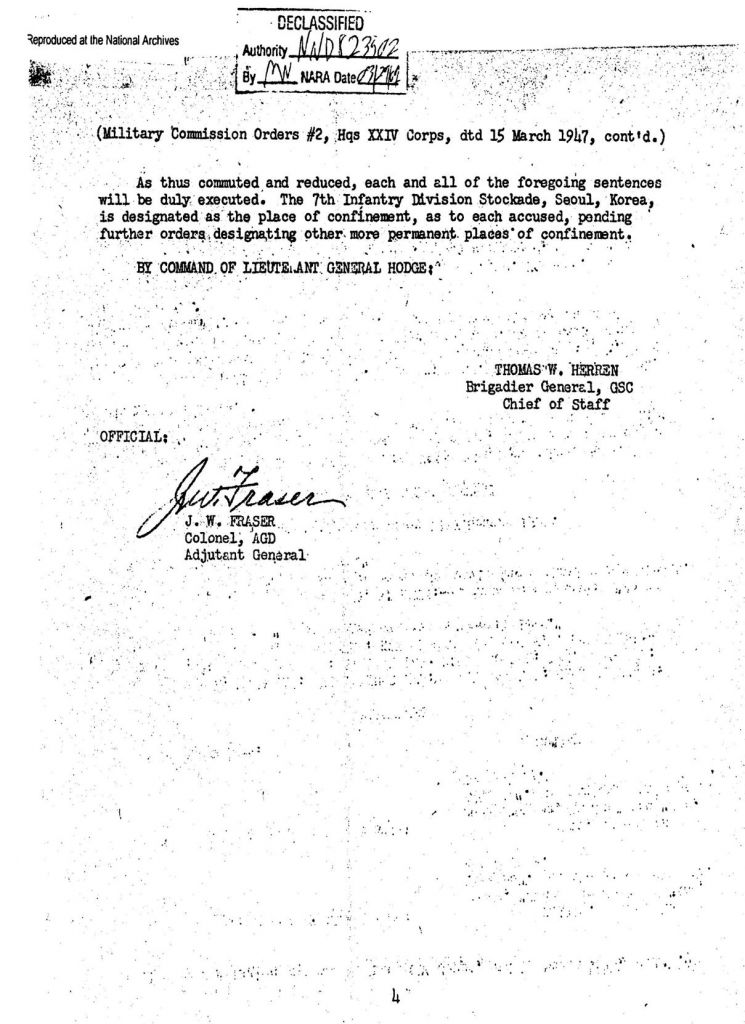
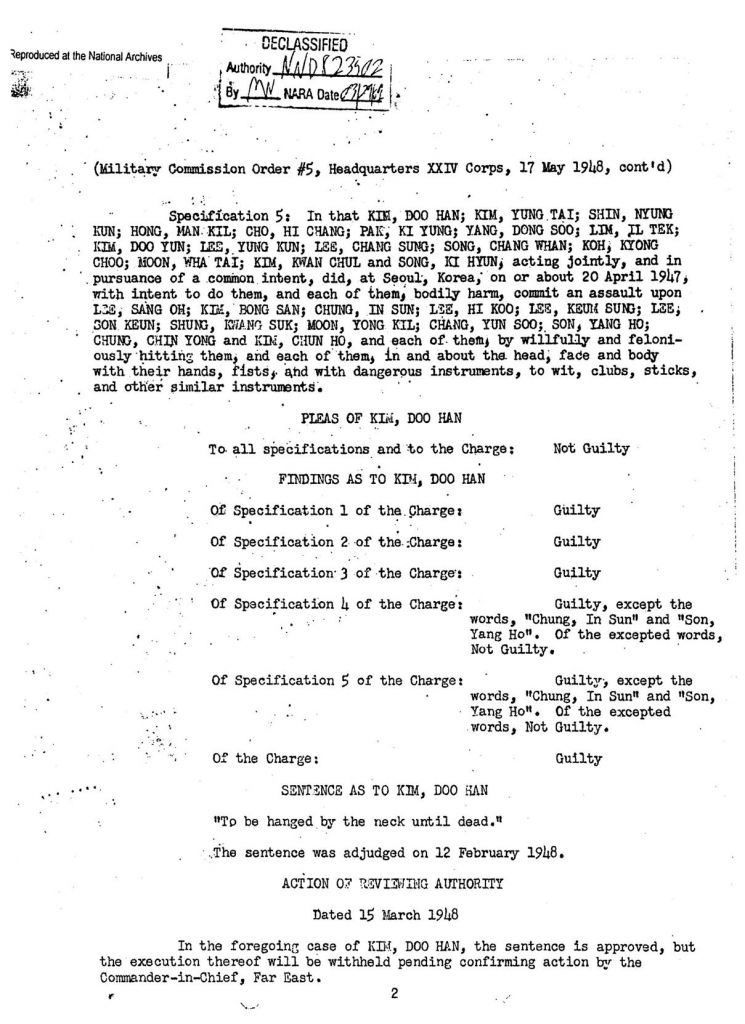
The documents include “Military Commission Order #2” dated March 15, 1948 (although the document mistakenly states the year as 1947), “Order #3” dated March 26 of the same year, and “Order #5” dated May 17.
According to Order #2, sixteen individuals including Kim Du-han were sentenced as follows: death by hanging (Kim Du-han), life imprisonment (Kim Young-tae, Shin Young-gyun, Hong Man-gil, Jo Hee-chang), 30 years imprisonment (Park Ki-young, Yang Dong-su, Im Il-taek, Kim Du-yoon, Lee Young-geun, Lee Chang-seong, Song Chang-hwan, Go Kyung-ju, Kim Gwan-cheol), and 20 years imprisonment (Moon Hwa-tae, Song Ki-hyun). It states that “the foregoing sentences will be duly executed.”
While a permanent place of confinement was being designated for these individuals, “The 7th Infantry Division Stockade, Seoul, Korea, is designated as the place of confinement” by order of Lieutenant General Hodge, the U.S. military government commander.
Order #3 shows that, except for Kim Du-han, the other involved parties were transferred from the 7th Infantry Division detention center to Mapo Prison, Daegu Prison, Gwangju Prison, and Busan Prison respectively.
Finally, Order #5 states that “the execution thereof will be withheld pending confirming action by the Commander-in-chief, Far East,” and that Daejeon Prison was designated as the place of confinement, with “the prisoner will forthwith be transferred thereto” recorded.
Subsequently, Kim Du-han was transferred to Daejeon Prison but was specially pardoned by former President Syngman Rhee after the establishment of the Republic of Korea in 1948. He led a tumultuous life, being elected as the 3rd National Assembly member (1954, Seoul Jongno District), the 6th National Assembly member (1965, Yongsan District by-election), and involved in the National Assembly filth-throwing incident (1966), before passing away at the age of 55 in 1972.
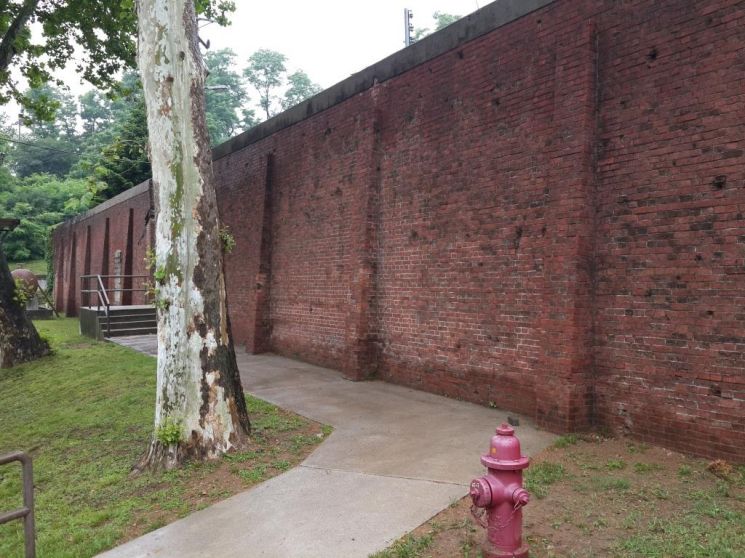
The 7th Infantry Division detention center is a military facility located within the Yongsan base. Its predecessor was the “Yongsan Military Prison” built by the Japanese 20th Division during the Japanese colonial period to imprison Japanese soldiers and military personnel who violated military law, completed in 1909. Although 111 years have passed, some buildings including the prison walls still remain in their original form within the Yongsan U.S. military base.
Other notable figures who are known to have passed through this place include independence activist Kang Ki-dong (1884?1911), An Du-hui (1917?1996), who assassinated Baekbeom Kim Gu, and poet Kim Soo-young (1921?1968), known for his philosophical and critical poetry.
Kim Cheon-su, head of the History and Culture Research Office at Yongsan Cultural Center, who found materials related to Kim Du-han at the National Institute of Korean History’s electronic archives, said, “We were able to confirm Kim Du-han’s imprisonment, which was previously known only through newspaper articles, in the records of the U.S. Forces Korea,” adding, “Many untold stories of modern history are likely buried here.”
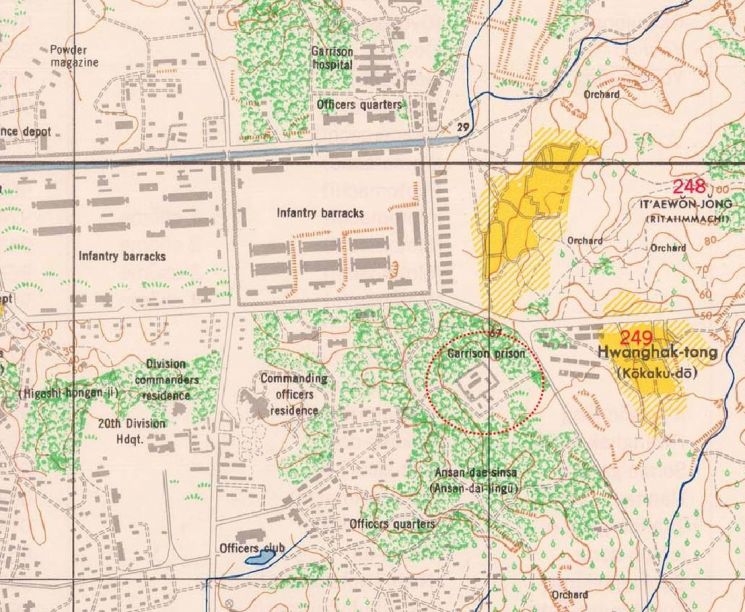
In 2014, Kim Cheon-su also made a significant impact by being the first in Korea to discover the so-called “Korean Yongsan Military Detention Area Detailed Map” (韓國龍山軍用收容地明細圖), a 3 million-pyeong scale detention area map created in 1906 before the Japanese army established the Yongsan base, and publicly released it in 2017.
The district plans to publish a history book on the Yongsan base, tentatively titled “The Korean War and Yongsan Base,” in December, which will include new materials such as the post-liberation stationing of the U.S. 7th Infantry Division at Yongsan base, records of Kim Du-han’s imprisonment, and the role of Yongsan base during the Korean War. This is expected to be the final volume of a Yongsan base history trilogy following “Searching for the History of Yongsan” (2014) and “Searching for the History of the Lost Dunjimi Old Village within Yongsan Base” (2017).
Seong Jang-hyun, Mayor of Yongsan District, said, “To create a complete Yongsan Park, it is our task to examine what truly happened on that land during the modern and contemporary periods,” adding, “We will continue to discover new materials related to Yongsan base and introduce them one by one to the citizens.”
© The Asia Business Daily(www.asiae.co.kr). All rights reserved.



















