Establishment of Special Task Force
Pre-installation of Transmission Network in Expected Demand Areas
System Improvements Including Pre-Connection and Post-Control
"3.2GW Volume to be Resolved by Next Year"
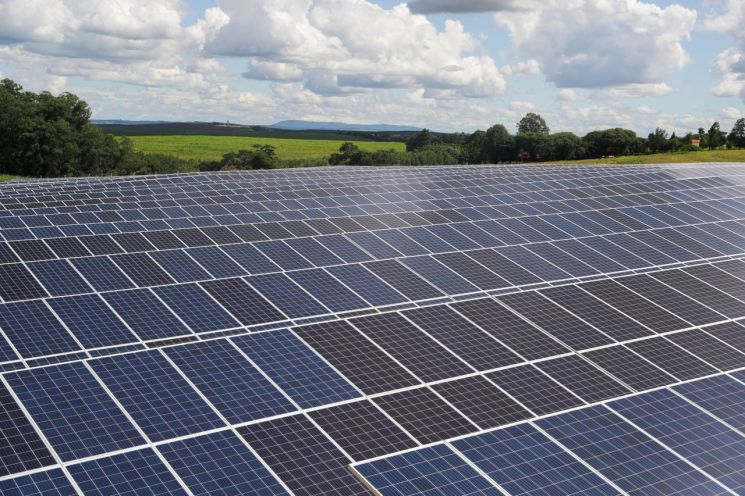
[Asia Economy Reporter Moon Chaeseok] Small-scale solar power operators are expected to resolve the issue of being unable to properly send electricity to Korea Electric Power Corporation (KEPCO) despite generating power due to delays in grid connection for solar power facilities. As renewable energy facilities rapidly increase, dissatisfaction over delays in power grid connection (power network linkage) is growing, and KEPCO has proposed proactive measures.
According to KEPCO on the 3rd, a 'Special Task Force for Renewable Energy Measures' was newly established on the 2nd, led by Kim Seongam, Vice President of the Power Grid division. Through this, they plan to resolve 3.2GW out of the 4.2GW currently waiting for connection by next year.
KEPCO created this special task force led by a vice president because it judged that a robust power grid system capable of handling the increasing demand for renewable energy is necessary to ensure stable power supply. President Kim Jonggap plans to directly check the progress every month.
According to KEPCO, after implementing the policy guaranteeing connection for renewable energy facilities under 1MW in October 2016, 14.4GW was concentrated in specific regions in a short period. This caused the 4.2GW connection delay.
KEPCO announced plans to resolve 3.2GW of the 4.2GW connection delay by next year. They plan to address 1GW by shortening the substation construction period (from 6 years to 3 years) and increasing the allowable capacity for distribution line connections (from 10MW to 12MW), among other measures.
First, KEPCO plans to pre-build transmission networks in areas expected to apply for renewable energy connections and expand disclosure of network information, as well as improve systems to increase connection capacity.
Through the special task force for renewable energy, KEPCO will improve grid linkage methods, shorten the construction period for transmission and distribution facilities, and reorganize related systems and organizations. Vice President Kim plans to meet with related renewable energy organizations such as solar and wind power associations at least once a month to listen to field difficulties.
Additionally, KEPCO plans to pre-construct transmission and distribution facilities in areas expected to apply for connections in the future. They aim to realize timely connections by building distributed power facilities (small-scale and low-capacity) near new and renewable energy power plants, which can shorten construction periods.
To increase the renewable energy acceptance rate of already installed facilities, KEPCO plans to improve systems such as pre-connection and post-control and the application of planned capacity standards. The planned capacity standard is a measure considering the characteristics of renewable energy, which does not easily achieve 100% output.
For example, if 1MW is applied for, previously the full 1MW capacity was considered when reviewing transmission network capacity, but going forward, only 0.7MW, which is 70% of the facility capacity, will be reviewed.
Furthermore, KEPCO will expand the disclosure of network information to the level desired by power producers. They have established a 'Capacity Information Disclosure System' on the KEPCO website so that power producers can easily check regional facility margin information.
Starting from July next year, they plan to additionally disclose all possible information such as margin information reflecting future power grid investment plans and possible connection timings.
A KEPCO official said, "KEPCO plans to continue supporting the expansion of new and renewable energy power generation by preparing various measures centered on the special task force to proactively respond to the increasing trend of renewable energy."
© The Asia Business Daily(www.asiae.co.kr). All rights reserved.

















