Azerbaijan Restores Areas Around Nagorno-Karabakh Using Drones and Advanced Weapons
Armenia Now Sees Russia as Its Only Ally
[Asia Economy Reporter Naju-seok] On the 31st of last month, the Armenian government urgently requested military support from Russia. This was because Armenia, which had effectively controlled Nagorno-Karabakh and its surrounding areas by repelling Azerbaijani forces during the 1990s war, found itself in the opposite situation in a war after 26 years.
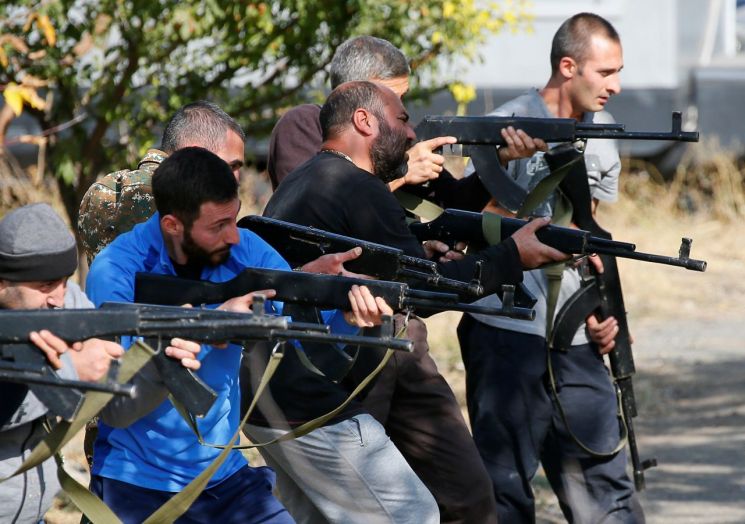 Armenian volunteer soldiers are undergoing military training at a training camp. [Image source=Reuters Yonhap News]
According to AP News and others, on that day, Armenian Prime Minister Nikol Pashinyan asked Russian President Vladimir Putin to quickly discuss possible military support for Armenia. Russia has not given an immediate response to this request. Prior to this, the Armenian Foreign Minister visited Russia to request mediation for a ceasefire.
Armenia's request for Russia's help indicates that the situation is serious.
According to foreign media, Azerbaijani forces have currently approached the road connecting Armenia and Nagorno-Karabakh. If this road falls to Azerbaijani forces, Nagorno-Karabakh would become like an island surrounded by Azerbaijan, making it even more difficult for Armenia to provide support.
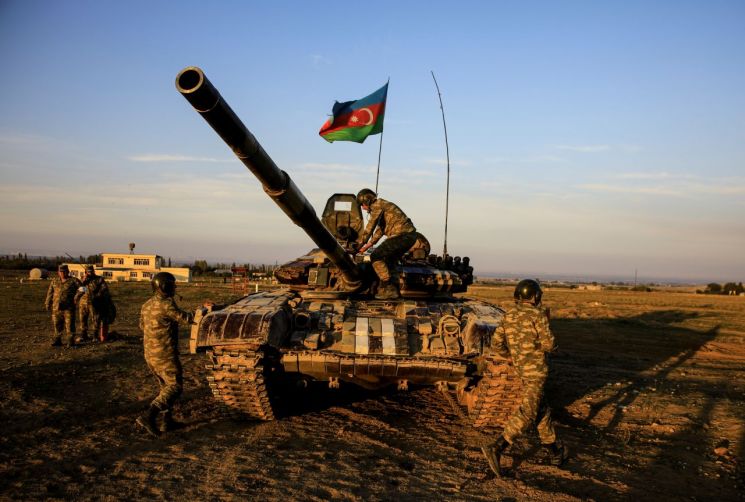
The situation was the opposite during the Nagorno-Karabakh war that ended in 1994. Armenian forces overwhelmed Azerbaijani forces. At that time, Armenia occupied about 7,000 km² of Azerbaijani territory, and Azerbaijani forces suffered heavy casualties. The situation has changed dramatically in just a few decades. Azerbaijani forces, equipped with Israeli aircraft and Turkish drones, are advancing by destroying Armenian tanks and anti-aircraft weapons.
Jack Watling, a researcher at the UK's military think tank RUSI (Royal United Services Institute), pointed out, "The Armenian forces are virtually defenseless," adding, "One side (Azerbaijan) is armed with modern weapons, while the other side (Armenia) is using weapons from the 1970s and 1980s."
An Azerbaijani government official explained, "Armenia has long boasted invincibility. But now they rely on outdated tactics such as tanks, heavy artillery, and fortifications, which are old military doctrines," and added, "Meanwhile, Azerbaijani forces are applying drones and modern military doctrines."
There are many conflicting claims about the current frontline formation, but according to military experts' analysis, Azerbaijani forces have taken control of more than 1,500 km². Armenia also acknowledges being on the defensive but insists the situation is not yet critical.
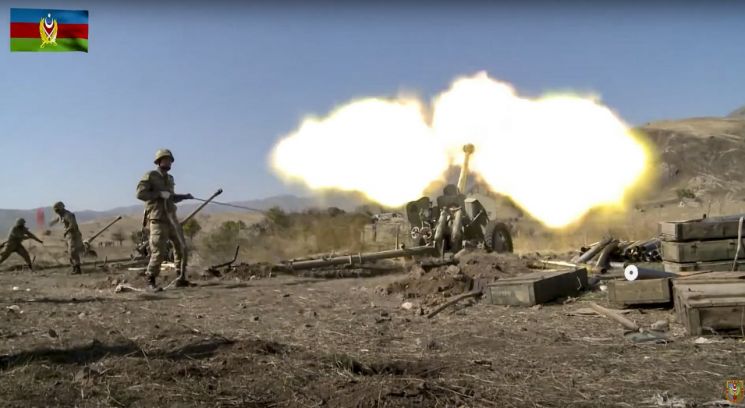
The divergent positions of both sides in this full-scale war that resumed after only a few decades are due to Azerbaijan's significant military buildup efforts. Azerbaijan, a country rich in oil and natural gas, has spent enormous amounts on its military. According to the Stockholm International Peace Research Institute's data, Azerbaijan has spent $24 billion (27.23 trillion KRW) on defense over the past decade, while Armenia has invested $4.7 billion. Thanks to this difference in defense spending, Azerbaijan has surpassed Armenia not only in the quality but also in the quantity of aircraft, drones, and rockets.
Experts believe that Azerbaijan has gained an advantage by utilizing weapons purchased from Israel, Russia, and Turkey, but the Armenian forces lack equipment to protect themselves from modern precision-guided weapons. In particular, the TB2 drone sold by Turkey's Bayraktar is known to be troubling the Armenian ground forces.
Besides weapons, there are also indications that Turkey is supporting Azerbaijan in military operations. It is reported that Azerbaijani forces are replicating tactics used by the Turkish military when it clashed with Syrian government forces in February this year. This has led to analyses suggesting that Turkey is providing support not only in terms of weapons but also in military operational stages.
However, there are also analyses that it remains to be seen whether Azerbaijani forces will continue to achieve victories. Until now, Azerbaijan has shown superiority in flatland areas, but most of Nagorno-Karabakh consists of mountainous terrain, which could make the war difficult. Experts also believe that the approaching winter will not be advantageous for Azerbaijan.
For Armenia, Russia remains the only reliable ally. Russia has established military bases in Armenia and signed a defense treaty to protect its ally if attacked from outside. However, Russia finds itself in a difficult position in this war. Its previously good relations with Azerbaijan are at risk, and there is also the possibility of armed conflict with Turkey, which claims to be a brother nation of Azerbaijan.
The peace plan proposed by Russia reveals this predicament. It includes provisions to return some of the territories that Armenia had effectively controlled since the 1990s war back to Azerbaijan, the internationally recognized sovereign state.
© The Asia Business Daily(www.asiae.co.kr). All rights reserved.

![Clutching a Stolen Dior Bag, Saying "I Hate Being Poor but Real"... The Grotesque Con of a "Human Knockoff" [Slate]](https://cwcontent.asiae.co.kr/asiaresize/183/2026021902243444107_1771435474.jpg)

















