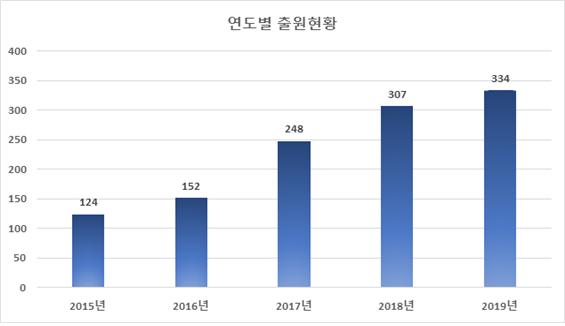
 Graph of Augmented Reality Application Filings from 2015 to 2019. Provided by the Korean Intellectual Property Office.
[Asia Economy (Daejeon) Reporter Jeong Il-woong] Although the popularity of the game ‘Pok?mon Go’ has somewhat waned, the utilization and popularity of Augmented Reality (AR), which served as the foundation for the game, appear to remain strong.
There is an analysis that the commercial success of AR games like Pok?mon Go, which once gained worldwide popularity, has driven the development of AR technology and patent applications in the industry.
According to the Korean Intellectual Property Office on the 1st, domestic patent applications related to AR applications (apps) have been increasing annually over the past five years: 124 in 2015, 152 in 2016, 248 in 2017, 307 in 2018, and 334 in 2019.
By applicant type in the AR field, small and medium-sized enterprises (SMEs) account for the largest share at 42.7%, followed by individuals at 31.3%, large corporations at 13.6%, universities at 8.3%, and research institutes at 3.9%.
Recently, the application of AR technology has been prominent in content service sectors such as education, travel, and exhibitions (55.9%), shopping sectors including marketing and purchasing (30.2%), and industrial sectors such as construction and manufacturing (7.1%).
The Korean Intellectual Property Office interprets the active patent applications for AR apps as a result of the commercial success of AR games like Pok?mon Go, which has led the industry to take an interest in the AR market and engage in discovering new services and developing technologies.
Additionally, the development of mobile communication technology has created an environment where large volumes of video data can be processed quickly, and the improved performance of smartphones supporting this has also positively influenced the increase in AR app patent applications.
In particular, the successive releases of augmented reality development tools for smartphones by Google and Apple have helped SMEs and individuals easily develop AR apps, while also driving the increase in related patent applications by these groups.
Kim Hyun-soo, head of the E-commerce Examination Division at the Korean Intellectual Property Office, said, “In the past, AR technology was mainly used in limited fields such as games and broadcasting, but recently, there is a growing trend of integration and utilization in various fields closely related to daily life, such as shopping and travel.”
He added, “Above all, as competition in the AR market intensifies, patent applications related to this technology are expected to increase further. Considering this trend, Korean companies need to not only develop excellent technologies in the AR field but also establish strategies to patent core technologies from the early stages of development.”
Meanwhile, AR refers to a technology that provides images synthesizing virtual objects into the real world in real time, making it appear as if the objects exist in the actual space.
For example, AR-enabled apps allow consumers to experience immersive shopping by checking furniture or home appliances they intend to purchase on their smartphones without visiting stores in person, and placing them in the actual space where they will be used.
© The Asia Business Daily(www.asiae.co.kr). All rights reserved.
!["The Woman Who Threw Herself into the Water Clutching a Stolen Dior Bag"...A Grotesque Success Story That Shakes the Korean Psyche [Slate]](https://cwcontent.asiae.co.kr/asiaresize/183/2026021902243444107_1771435474.jpg)
















