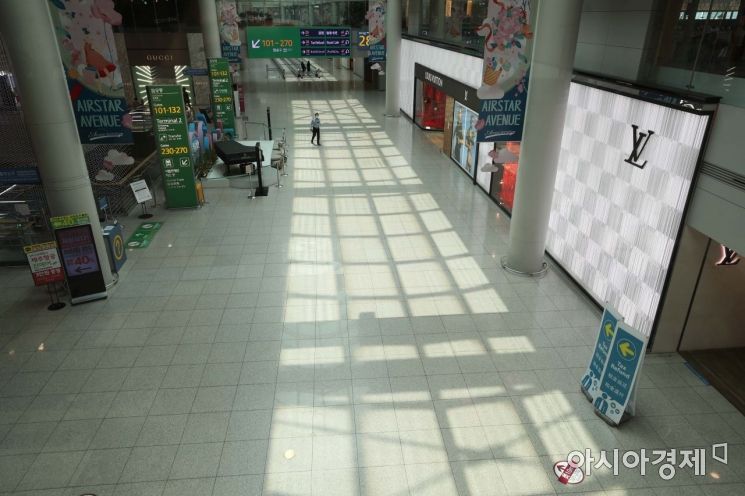
 On the 18th, the duty-free shop at Terminal 1 of Incheon International Airport was quiet due to the impact of the novel coronavirus (COVID-19). Photo by Mun Ho-nam munonam@
[Asia Economy Reporter Seungjin Lee] In the distribution industry, which has been hit hard by the novel coronavirus infection (COVID-19), efforts for mutual growth between large corporations and small and medium-sized enterprises (SMEs) continue. Despite difficulties across the industry, some have expanded the scale of support for SMEs compared to last year, maintaining a spirit of coexistence.
According to the distribution industry on the 31st, the home shopping sector has taken the lead in supporting SMEs this year. The home shopping industry, which saw some sales increase due to the spread of non-face-to-face consumption culture caused by COVID-19, has linked this to support for SMEs.
Lotte Home Shopping established various new support measures this year for SMEs struggling due to COVID-19. They newly created a special exhibition for SMEs, focusing on products from COVID-19 affected areas, and increased opportunities to enter the 'Sangsaeng Studio,' a broadcast with preferential sales commissions for SME products through online entry consultation meetings. They are also operating the Dongbang Growth Mutual Cooperation Fund with a scale of 200 billion KRW.
CJ ENM O Shopping Division selected six companies in July and provided a total of 100 million KRW in product development support funds and broadcasting entry benefits. In August, they also provided a total of 70 million KRW in cash incentives to excellent SME partners, as part of the 'Innovation-led Wage Gap Resolution Agreement' signed between the O Shopping Division and the Win-Win Growth Committee.
NS Home Shopping also spared no budget support for SMEs. They contributed a total of 300 million KRW fund to support research and development of SME partners and supported production costs of home shopping insert videos with 150 million KRW for 12 partner companies. Additionally, they provided a total budget of 200 million KRW, 100 million KRW each for food and non-food sectors, to improve the product quality of SME partners.
Department stores and duty-free shops, which suffered the biggest sales hits this year, also took the lead in supporting SME sales channels. Lotte Shopping joined hands with the Korea Federation of SMEs to assist SMEs. On the 16th, Lotte Department Store held a product evaluation meeting to select companies to enter permanent SME-exclusive curated stores operating at four stores: Main Store, Jamsil Store, Yeongdeungpo Store, and Busan Main Store. Companies finally selected through the evaluation will receive benefits such as preferential sales commissions, exemption from interior costs, promotional expenses, and labor costs.
Notably, buyers from Lotte Shopping’s online and offline business divisions, including Lotte Department Store, Lotte Mart, Lotte Super, and Lotte e-Commerce, also attended this evaluation meeting, expanding the scope of sales channels compared to last year.
Lotte Duty Free, which saw sales drop by up to 90% compared to last year, supported sales channels for SME brands entering duty-free shops. As 'K-Beauty' products faced blocked overseas sales channels due to COVID-19, Lotte Duty Free contributed to sales promotion by supporting live broadcasts of about 40 products from 10 domestic SME beauty brands in July.
In addition, support for SMEs is being carried out in various places. CJ Olive Young supports marketing costs for SMEs through its SME support program 'Joyful Companion.' CJ Olive Young, which supported 30 companies last year, plans to expand the scale of supported companies this year.
A distribution industry official explained, "This year, the distribution industry has been a difficult time for both large corporations and SMEs," adding, "Nevertheless, many large corporations are generously contributing to support SMEs to prevent the entire industry from collapsing."
© The Asia Business Daily(www.asiae.co.kr). All rights reserved.

















