Deliberation and Approval After Gathering Opinions Starting in April
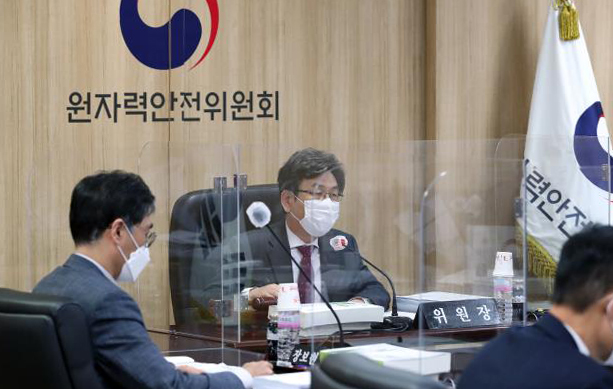 The scene of the 127th Nuclear Safety Committee plenary meeting held on the 30th. (Image source=Yonhap News)
[Asia Economy Reporter Moon Chaeseok] The Nuclear Safety and Security Commission (NSSC) has listened to voices from the field and restructured nuclear safety administrative procedures to spread a voluntary safety culture.
On the 30th, the NSSC held the 127th Nuclear Safety and Security Commission meeting and deliberated and resolved the "Partial Amendment (Draft) of the Enforcement Rules and Subordinate Regulations of the Nuclear Safety Act," which includes these contents.
The NSSC has been listening to field difficulties through several meetings and site visits over about six months since April to increase the acceptance of safety regulations in industrial sites and enable the spread of a voluntary safety culture. This amendment was prepared after review based on field opinions.
Currently, the criteria for radiation dose reading handlers are limited to four-year university graduates, but the amendment adds junior college graduates with certain practical experience.
The qualification for deputy radiation safety managers in the non-destructive testing field, previously limited to license holders, can now be performed by field-experienced personnel after completing training.
An NSSC official expressed hope that "these measures will enable companies facing recruitment difficulties to comply with laws and perform safety management."
Additionally, administrative procedures directly related to business operators' convenience, such as usage restrictions, reporting, and inspections, will also change. These include ▲ lifting the total ban on outdoor use of mobile radiation-generating devices in the non-destructive testing field ▲ clarifying the performance inspection period for reading systems ▲ simplifying the contents of transport documents for L-type transport containers.
An NSSC official explained, "L-type transport containers are containers with radiation exposure levels in case of damage at 0.001 to 0.0001 times that of A-type containers, which have exposure levels below 50 mSv."
He added, "Unlike international standards, only South Korea has applied the requirement to prepare declarations and complicated transport documents when transporting L-type containers. These will be exempted or simplified, and various basic data necessary for container classification have been supplemented to meet the latest international standards."
Chairman Eom Jaesik said, "Through active communication with the field, we will continuously improve even the smallest issues that hinder voluntary safety management intentions. If the acceptance of safety regulations in radiation sites is increased, it is expected to ultimately serve as an opportunity for the spread of a safety culture throughout the industry."
This amendment will be promoted for legislation aiming for implementation in the first half of next year after consultation with related agencies and public notice.
Meanwhile, at the meeting, the NSSC decided to resubmit the "Change Permit (Draft) for Nuclear Utilization Facilities" related to KEPCO Nuclear Fuel's first plant for further discussion.
This change permit involves installing preprocessing and reconversion processes at KEPCO Nuclear Fuel's first plant to recover uranium from uranium compound debris generated during the fuel production process.
© The Asia Business Daily(www.asiae.co.kr). All rights reserved.

















