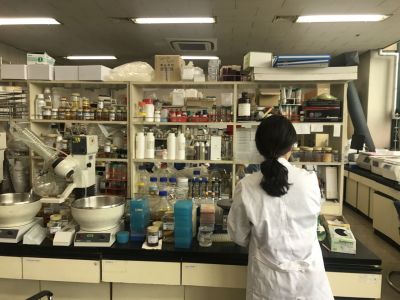
 An employee working as a researcher at VensLab Co., Ltd., selected as a participant in the WISET Science and Technology R&D Alternative Workforce Utilization Support Project. The photo shows the back of the employee to protect privacy.
 [Photo by WISET]
[Asia Economy Reporter Kim Jong-hwa] Recently, prolonged COVID-19 has intensified employment insecurity among small and medium-sized enterprises (SMEs).
According to the Small and Medium Business Institute's report titled 'Employment Outlook and Policy Tasks for SMEs Amid the Spread of COVID-19,' 35.5% of SMEs responded that they plan to reduce the number of employees in the second half of the year compared to the first half. Additionally, 72.5% expect their business conditions to worsen in the second half compared to the first half.
Employment insecurity is also increasing among workers who have applied for caregiving leave due to COVID-19. Among all parental leave takers, 55.8% work at SMEs with fewer than 300 employees, totaling 33,604 people. For SME workers, returning to work after parental leave is uncertain due to business deterioration caused by the economic downturn. Companies also face difficulties in hiring replacement workers for those on parental leave due to worsening business conditions.
In response, government ministries, affiliated organizations, and local governments in the public sector are implementing various projects to alleviate employment insecurity in SMEs. Companies struggling to secure labor costs and hire replacement workers for those on leave should take note of the following support programs.
Korea Center for Women in Science, Engineering and Technology (WISET) Provides Labor Cost Support for Replacement Workers
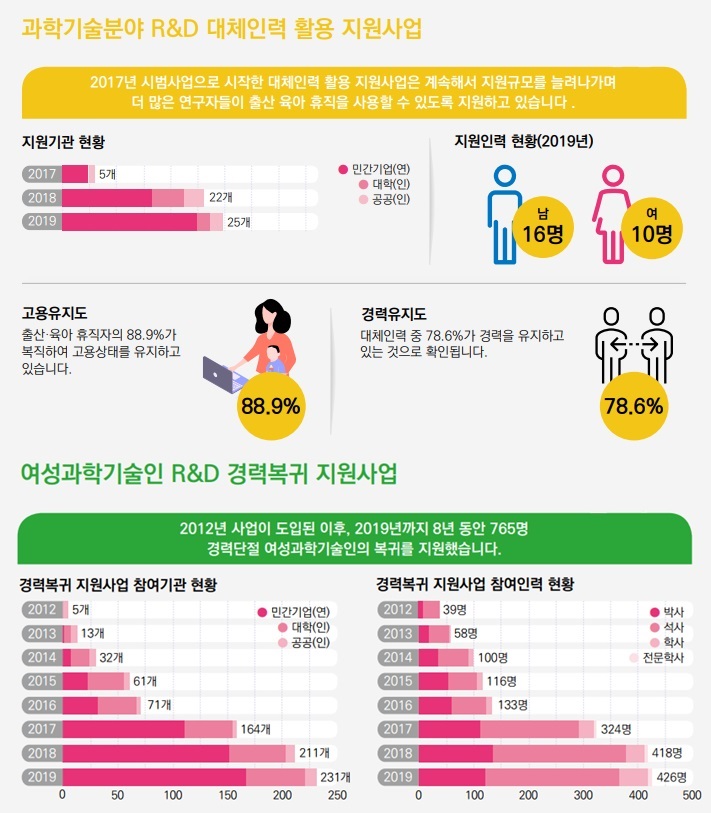
The Korea Center for Women in Science, Engineering and Technology (WISET), supported by the Ministry of Science and ICT, operates the 'Support Project for Utilizing Replacement Workers in Science and Technology R&D.' When companies and research institutes hire replacement workers for employees on maternity or parental leave or those working reduced hours for childcare, the government provides support funds up to 21 million KRW for bachelor's and master's degree holders and up to 23 million KRW for doctoral degree holders.
The project also supports male parental leave and reduced working hours due to COVID-19, not only female scientists and engineers. If suitable replacement workers cannot be found, WISET offers a customized recruitment linkage service using its replacement worker pool.
Additionally, through the 'Support Project for Career Return of Women Scientists and Engineers in R&D,' WISET supports the return of women scientists and engineers who have experienced career interruptions in R&D fields. It provides labor cost and training support to women in science and engineering who are unemployed or have career gaps due to childbirth, childcare, or family caregiving, supporting participating institutions and personnel with labor costs for up to three years (maximum 36 months).
Especially this year, to overcome the COVID-19 crisis, application requirements have been relaxed and the support scope expanded. Short-term workers enrolled in employment insurance (interns, part-time workers, etc.) and previous participants who could not complete their contract period due to unavoidable reasons are now included. The credit rating requirements for companies have also been eased.
Ministry of Employment and Labor Provides Indirect Labor Cost and Employment Retention Subsidies for Remote Work
The Ministry of Employment and Labor has simplified the support procedures for remote work for pregnant workers and others. When employers apply for 'remote work indirect labor cost' support for pregnant workers and workers who are parents of elementary school students at local employment centers nationwide, approval can be granted immediately without a business plan review process.
The remote work indirect labor cost support system provides employers with up to 5.2 million KRW per worker annually for up to one year, depending on the number of remote work days per week for workers in small and medium-sized enterprises and mid-sized companies. The same support applies to telecommuting, staggered working hours, and flexible work systems.
The employment retention subsidy period has also been extended from 180 days to 240 days. This program provides employers who must adjust employment due to decreased sales or production with about 67-75% of labor costs, up to 66,000 KRW per day (maximum 1.98 million KRW per month), when they implement employment retention measures such as business suspension or leave.
Seoul City Accepts Applications for Labor Cost Support for Outstanding Startup Technical Personnel
Startups established less than three years ago are particularly vulnerable to the COVID-19 crisis. To support early-stage startups facing direct difficulties due to COVID-19, Seoul City and the Seoul Business Agency (SBA), a support organization for small and medium-sized ventures, are implementing the '2nd Seoul City Outstanding Startup Technical Personnel Labor Cost Support Project.'
Eligible applicants are technology startups located in Seoul that employ three or more staff or have accumulated investment of at least 30 million KRW since 2018. From June 1 to October 31, companies can receive labor cost support of up to 5 million KRW per employee, with a maximum of 7 employees per company, totaling up to 35 million KRW.
The first recruitment targeted promising startups in fields such as bio and non-face-to-face services with five or more regular employees. However, during the first support project, the need to support early-stage growth companies was confirmed, leading to relaxed eligibility criteria. Applications are accepted online via the official Seoul Startup Hub website.
© The Asia Business Daily(www.asiae.co.kr). All rights reserved.
![User Who Sold Erroneously Deposited Bitcoins to Repay Debt and Fund Entertainment... What Did the Supreme Court Decide in 2021? [Legal Issue Check]](https://cwcontent.asiae.co.kr/asiaresize/183/2026020910431234020_1770601391.png)

















