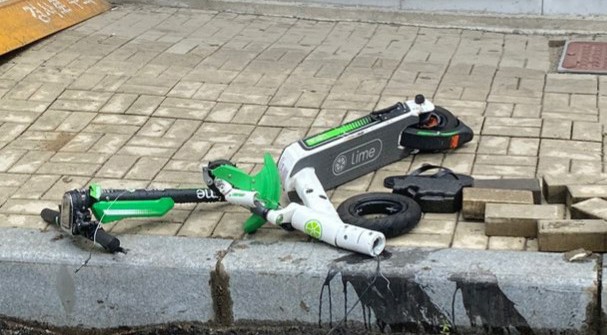
[Asia Economy Reporter Oh Hyung-gil] Safety accidents are rapidly increasing due to the spread of personal mobility (PM), a single-person transportation device. Since insurance subscription to support compensation for accident damages is not mandatory, individuals have to handle accidents on their own.
Insurance companies are rushing to launch insurance products targeting individuals and shared services, making swift efforts to embrace personal mobility, which has been left in a 'coverage blind spot.'
According to data submitted by the Ministry of Land, Infrastructure and Transport and the National Police Agency to Cho Oh-seop, a member of the National Assembly Land, Infrastructure and Transport Committee from the Democratic Party of Korea, PM-related traffic accidents increased nearly fourfold over three years: 117 cases in 2017, 225 in 2018, and 447 in 2019.
The number of fatalities doubled from 4 in both 2017 and 2018 to 8 in 2019, and the number of injuries also surged sharply from 124 in 2017, 238 in 2018, to 473 in 2019.
Analyzing PM traffic accidents (based on 2019), collisions between PM and vehicles were the most frequent at 262 cases, followed by PM and pedestrians at 130 cases, and single-vehicle accidents at 55 cases.
In particular, 62% of accident resolutions were handled through monetary compensation between the parties involved, while only 20.9% of cases were reported to insurance companies, and a mere 10.3% were reported to the police for processing.
As of last year, 20 companies (including those planning to introduce services) operate 16,570 PM units in shared services, and this number is expected to exceed 40,000 this year. Among the 20 companies, 14 are known to have subscribed to insurance with 7 insurers.
However, these are group insurance policies rather than dedicated insurance, which do not protect both users and pedestrians and focus mainly on accidents caused by device defects, serving the companies rather than the users.
Rep. Cho said, "As ultra-small electric vehicles such as electric kickboards gain popularity mainly among young people, the related industry is rapidly growing, and safety accidents are also increasing sharply. To resolve safety accidents, it is urgent to introduce measures such as mandatory insurance subscription and attaching signs indicating insurance subscription, as done in countries like Germany."
Recently, financial authorities and the non-life insurance industry have been preparing compensation measures for electric kickboards or launching related insurance products.
The Financial Supervisory Service revised the standard automobile insurance policy terms to allow compensation for injuries caused by electric kickboards through automobile insurance subscribed by the individual or their family.
The Financial Supervisory Service newly defined 'personal mobility devices' in the uninsured motor vehicle category to ensure that electric kickboards are clearly covered by automobile insurance (uninsured motor vehicle injury) as before. However, considering that the revised Road Traffic Act classifies electric kickboards closer to bicycles with lower risk, the coverage limit was adjusted to within Bodily Injury I. The coverage limit is up to 150 million KRW for death and up to 30 million KRW for injury.
KB Insurance signed a business partnership agreement (MOU) with Beam Mobility Korea, the operator of the shared electric kickboard mobile platform 'Beam,' to create a safe shared electric kickboard usage environment. Both companies plan to develop and provide insurance products for safe electric kickboard use and promote various marketing collaborations for mutual growth.
KB Insurance plans to develop and offer insurance products that cover bodily injury accidents caused by operational negligence or rider negligence of shared electric kickboard users, as well as medical expenses for the users themselves.
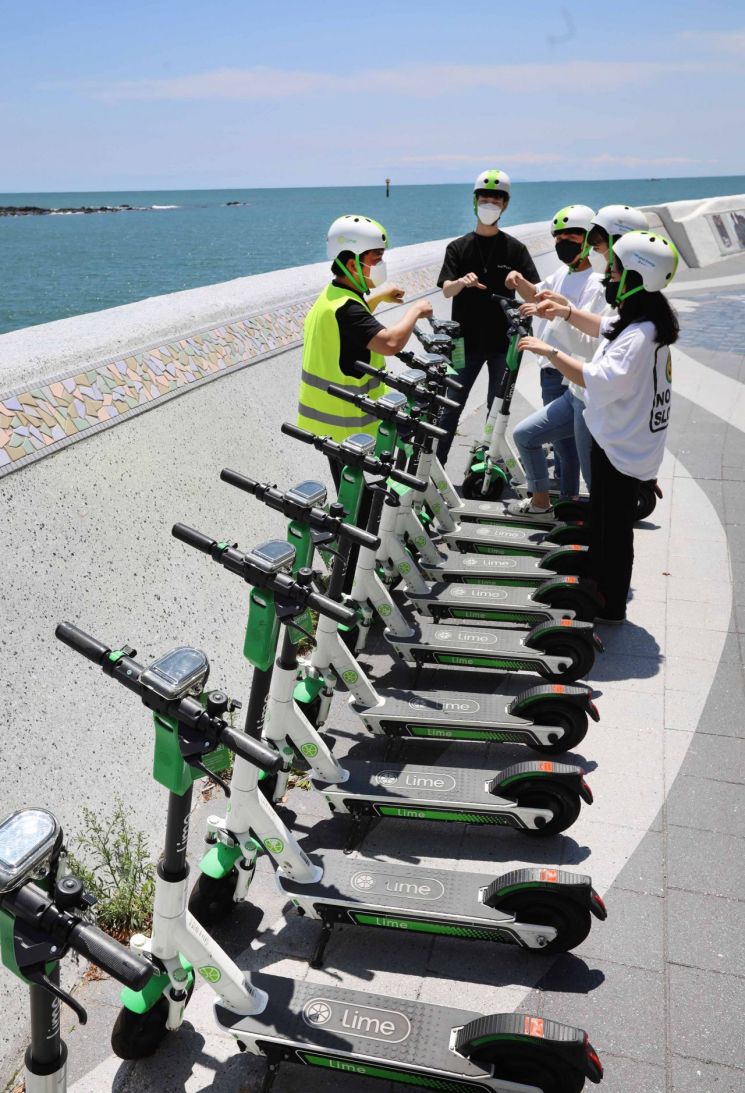
Hanwha General Insurance also agreed to provide insurance services for the safety of riders and pedestrians with Lime Korea, the domestic subsidiary of the global electric kickboard sharing operator. The insurance covers third-party liability (bodily injury and property damage) caused by the rider's negligence during shared kickboard use and injury or death accidents of the rider.
© The Asia Business Daily(www.asiae.co.kr). All rights reserved.


















