Government's 'Future Vehicle Expansion and Market Preemption Strategy'
Focus on Supporting Mid-Range Vehicles... Popularization of Electric Cars
Cumulative Supply of 1.33 Million Electric and Hydrogen Vehicles by 2025
Creating an Environment for Continuous Charging Like Mobile Phones
 Model S vehicles displayed in front of the Tesla store
 [Image source=Yonhap News]
[Asia Economy Reporters Kim Bo-kyung and Kim Dong-pyo] The government will eliminate or differentiate subsidies for high-priced electric vehicles such as Tesla starting next year. The policy aims to focus support on high-performance mid-priced vehicles to popularize electric cars. The goal is to lower vehicle prices and expand infrastructure to distribute a cumulative total of 1.33 million electric and hydrogen vehicles by 2025.
On the 30th, the government announced the 'Future Automobile Expansion and Market Preemption Strategy' at Hyundai Motor Company's Ulsan plant, with President Moon Jae-in in attendance. The event was attended by Vice Prime Minister and Minister of Strategy and Finance Hong Nam-ki, ministers from the Ministry of Environment, Ministry of Trade, Industry and Energy, Ministry of Land, Infrastructure and Transport, and industry officials.
Upon arrival, President Moon toured Ulsan Plant 5, guided by Chung Eui-sun, Chairman of Hyundai Motor Group. This event was seen as another demonstration of President Moon's interest in the future automobile industry. Since taking office, this was his 11th visit to domestic and international automobile production and export sites.
Previously, as part of the Korean New Deal policy, the government announced plans to distribute 1.13 million electric vehicles and 200,000 hydrogen vehicles by 2025. The announcement included specific strategies such as ▲improving convenience in vehicle charging and parking ▲securing price competitiveness comparable to internal combustion engine vehicles ▲restructuring subsidies ▲expanding mandatory eco-friendly vehicle purchases by public institutions.
To enhance convenience for electric vehicle users, an environment enabling continuous charging like mobile phones will be established. By 2025, a cumulative total of 500,000 electric vehicle chargers will be installed at residential areas, workplaces, and other daily life hubs. To achieve this, the mandatory installation rate of electric vehicle chargers in new buildings from 2022 onward will be raised from the current 0.5% to 5%, and existing buildings will also be newly required to install chargers. Hydrogen charging stations are planned to reach 72 units by the end of this year, 310 units by 2022, and 450 units by 2025.
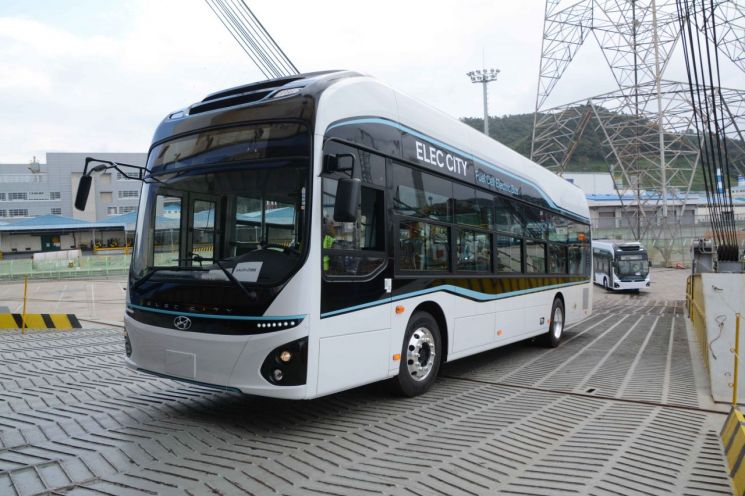
Subsidy restructuring to open the era of electric vehicle popularization will also be pursued. Starting next year, a price-tiered cap system will be introduced to reduce subsidies for high-priced vehicles and increase support for high-performance mid-priced vehicles. Attention is focused on whether the controversy over Tesla sweeping subsidies will disappear. However, the government emphasized that this is not a measure targeting specific manufacturers or models. According to World Trade Organization (WTO) regulations, subsidy discrimination between domestic and imported vehicles is not allowed. Other countries such as China, Germany, and France also do not provide subsidies for high-priced electric vehicles based on a price cap.
An official from the Ministry of Environment explained, "We are not targeting any specific company or country," adding, "The same standard will be uniformly applied to vehicles exceeding the set amount." The government plans to finalize the criteria by the end of this year through consultations with industry, consumers, and civic groups and apply them starting next year.
Meanwhile, the government will continue to support development and demonstration to enable domestic manufacturers to launch eco-friendly commercial vehicles such as hydrogen trucks and hydrogen buses. It will promote the introduction of a 'green vehicle purchase target system' for large-scale buyers such as rental car companies and large corporate fleets, and strengthen the mandatory purchase ratio of electric and hydrogen vehicles by public institutions from 80% next year to 100% in 2022.
© The Asia Business Daily(www.asiae.co.kr). All rights reserved.
![User Who Sold Erroneously Deposited Bitcoins to Repay Debt and Fund Entertainment... What Did the Supreme Court Decide in 2021? [Legal Issue Check]](https://cwcontent.asiae.co.kr/asiaresize/183/2026020910431234020_1770601391.png)
















