Both Ruling and Opposition Parties, and Government Promote... Support for Vulnerable Groups in Low-Interest and COVID-19 Era
Concerns Over Potential Shift to Underground Market
[Asia Economy Reporter Park Cheol-eung] The statutory maximum interest rate of 24% per annum is set to be lowered. This is because not only the ruling party but also opposition parties have proposed bills to reduce the cap. While the intention is to ease the burden in line with the low-interest-rate environment, there are concerns that low-credit borrowers may be driven into underground financial markets.
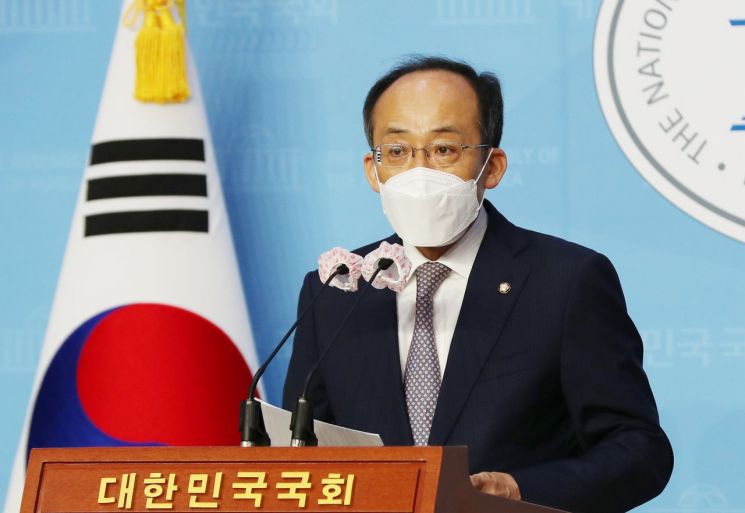
According to the National Assembly on the 30th, Choo Kyung-ho, a member of the People Power Party, submitted a bill to amend the Interest Limitation Act the day before, lowering the maximum interest rate to 20% per annum. Choo explained the background of the proposal, saying, "Since the global financial crisis, accommodative monetary policies have maintained a low-interest-rate trend, causing market lending rates to steadily decline. However, due to the threshold effect of the formal financial sector, low-credit borrowers such as small business owners and low-income citizens pushed to loan sharks and private lenders still suffer from excessive interest burdens."
Choo, a former first vice minister of the Ministry of Economy and Finance and currently the deputy chair of the People Power Party's Policy Committee, is a leading economic expert. Besides Choo, eight other members of the same party, including Jung Jin-seok, Lim Eui-ja, and Seo Byung-soo, as well as Jang Hye-young from the Justice Party, jointly proposed the bill.
Earlier, six members of the Democratic Party had already submitted bills to lower the cap, and the total number of co-sponsors from the same party reaches 50.
Members Kim Nam-guk and Moon Jin-seok proposed the most radical plan, capping the maximum interest rate at no more than 10%. Both cited the severe economic recession caused by the novel coronavirus disease (COVID-19) as one of the reasons for their proposal.
Member Song Gap-seok proposed 22.5%, while Members Park Hong-geun and Kim Cheol-min suggested 20%, similar to Choo's proposal. The current law exempts principal amounts under 100,000 won from the maximum interest rate, but Member Seo Young-kyo has also proposed a bill to delete this clause. Seo explained, "Recently, high-interest loan businesses have been rampant, lending amounts under 100,000 won to economically vulnerable groups such as the elderly and youth under the pretext of 'proxy deposits,' charging interest rates exceeding 1000%."
The government also supports lowering the current maximum interest rate. On the 23rd, during a comprehensive audit by the National Assembly's Planning and Finance Committee, Deputy Prime Minister and Minister of Economy and Finance Hong Nam-ki responded to Choo's related question by saying, "I think 24% is high. It needs to be lowered." Hong added, "We are reviewing this because vulnerable groups relying on that interest rate band might be pushed outside the formal financial system and exposed to even higher underground interest rates if things go wrong," and "The issue of lowering the maximum interest rate has been under consideration for some time."
Heo Byung-jo, a senior expert of the National Assembly's Legislation and Judiciary Committee, stated in a review report on a bill proposed by Member Kim Cheol-min in July, "The Ministry of Justice agrees with the intention to reduce the maximum interest rate to alleviate the high-interest burden on economically vulnerable groups. However, considering the economic situation, it is preferable to allow flexible adjustments through enforcement ordinances rather than directly lowering the cap in the law."
Additionally, the Financial Services Commission reportedly stated, "Considering the recent low-interest-rate trend, we agree on the necessity to lower the maximum interest rate. However, to avoid side effects that could restrict low-credit borrowers' access to funds, it is necessary to comprehensively consider trends in the demand for funds among ordinary citizens, the business conditions of high-interest financial sectors, and the supply status of policy-based financial services for low-credit borrowers when deciding the timing and method of reduction."
© The Asia Business Daily(www.asiae.co.kr). All rights reserved.

















