National Archives Opens Late Joseon Dynasty 'Gwansanggam Cheonghyangryeok Gojun Deungnok' to the Public
[Asia Economy Reporter Jo In-kyung] A record believed to have been created by the Joseon Dynasty's late-period national astronomical institution, the 'Gwansanggam (觀象監),' has been restored after 200 years.
The National Archives of Korea announced on the 30th that it has restored the 'Gwansanggam Cheonghyangryeok Gojun Deungnok (觀象監淸鄕曆考準謄錄),' which contains an analysis adapted to Korea by comparing the Joseon Dynasty's calendar books (曆書: books recording the months, days, solar terms, and special meteorological changes throughout the year in chronological order) with Chinese calendar books.
The Gwansanggam Cheonghyangryeok Gojun Deungnok is a record that transcribes the Gwansanggam's official reports to the king, called Gwansanggam Gyemok (觀象監啓目), in chronological order, and is known to have been compiled once a year. In 2015, it was discovered in a fragmented state within the wooden frame of a folding screen owned by a private individual during repair and was donated to the Korea Meteorological Administration.
The restored records include 25 entries from a 100-year period between the 14th year of King Jeongjo's reign (1790) and the 27th year of King Gojong's reign (1890), holding significant historical value as materials that reveal Joseon Dynasty astronomy and the activities of the Gwansanggam at that time.
These records contain information on the differences and causes regarding the timing and dates of Chinese calendar books and solar terms, as well as the times of Hapsak (合朔: when the moon is between the sun and the earth forming a straight line), Hyeon (弦: first and last quarter moons), and Mang (望: when the sun, earth, and moon are aligned in order on a straight line). They also include opinions that, in cases of discrepancies with China, Korea's calendar books should be used as the standard.
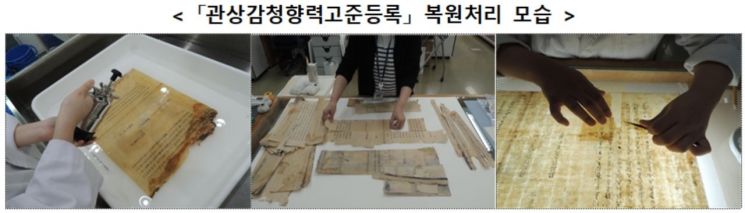
The restoration process, including treatment and replica production, was completed over approximately four months. At the time of application for restoration, the Gwansanggam Cheonghyangryeok Gojun Deungnok was fragmented into dozens of pieces, showing traces of water damage and mold contamination, with many missing parts. The National Archives restoration team carefully matched the fragments to complete 14 intact records, removed contaminants, and restored the original appearance using naturally dyed hanji paper. During this process, five bookbinding holes were discovered on the edges of the records, suggesting that the original was in book form.
The restored Gwansanggam Cheonghyangryeok Gojun Deungnok will be exhibited at the National Meteorological Museum, Korea's first meteorological history museum, opening on the 30th in Jongno-gu, Seoul, and will be available for viewing starting in November.
© The Asia Business Daily(www.asiae.co.kr). All rights reserved.
![User Who Sold Erroneously Deposited Bitcoins to Repay Debt and Fund Entertainment... What Did the Supreme Court Decide in 2021? [Legal Issue Check]](https://cwcontent.asiae.co.kr/asiaresize/183/2026020910431234020_1770601391.png)















