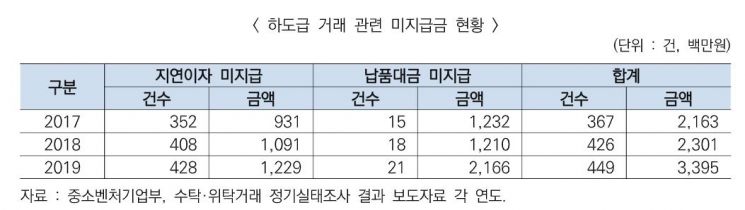
 Status of unpaid amounts related to subcontract transactions. Data provided by the Ministry of SMEs and Startups, Korea Institute for Industrial Economics and Trade
[Asia Economy Reporter Moon Hyewon] Although the proportion of cash payments for subcontracting fees has increased, delays in payment remain unchanged.
According to the 'Overseas SME Policy Trends' published on the 30th by the Small and Medium Business Institute (hereinafter referred to as SMBI), the proportion of cash payments among South Korea's subcontracting payment methods (cash, promissory notes, accounts receivable secured loans, etc.) was 65.6% as of last year. This represents an increase of 17.7 percentage points compared to 2014.
Over the past three years, both delayed interest related to subcontracting transactions and the number and amount of unpaid delivery payments have increased. According to the Ministry of SMEs and Startups' 'Regular Survey on Consignment Transactions,' as of 2019, unpaid delayed interest amounted to 1.229 billion KRW with 428 cases. During the same period, unpaid delivery payments amounted to 2.166 billion KRW with 21 cases.
Under the current Subcontracting Transactions Fairness Act (Subcontracting Act), measures for delayed payments include ▲ delay supervision (Fair Trade Commission's corrective orders to the primary contractor for violations) ▲ information disclosure (disclosure on the Fair Trade Commission website for one year) ▲ administrative sanctions (suspension of illegal acts by the primary contractor, imposition of fines, etc.).
SMBI proposed strengthening standards such as shortening payment deadlines and increasing overdue interest rates. For example, the payment period would be shortened from the current 60 days to within 30 days, and the overdue interest rate would be increased from the current 15.5% per annum to over 20% per annum.
They also suggested enhancing the role of the payment adjustment organization and strengthening the 'Sangsaeng Payment (a system where the primary contractor's payment is guaranteed by a bank)' system to create a smooth payment environment. To improve understanding of the field conditions of SMEs, education or consulting services on related laws were also proposed as measures.
There was also a call to improve payment transaction practices for domestic 2nd and 3rd tier subcontractors. According to SMBI, since 2nd and 3rd tier subcontractors are more likely to experience unfair trade practices, efforts to prevent and eradicate unfair acts from the perspective of the entire subcontracting transaction ecosystem are required. No Minseon, head of SMBI's Future Strategy Research Group, said, "Currently, the Subcontracting Act does not clearly define the obligations between the primary contractor and 2nd and 3rd tier subcontractors," adding, "It is necessary to establish a virtuous cycle payment plan for coexistence between the primary contractor and 2nd and 3rd tier subcontractors."
© The Asia Business Daily(www.asiae.co.kr). All rights reserved.
![User Who Sold Erroneously Deposited Bitcoins to Repay Debt and Fund Entertainment... What Did the Supreme Court Decide in 2021? [Legal Issue Check]](https://cwcontent.asiae.co.kr/asiaresize/183/2026020910431234020_1770601391.png)
















