[Agency for Defense Development]Many advanced military countries such as the United States, China, Russia, and Israel are accelerating the development of cyber weapon systems and core technologies in preparation for future cyber warfare.
Recently, North Korea's cyber threat activities have been reported daily, with over 6,000 elite personnel operating worldwide centered around North Korea's cyber warfare leadership (Bureau 121). Cyber attacks are widely known to lead not only to financial extortion but also to information acquisition and system paralysis/destruction. As we enter the era of the Fourth Industrial Revolution and a hyper-connected society, the power of cyber warfare is expected to become even more immense.
Since the 2016 defense network hacking incident, no significant events have occurred, so North Korea's cyber attacks may be perceived as inactive threat activities; however, daily intrusion incidents into our public institutions, financial sector, and defense are still being recorded. The continuous cyber threats and the sophistication of threat technologies demand relentless technological competition between offense and defense, and complacency in preparedness inevitably leads to defeat in cyber warfare.
▲ Military preparedness against cyber threats = To deter cyber attacks, the defense shield must be continuously strengthened to prevent vulnerabilities from easily being exposed. Real-time situational awareness and proper response capabilities must be established to minimize damage from enemy activities that have penetrated internally. Making it difficult for enemy attacks to succeed and costly to execute is essential to suppress enemy attack activities.
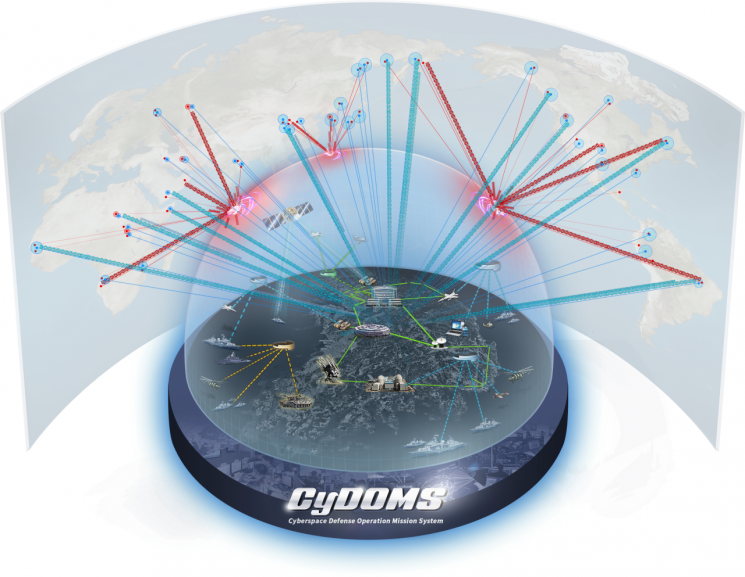
To systematize this, a strategy is needed to meticulously detect and integrate the enemy's infiltration stages and systematically conduct counter-operations. Response activities should be supported and executed by automated systems, and related organizations must establish a system to cooperate in real time for response, continuously improving and advancing the system's performance.
▲ What are the trends in core cyber technology development? = The Agency for Defense Development is focusing on four major core cyber technology developments to lead future cyber warfare technology fields. These include command decision automation technology through cyber situational awareness, cyber training system construction technology for cyber warfare effect analysis and training support, security enhancement and verification technology throughout all stages of weapon system acquisition, and cyber detection and response technology for inference, tracking, and tolerance against enemy cyber attacks.
In particular, command decision automation technology is a core technology for cyber warfare command and control, which closely monitors enemy activities to recognize situations in real time to prevent damage to our assets. This technology integrates big data-based machine learning for detecting and tracking anomalies, summarization analysis technology that organizes numerous alarms, and visualization technology that enhances situational awareness of analysts and commanders by visualizing the invisible cyberspace in 3D.
The cyber battlefield management system will be utilized as the basic framework for conducting cyber operations. The development of this system is planned to be carried out jointly with the Joint Chiefs of Staff, Cyber Operations Command, and other required forces based on the core technology research results of the Agency for Defense Development.
Additionally, the Agency for Defense Development is striving to secure world-class cyber warfare technology through cooperation with U.S. research institutes possessing cutting-edge technology. It participated for the first time domestically in the U.S. Defense Advanced Research Projects Agency (DARPA) project, gaining experience in technologies to protect and recover power grids from cyber threats. It is also jointly researching Cyber BlackBox technology with the U.S. Air Force Research Laboratory, which monitors cyber attacks and recovers damage in weapon system environments. This research prepares for the spread of future IoT-based unmanned weapon systems.
Through various efforts, the Agency for Defense Development is playing a leading role in developing defense cyber warfare technology and is doing its best to ensure national cyber security by cooperating with public and private cyber protection agencies.
© The Asia Business Daily(www.asiae.co.kr). All rights reserved.

















