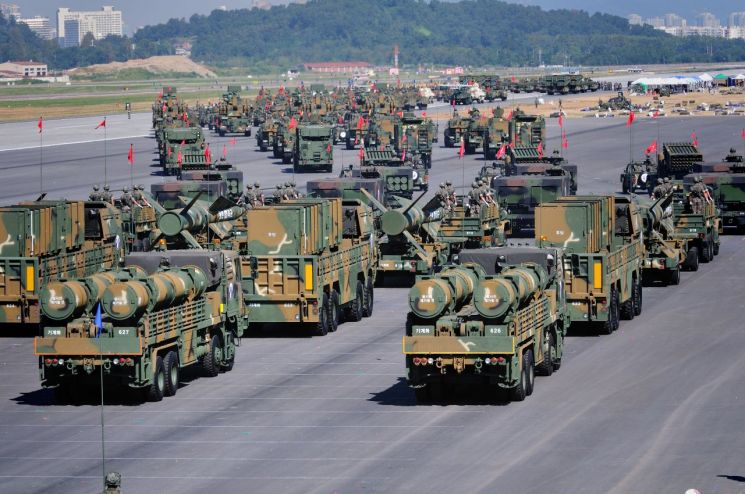
 The 65th Armed Forces Day event in 2013 was held at Seongnam Seoul Airport, showcasing state-of-the-art equipment. (Photo by Kim Namho)
[Kim Min-wook, Editor-in-Chief of Monthly Defense and Technology] The ‘2013-2017 Defense Industry Promotion Basic Plan’ outlined the future vision of our defense industry. In 2012, the Defense Acquisition Program Administration (DAPA) drafted the ‘2013-2017 Defense Industry Promotion Basic Plan,’ presenting the vision of “leaping forward to an advanced defense industry with international competitiveness.” The policy goals to achieve this were set as fostering 10 world-class defense companies and entering the advanced G8 (Group of Eight) in defense science and technology levels.
The four major policy directions by sector were: first, promoting competition in the domestic defense market; second, strengthening the core competencies of defense companies; third, stabilizing the quality of defense products; and fourth, expanding entry into the international defense market. To implement these, 12 key tasks were selected, including improving the defense material designation system, enhancing the defense cost system, expanding the commercialization of defense standards, activating defense information disclosure, fostering specialized defense companies and balanced development between large and small-medium enterprises, establishing a civilian-led defense research and development (R&D) system, building a total life cycle quality management system, promoting core technology and parts development, and developing country-specific tailored export strategies and market-leading weapon systems.
▲ Formation of the ‘Joint Investigation Team for Defense Project Corruption’ and Enhancing Transparency in the Defense Industry= Issues of transparency in defense projects began to surface prominently after the special audit of the Yulgok Project in 1993. Major incidents related to transparency included the 1993 artillery shell procurement fraud case and the 1998 Linda Kim case. During the Roh Moo-hyun administration, the Defense Acquisition Program Administration was established in December 2003 following a military supply corruption scandal.
The Lee Myung-bak administration strengthened verification of defense costs and sanctions against fraudulent companies due to negative perceptions of defense projects, with several prosecutorial investigations into cost inflation.
Under the Park Geun-hye administration, in 2013, the Defense Technology Quality Institute uncovered numerous companies falsifying test certificates for parts and reported them to the prosecution. In 2014, allegations arose regarding the purchase of sonar (acoustic detectors) for the Tongyeong-class (surface structure ship) at inflated prices from overseas companies, leading to the arrest of a retired officer on bribery charges and the coining of the term ‘Gunpia,’ referring to the network of retired and active officers with close ties.
Additionally, defects in domestically developed weapon systems such as the K2 tank (Black Panther) power-pack, K21 infantry fighting vehicle, and K11 hybrid rifle were frequently reported in the media, increasing distrust in the defense industry. Consequently, in November 2014, the government formed a large-scale ‘Joint Investigation Team for Defense Project Corruption’ to begin investigations.
Common transparency issues in defense projects include leaks of classified information, cost inflation and document falsification, unfair company selection, overpriced purchases, poor quality or defective equipment, monopoly abuses, and lobbying suspicions. Causes of these issues include excessive information blocking, limited opportunities for project participation, closed decision-making systems, inadequate data verification, and subjective evaluations. To enhance transparency in defense projects, principles of openness, competition, verification, objectivity, and oversight must be established, supported by expertise.
The government has continuously worked to secure transparency in defense projects. To expand information disclosure, after the 1994 Yulgok audit, the defense project budget shifted from a lump-sum budget system to a detailed itemized statement system. In 1999, the Ministry of National Defense’s Acquisition Office established a policy to expand information disclosure on defense projects and prepared a separate viewable version of the mid-term defense plan for companies. Subsequently, the Joint Chiefs of Staff also prepared viewable versions of joint weapon system planning documents.
To expand openness and competition, since 2006, civilian members have been included in the Defense Project Promotion Committee, and academic and field personnel have participated as evaluators of company selection proposals. From 2009, the specialization and affiliation system was abolished to establish an open and competitive system. In 2012, the expansion of multiple designations for defense materials and companies was promoted, and a multiple-company R&D system was activated. To strengthen verification functions, the DAPA Cost Accounting Verification Team was established in 2011, and the defense cost management system certification was introduced in 2012.
To ensure objectivity, competitive bidding was introduced for company selection in 1997, and the lowest cost meeting conditions method was adopted in 1999. From the KHP (Surion) project, techniques such as AHP (Analytic Hierarchy Process) were used to supplement the problems of subjective comprehensive evaluation methods. Under the DAPA system, various scientific project management techniques such as EVMS (Earned Value Management System) and CAIV (Cost As an Independent Variable) have been utilized.
The oversight system is sufficiently secured. Defense projects undergo annual National Assembly audits. The Board of Audit and Inspection has established a Defense Project Audit Team conducting ongoing audits. Numerous oversight bodies, including the Ministry of National Defense and DAPA audit offices, ombudsmen, the Defense Security Command (now Military Security Support Command), military investigative agencies, prosecutors, and the media, monitor defense projects. Despite these efforts, transparency issues have not been completely eliminated. Transparency sometimes conflicts with efficiency and expertise, so excessive emphasis on transparency alone is not feasible; a balance must be struck, which is challenging.
However, media reports often label corruption related to foreign procurement projects involving arms brokers as ‘defense industry corruption.’ Moreover, performance shortfalls or defects in domestic equipment tend to be perceived as corruption. While performance shortfalls and equipment defects can raise suspicions of corruption, they often result from trial and error during development, lack of technical capability, or insufficient expertise in project and quality management rather than actual corruption.
Even the U.S. F-35 fighter jet, considered the most advanced, experienced engine fires during initial production, and the UH-60 helicopter took five years after deployment to resolve system icing issues.
Following the trend toward high-performance, high-precision, multifunctional complex systems in modern weaponry, major advanced countries apply evolutionary acquisition strategies under long-term plans before starting weapon system development and continuously incorporate the latest technologies post-development to pursue technological superiority.
▲ Autonomous Restructuring of Defense Companies= In 2014, Hanwha Corporation acquired Samsung Techwin and Samsung Thales, marking a new change with autonomous restructuring in the defense industry, significantly altering the competitive landscape and company scale.
“Let’s grow it into Korea’s Lockheed Martin.” On November 27, 2014, Hanwha Group Chairman Kim Seung-yeon said this first to major affiliate presidents after acquiring defense companies Samsung Techwin (now ‘Hanwha Aerospace’) and Samsung Thales (now ‘Hanwha Systems’) from Samsung Group the previous day. The deal was a major transaction worth 840 billion KRW.
Hanwha Group’s defense business growth has been steady, with Hanwha Aerospace overseeing aviation and defense businesses, Hanwha Defense focusing on ground defense power and unmanned systems, and Hanwha Systems investing capabilities in communications and radar businesses, each responsible for the Air Force, Army, and Navy respectively, creating synergy effects.
According to the defense industry on January 21, 2020, the combined sales of Hanwha Group’s defense affiliates?Hanwha Corporation, Hanwha Aerospace, Hanwha Defense, and Hanwha Systems?were expected to surpass 5 trillion KRW in 2019, a 178% increase from 1.8 trillion KRW five years earlier. Consequently, Hanwha Group’s global defense industry ranking soared. In the ‘Global Defense Companies TOP 100’ compiled by the U.S. military magazine Defense News, Hanwha Group jumped into the top 20 last year. Such rapid advancement from outside the top 50 five years ago is rare.
Hanwha Group aims to increase sales to 14 trillion KRW by 2030 and is striving to enter the global top 10. If ongoing projects in India and Australia for the ‘Biho Complex’ air defense system and the ‘Redback’ armored vehicle succeed, these two projects combined will secure orders worth 8 trillion KRW, becoming key to Hanwha Group’s defense sales and global rise.
© The Asia Business Daily(www.asiae.co.kr). All rights reserved.
![User Who Sold Erroneously Deposited Bitcoins to Repay Debt and Fund Entertainment... What Did the Supreme Court Decide in 2021? [Legal Issue Check]](https://cwcontent.asiae.co.kr/asiaresize/183/2026020910431234020_1770601391.png)
















