First Director-General Level Talks Since Prime Minister Suga Yoshihide's Inauguration... No Notable Progress
Differences Remain on Issues Like Forced Labor and Export Controls
South Korea Emphasizes "Japan Must Show More Sincere Attitude to Resolve Forced Labor Issue"
Takizaki, Director-General of Japan's Foreign Ministry, Also Meets Lee Do-hoon, Head of Korean Peninsula Headquarters, to Discuss 'Korean Peninsula Peace Cooperation'
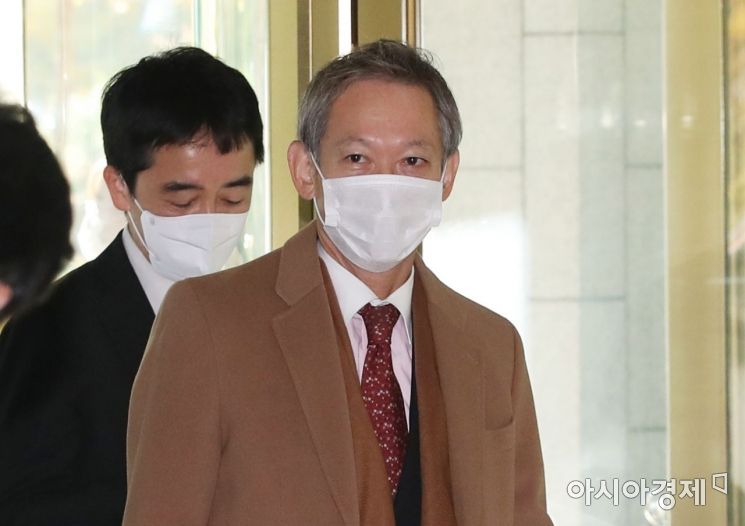 Takizaki Kigeki, Director-General for Asia and Oceania at the Japanese Ministry of Foreign Affairs, is entering the Ministry of Foreign Affairs building in Jongno-gu, Seoul on the 29th to attend the Korea-Japan diplomatic director-general level talks. Photo by Kang Jin-hyung aymsdream@
[Asia Economy Reporter Lim Cheol-young] After eight months, diplomatic officials from Korea and Japan held face-to-face talks in Korea, but no significant progress was made on current issues such as the forced labor during Japanese colonial rule and export restrictions. However, it is reported that during this face-to-face meeting, the Japanese side showed a willingness to resolve the conflicts, unlike during Prime Minister Shinzo Abe's administration.
Kim Jeong-han, Director of the Asia-Pacific Bureau at the Ministry of Foreign Affairs, held a Korea-Japan director-level meeting with Takizaki Shigeki, Director of the Asia and Oceania Bureau at Japan’s Ministry of Foreign Affairs, at the Ministry of Foreign Affairs building in Seoul on the 29th, exchanging opinions on mutual interests for about two hours. This was the first director-level meeting since Prime Minister Yoshihide Suga took office.
Director Kim reiterated the Korean government’s position on the forced labor issue during Japanese colonial rule, emphasizing the need for the Japanese government and the defendant companies to show a more sincere attitude toward resolving the problem, and urged the Japanese government to promptly withdraw the unfair export restrictions. Director Takizaki explained the position that the Japanese government has maintained so far.
A Ministry of Foreign Affairs official explained, "Director Kim stated that Japan needs to actively respond to hold the Korea-Japan-China trilateral summit within this year, and Director Takizaki conveyed Japan’s position on this." The Japanese government has consistently taken the stance that the Korean government should first present a solution to the forced labor compensation ruling issue, indirectly indicating that without a resolution to the forced labor issue, it would be difficult for Prime Minister Suga to participate in the trilateral summit.
The official added, "However, there is a consensus that the issue should be resolved through dialogue," and "the willingness to resolve the issue is higher than in the past."
The issue of contaminated water from the Fukushima nuclear power plant was also brought to the discussion table. Director Kim emphasized Korea’s serious recognition and grave concerns regarding the Fukushima nuclear contaminated water issue, and Director Takizaki explained the Japanese government’s position. The Ministry of Foreign Affairs official stated, "Both directors agreed on the importance of continued communication and consultations between the two sides to resolve bilateral issues and decided to continue diplomatic consultations."
Takizaki, who also serves as Japan’s chief representative for North Korea nuclear issues, met with Lee Do-hoon, Director-General for Korean Peninsula Peace and Security Affairs at the Ministry of Foreign Affairs, before the director-level talks to hold Korea-Japan chief-level talks on North Korea nuclear issues.
During the talks, both sides exchanged views on ways to cooperate between Korea and Japan and among Korea, the U.S., and Japan to manage the current situation stably and to make progress toward the complete denuclearization of the Korean Peninsula and the establishment of lasting peace. In particular, they shared the recognition that key regional countries, including Japan, support the prompt resumption of dialogue and continuous cooperation. Both sides agreed to maintain close communication and cooperation on North Korea nuclear and related issues going forward.
© The Asia Business Daily(www.asiae.co.kr). All rights reserved.

















