Intensifying Jeonse Crisis After Enforcement of Lease Laws 2
Government Blames 'Household Fragmentation, Low Interest Rates, Previous Administration'
Experts Say "Ignoring Root Causes of Market Chaos, Only Fueling Anger with Forced Excuses"
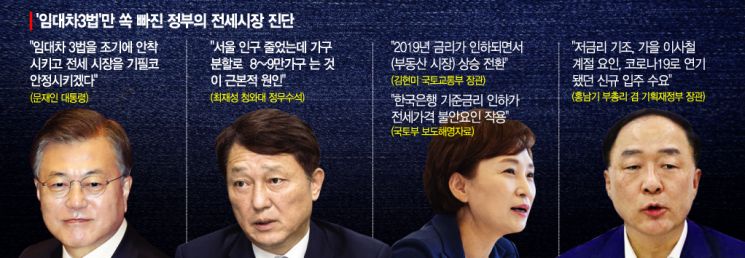
[Asia Economy Reporters Inho Yoo and Chunhee Lee] Disappointment and anger are spreading in the market over the government's unrealistic diagnosis and solutions for the Jeonse and monthly rent market. Despite the rental market crisis caused by the two rental laws?the contract renewal request system and the rent ceiling system?forcefully introduced by the government and ruling party, the government is citing completely different causes such as "low interest rates," "household fragmentation due to population decline," and "blaming the previous administration." Meanwhile, it only repeats calls for the "smooth implementation" of the two rental laws, which are the direct cause of the crisis, thereby amplifying market dissatisfaction. The government is even being criticized for evading responsibility through evasive rhetoric.
Blue House: "The cause of the Jeonse crisis is household fragmentation," "Rising housing prices are the fault of the Park Geun-hye administration"
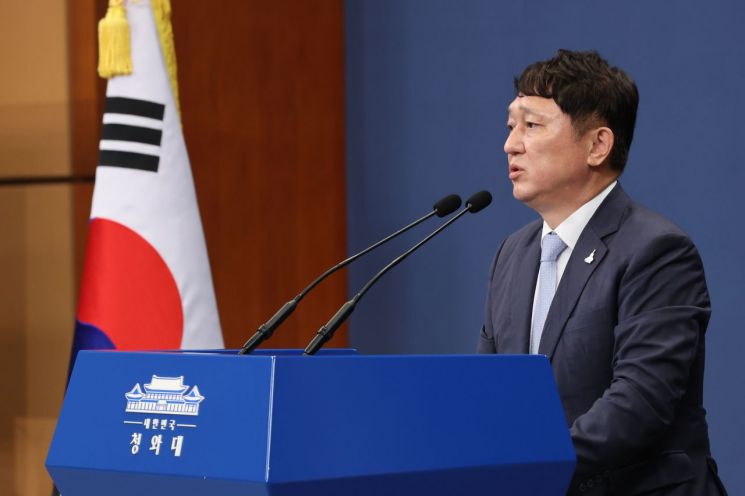
On the 29th, statements by Choi Jae-sung, Senior Secretary for Political Affairs at the Blue House, have come under fire in frontline real estate brokerage circles and online communities. This came on the same day that President Moon Jae-in failed to present a sharp solution to the Jeonse and monthly rent market in his policy speech, when Choi mentioned "household fragmentation" as the cause of the Jeonse crisis in an interview with KBS News.
Choi attributed the instability in the Jeonse market to "the strong operation of real estate policies reducing buying demand, which increased the Jeonse market. Although Seoul's population has decreased, the number of households has increased by nearly 90,000," citing both a shortage of supply and household fragmentation as causes of the Jeonse crisis. Regarding the rise in housing prices, Choi stated, "The Park Geun-hye administration implemented real estate stimulus measures, pushing people to 'take out loans to buy houses,' which drove up housing prices."
Online, Choi's remarks have been met with criticism such as "How long will you keep blaming the previous administration?" and "Did you even look around the market before making those comments?" Experts have also criticized these claims as unrealistic and forced. Professor Choi Hwang-soo of Konkuk University's Department of Real Estate said, "The issue of household increase was foreseeable from the past, so bringing it up now is just an excuse to blame external factors and deny responsibility," adding, "Blaming the previous government after three and a half years in power inevitably raises questions about what has been done during that time."
Ministry of Land, Infrastructure and Transport: "Jeonse crisis is due to low interest rates"
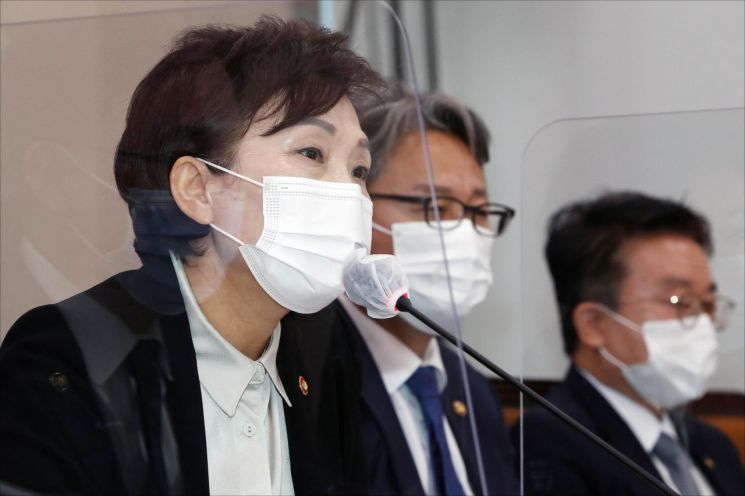 Minister of Land, Infrastructure and Transport Kim Hyun-mi is responding during the comprehensive audit of the Land, Infrastructure and Transport Committee held at the National Assembly in Yeouido, Seoul, on the morning of the 23rd.
 [Photo by Yonhap News]
This perception is repeatedly echoed in recent statements by government officials, who consistently exclude the two rental laws when discussing the causes of the Jeonse and monthly rent crisis.
The Ministry of Land, Infrastructure and Transport, the main responsible agency, stirred controversy by explaining the Jeonse crisis as a result of "low interest rates." On the 19th, the ministry stated in a press release, "The Bank of Korea inevitably lowered the base interest rate to overcome the economic crisis, which has acted as a destabilizing factor for Jeonse prices."
Minister Kim also said at the comprehensive national audit on the 23rd, "After the September 13 real estate measures, interest rates were stable and declining in early 2019, but as rates were lowered mid-year, the trend reversed to an upward phase."
Deputy Prime Minister and Minister of Economy and Finance Hong Nam-ki also, on the 28th at the 'Real Estate Market Inspection Meeting of Related Ministers,' cited "low interest rates," "seasonal moving factors," and "delayed new housing demand due to COVID-19" as reasons for the Jeonse crisis without mentioning the two rental laws, drawing public criticism for being out of touch with the market.
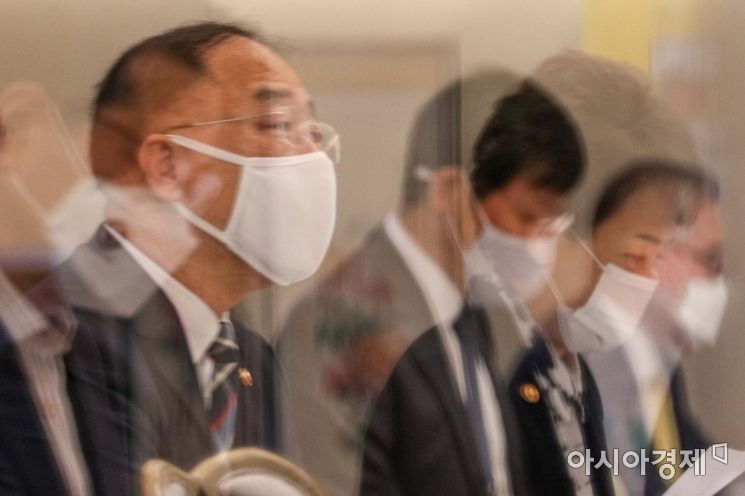 Hong Nam-ki, Deputy Prime Minister and Minister of Economy and Finance, is delivering opening remarks at the '9th Real Estate Market Inspection Ministers' Meeting' held on the 28th at the Government Seoul Office in Jongno-gu, Seoul. Photo by Kang Jin-hyung aymsdream@
However, recent market prices and listings show that the Jeonse market began to deteriorate sharply around late July when the two rental laws were implemented. According to the weekly apartment price trends by the Korea Real Estate Board as of the 12th, Seoul apartment Jeonse prices rose 0.08% from the previous week, continuing an upward trend for 68 consecutive weeks and marking the largest increase in nine years.
The situation with listings is even more severe. In Seohyeon-dong, Bundang New Town, Gyeonggi Province, for an 84㎡ (exclusive area) apartment, the recently reported actual transaction price is 650 million KRW, but no listings are available on the market below 850 million KRW. Frontline brokerage offices explain that the reported transactions were contracts signed some time ago and thus represent past figures.
In major areas of Seoul, there are large complexes with thousands of households where no Jeonse listings are available at all. For example, in Hwagok-dong, Gangseo-gu, the 'Hwagok Prugio' complex has 2,176 households but not a single Jeonse listing was found.
Experts: "The government's attitude is the problem"… "They should honestly admit what cannot be done"

The market is increasingly criticizing the government for seeking the cause of policy failure elsewhere. Seo Jin-hyung, President of the Korea Real Estate Society and professor at Gyeongin Women's University, said, "While it is true that liquidity abundance due to low interest rates had an impact, ultimately the two rental laws acted as a catalyst," adding, "If the market were stable as the government claims, then why introduce such policies?"
Professor Kwon Dae-jung of Myongji University also pointed out, "The two rental laws reduced Jeonse transactions, and the abolition of the registered rental business system greatly affected supply shortages," and criticized the government's attitude as political intervention aimed at reassuring public opinion despite knowing there are problems.
Experts warn that the current situation may not be a simple transitional phase following the implementation of the two rental laws but could become a structural problem. Therefore, they argue that the only solution is for the government to acknowledge policy failure and repeal the laws. Professor Choi said, "Rather than just blaming the previous administration or the market, the right approach is to honestly admit what cannot be done based on a clear understanding of reality and seek public consent."
Yoon Ji-hae, a researcher at Real Estate 114, said, "There is no clear alternative," and suggested, "Since expanding supply will not have immediate effects, a policy shift is needed to provide benefits to landlords rather than tenants to stabilize the Jeonse market."
© The Asia Business Daily(www.asiae.co.kr). All rights reserved.



















