US Presidential Election, COVID-19, and Capital Gains Tax Impact
Significant Decline in Upward Momentum Since March
Weakness for Three Consecutive Years Since 2018
Expectations for Rise Early Next Year Remain Valid
[Asia Economy Reporter Oh Ju-yeon] Will the stock market turn bullish after spending the 'last night of October'? Over the past three years, the domestic stock market has shown weakness every October. Although there is a tendency to reduce stock holdings ahead of the year-end each year, this year the upward momentum since March has significantly weakened due to the November U.S. presidential election, the resurgence of COVID-19, and the tightening of major shareholder capital gains tax criteria. However, there is an assessment that next year’s stock market is expected to be strong due to economic recovery and corporate earnings improvement, and this downturn should be seen as an opportunity. Although volatility may persist until the year-end around the U.S. presidential election, the expectation of a rise in early next year remains valid.
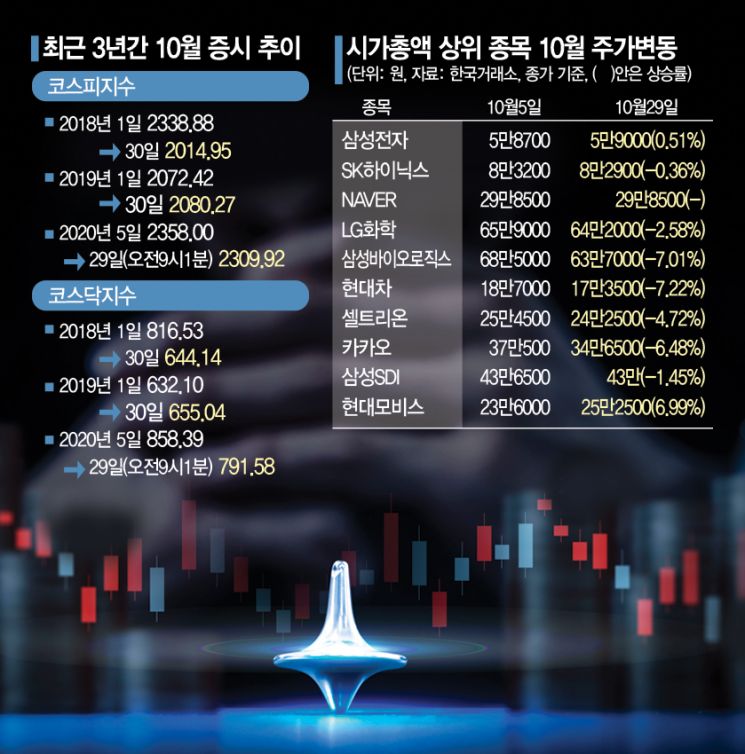
According to the Korea Exchange on the 29th, the KOSPI index has shown poor performance in October for the past three years since the crash in October 2018. In 2018, when the U.S.-China trade conflict escalated, the domestic stock market stagnated in July and August, then plunged in October as the KOSPI dropped by 323.93 points. On October 1, 2018, the KOSPI was at 2338.88 but fell to 2014.95 by the 30th, a 13.85% decline. During the day, it even broke below the 1985 level.
Last year, the market rose from the 1970 level in September to the 2100 level but experienced fluctuations, falling to 2020 in early October. It closed at 2080.27 on October 30, up slightly by 7.85 points from 2072.42 on October 1. This year, the market, which had sharply dropped in March due to COVID-19, continued to rise until August but was halted by uncertainties such as the COVID-19 resurgence and the U.S. presidential election. From 2358.00 on the 5th, it dropped 2.11% to 2308.36 as of 9:54 a.m. on the day. Considering that the KOSPI closed at 2403.15 on the 13th, surpassing the 2400 mark, the roughly 100-point drop in half a month feels even more significant.
The decline in the domestic stock market on this day is largely due to the risk-asset aversion caused by the COVID-19 situation in the U.S. and Europe. The U.S. and European stock markets plunged 2-4% the previous day. France and Germany announced economic lockdowns in response to the uncontrollable spread of COVID-19, and in the U.S., the daily average number of confirmed cases exceeded 70,000, increasing by about 20% compared to the previous week, intensifying fear. Experts say that regardless of whether President Donald Trump or Democratic candidate Joe Biden wins the election, if the current COVID-19 situation does not improve, the U.S. may also impose economic lockdowns, and investment sentiment could remain subdued for some time.
Seo Sang-young, head of the investment strategy team at Kiwoom Securities, predicted, "Until the results of the U.S. presidential and congressional elections are decided, volatility in the Korean stock market is inevitable." Lee Kyung-min, head of the investment strategy team at Daishin Securities, also said, "Even if the fundamental changes driving trend shifts are positive, investment sentiment and supply-demand will inevitably be shaken in a noise-amplified period," adding, "A tougher phase may continue until next week."
He emphasized that the volatility expansion phase, which will continue for some time in the long term, could be another opportunity following March. This is because global economic recovery, the base effect on inflation, and increased U.S. fiscal spending are expected around late Q1 to early Q2 next year. Lee said, "With liquidity and policies supporting it, a direction and trend of economic recovery will be established," adding, "Although speed adjustments due to COVID-19 spread are inevitable, economic recovery is expected to continue into next year." He continued, "Currently, the economic recovery trend is valid, but it is a speed adjustment phase," and explained, "Although there may be short-term corrections, this is a chance to increase exposure." Han Dae-hoon, a researcher at SK Securities, said, "Investment sentiment for small and mid-cap stocks is likely to remain weak until year-end, but the stock market is expected to be bullish next year," emphasizing, "Considering the January effect, it is time to consider a phased buying strategy for small and mid-cap stocks with solid growth stories looking toward next year."
© The Asia Business Daily(www.asiae.co.kr). All rights reserved.

















