Bankers Struggling with Personal Loans... Eyeing Other Banks' Loan Products
[Asia Economy Reporter Park Sun-mi] Kim Jin-myung (43, pseudonym), a deputy general manager at a major commercial bank in City A, recently borrowed 35 million KRW through KakaoBank's (K-Bank) credit loan product with an annual interest rate of 2.64% due to urgent financial needs. Although he could have taken out a loan from his own bank, the loan limit was far too low for the amount he needed. In the past, he used loan products from other banks that came to the bank headquarters for sales, but since K-Bank offered a higher limit and lower interest rates, he switched to being a 'K-Bank' customer. Kim said, "Others take out bank loans to invest, but for bank employees, it is actually harder to get loans due to regulations," adding, "Among bank employees, using K-Bank's overdraft credit loan, which can be easily obtained non-face-to-face, is the trend."
Bank employees are borrowing money from internet-only banks due to loan limit regulations. They are supplementing funds insufficient from their own bank loans through relatively low-interest internet-only banks. Inside banks, there are complaints about reverse discrimination due to strict internal control regulations, and strong calls to raise loan limits in line with income and inflation rates since the law was enacted in 1998.
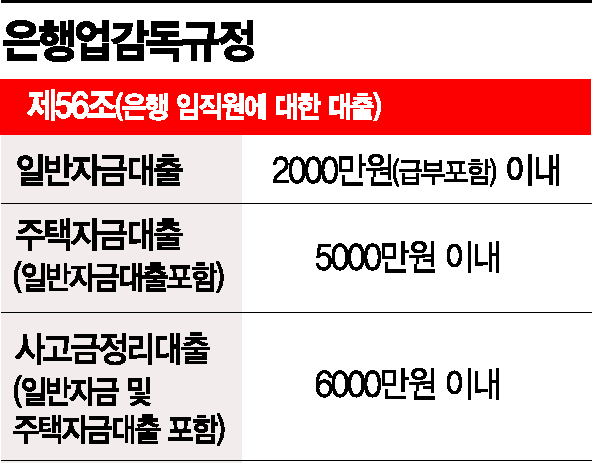
According to the banking sector on the 29th, employees of commercial banks can only borrow up to 20 million KRW within their workplace due to the Banking Supervision Regulations. The Banking Supervision Regulations, under Section 6 Prohibited Business, Article 56 (Loans to Bank Employees), set the limit for general fund loans at 20 million KRW and housing fund loans (including general fund loans) at 50 million KRW.
The notion that it is easy to secure funds because one is a bank employee is now outdated. At one time, banks offered employees credit loans at interest rates in the 1% range with ultra-low interest benefits, but now they receive the same interest rates as general customers and can only borrow up to 20 million KRW due to the Banking Supervision Regulations. This is why employees with million-won annual salaries and top credit ratings of grade 1 still have to look for loan products from other banks if they want to borrow more than 20 million KRW.
Due to the non-face-to-face feature, Hana Bank's Hana OneQ credit loan product is as popular among bank employees as K-Bank. According to the office of Oh Ki-hyung, a member of the Democratic Party, from January to August this year, the credit loan growth rate among financial institution employees was highest at Hana Bank at 32.3% among the five major banks. Hana Bank sets the average interest rate for credit loans for financial institution employees at the 2% range.

"Outdated Reverse Discrimination" VS "Must Be Maintained to Prevent Financial Accidents"
Within the banking sector, there are complaints that limiting credit loans for bank employees to 20 million KRW is outdated reverse discrimination in an era where loans have become commonplace to the extent that new terms like 'Yeongkkeul' (borrowing all available funds) and 'Debt Investment' have emerged. In fact, many bank employees take out credit loans up to the 20 million KRW limit and use loan products from other banks when additional funds are needed.
A senior bank executive said, "There is even talk within the banking sector that K-Bank's main customers are bank employees," pointing out, "Bank employees sell low-interest loan products to customers but ironically cannot subscribe to these products themselves and have to sign loan applications from other banks." Another bank employee said, "The loan regulations for bank employees have not changed since the Banking Supervision Regulations were created during the 1998 IMF financial crisis," adding, "While the intention to prevent financial accidents among employees is understandable, there is a need to improve limits to reflect current realities."
On the other hand, some voices argue that the loan limit restrictions for employees should be maintained to prevent financial accidents. Even if employees receive loans under the same conditions and interest rates as general customers, since loan assessments are conducted by colleagues, the act of borrowing itself could exert implicit pressure and potentially provide an opportunity for financial accidents.
Banks operate welfare programs that support employees with a certain amount of jeonse (key money deposit) funds and participate in contracts for company-leased housing to assist employees facing reverse discrimination in credit loans. However, these programs are also criticized as outdated. Many banks limit the price of contracted jeonse housing to about 150 million KRW in Seoul, which does not adequately reflect the current situation of rapidly rising jeonse prices.
© The Asia Business Daily(www.asiae.co.kr). All rights reserved.
![A Woman Who Jumps Holding a Stolen Dior Bag... The Mind-Shaking, Bizarre Con of a "Human Knockoff" [Slate]](https://cwcontent.asiae.co.kr/asiaresize/183/2026021902243444107_1771435474.jpg)
















