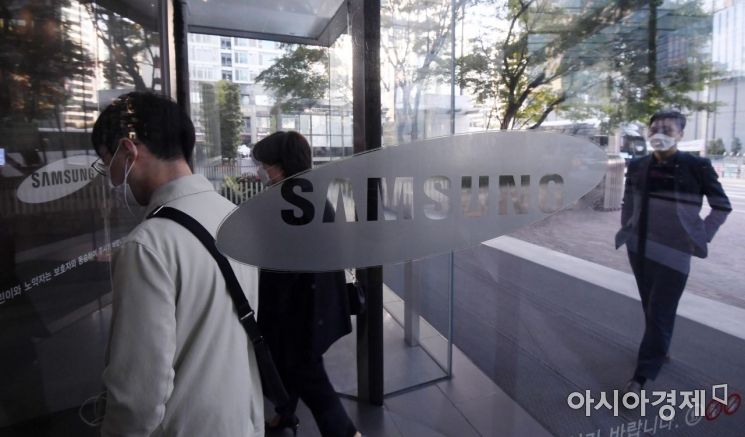
 On the 29th, when Samsung Electronics announced its confirmed third-quarter results, employees were coming and going at the Samsung Electronics building in Seocho-gu, Seoul. Despite the resurgence of COVID-19, Samsung Electronics achieved a record high with third-quarter sales approaching 67 trillion won this year. Operating profit also exceeded 10 trillion won for the first time in two years. The third-quarter operating profit was 12.3533 trillion won, an increase of 58.83% compared to the same period last year. Photo by Kim Hyun-min kimhyun81@
[Asia Economy reporters Changhwan Lee and Jinju Han] Samsung Electronics' surprise third-quarter earnings were largely due to pent-up demand caused by the COVID-19 pandemic, which significantly boosted set businesses such as mobile and home appliances. The company's core semiconductor segment also exceeded expectations thanks to increased mobile demand and expanded sales to Huawei.
◆Smartphone and Semiconductor Earnings at Super Boom Levels
The standout business division in Samsung Electronics' third-quarter results was the IT & Mobile (IM) division, responsible for smartphones. The IM division posted sales of 30.49 trillion KRW and operating profit of 4.45 trillion KRW in Q3. Sales increased by 4.2% year-on-year, while operating profit surged by 52.4%.
Sales of flagship models such as the Galaxy Note20 and Galaxy Z Fold2 rose by 50% compared to the previous quarter, driving the third-quarter performance. Increased sales of wearable products like the Galaxy Tab S7 tablet, Galaxy Watch3, and Galaxy Buds Live also contributed to profit growth.
Kim Kyung-min, a researcher at Hana Financial Investment, explained, "Shipments increased mainly for mid-range models, improving profitability, and the higher volume led to better profit margins compared to before. The expansion of online channel sales also contributed to profitability improvement."
The semiconductor division also delivered better-than-expected results. The semiconductor business posted an operating profit of 5.54 trillion KRW in Q3, up about 82% year-on-year. Sales rose 7% to 18.8 trillion KRW. Although server demand, which had driven performance, weakened, the memory division improved results by actively responding to increased mobile and PC demand due to COVID-19 and expanding sales of solid-state drives (SSD) for new game consoles.
It is also analyzed that increased orders from Huawei had an impact. Huawei reportedly made concentrated purchases of Samsung's semiconductors from late August to early last month, before the U.S. sanctions took full effect. Recently, significant new orders in the foundry (semiconductor contract manufacturing) division have also contributed to defending earnings.
The Consumer Electronics (CE) division, responsible for TVs and home appliances, also saw its third-quarter operating profit improve by 200% to 1.56 trillion KRW from 520 billion KRW in the same period last year. Sales increased 27% from 11 trillion KRW to 14 trillion KRW. Demand for TVs and home appliances surged due to economic stimulus effects in various countries and a rebound consumption effect centered on major countries in Q3.
TV sales sharply increased due to active responses to replacement demand and premium product marketing such as QLED and large-sized TVs tailored to recent consumer trends. Home appliance sales grew significantly with premium products like the Bespoke refrigerator and Grande AI. Interest in hygiene appliances rose amid the COVID-19 pandemic, boosting sales of dryers and Air Dressers, contributing to improved performance.
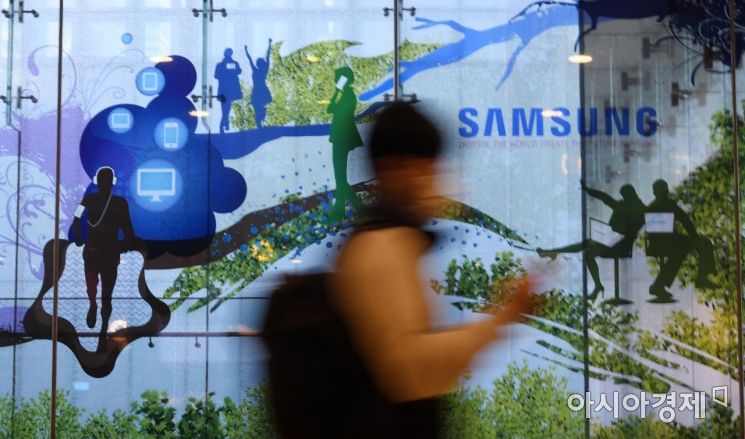 On the 29th, when Samsung Electronics announced its confirmed third-quarter earnings, citizens were passing by in front of the Samsung Electronics PR Center in Seocho-gu, Seoul. Despite the resurgence of the novel coronavirus disease (COVID-19), Samsung Electronics achieved a record high with third-quarter sales approaching 67 trillion won this year. Operating profit also exceeded 10 trillion won for the first time in two years. The third-quarter operating profit was 12.3533 trillion won, an increase of 58.83% compared to the same period last year. Photo by Kim Hyun-min kimhyun81@
Q4: Variables of COVID-19 Resurgence and U.S.-China Trade Disputes
However, earnings are expected to face adjustments starting in the fourth quarter, mainly due to a slowdown centered on semiconductors. Since the U.S. sanctions on Huawei took full effect after the 15th of last month, semiconductor supply to Huawei, one of Samsung's top five customers, has been halted, and a price decline for server DRAM is inevitable through Q4.
A Samsung Electronics official stated, "In Q4, overall profitability is expected to decline due to continued weak demand for server memory and intensified competition in the set business. Especially in semiconductors, profitability may decrease due to weak server prices caused by customer inventory adjustments and initial costs for new production lines."
Concerns are also growing over the rapidly deteriorating global economic situation as COVID-19 resurges mainly in Europe and the U.S., leading to economic lockdowns. Market lockdowns could worsen demand again for sets such as mobile and home appliances. Marketing expenses for set products like mobile devices are also expected to increase in Q4 due to new product launches by competitors such as Apple.
Lee Seung-woo, a researcher at Eugene Investment & Securities, said, "In Q4, profits are expected to slow compared to Q3 due to the won-dollar exchange rate decline, reduced semiconductor sales to Huawei, and a correction process following the sharp increase in set shipments in Q3."
© The Asia Business Daily(www.asiae.co.kr). All rights reserved.
!["I'd Rather Live as a Glamorous Fake Than as a Poor Real Me"...A Grotesque Success Story Shaking the Korean Psyche [Slate]](https://cwcontent.asiae.co.kr/asiaresize/183/2026021902243444107_1771435474.jpg)

















