US Senate Commerce Committee Virtual Hearing... Debate Over Content Posting Immunity
CNBC "Political Deadlock Maintains Communications Decency Act... Only Big Tech 3 Benefit"
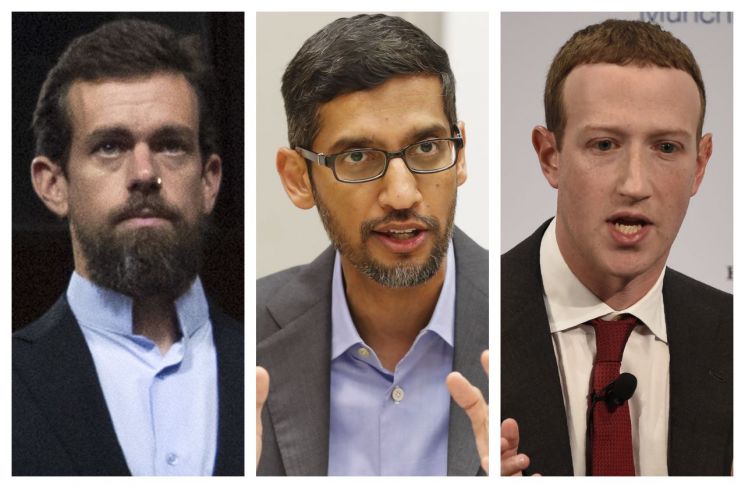 ▲(From left) Jack Dorsey, Twitter CEO; Sundar Pichai, Google CEO; Mark Zuckerberg, Facebook CEO [Image source=AP News]
[Asia Economy Reporter Kwon Jae-hee] CEOs of Google, Facebook, and Twitter appeared before the U.S. Congress hearing and unanimously stated that the immunity privileges of online platform (SNS) companies should be maintained. The Republican and Democratic parties ended the session without any progress, confirming only their opposing positions.
According to the Wall Street Journal (WSJ) on the 28th (local time), the U.S. Senate Commerce Committee held a virtual hearing on the amendment of Section 230 of the Communications Decency Act, summoning Mark Zuckerberg, CEO of Facebook, Sundar Pichai, CEO of Google, and Jack Dorsey, CEO of Twitter, as witnesses.
Enacted in 1996, Section 230 of the Communications Decency Act grants broad immunity privileges to online platform companies from legal liability for user-generated content. Accordingly, SNS companies have autonomously regulated content deemed harmful or inappropriate based on this provision.
In response, the Republican Party is pushing for amendments to Section 230, arguing that internet platforms are abusing it to censor conservative views.
Roger Wicker, Republican Senator from Mississippi and chairman of the committee, stated, "The immunity privilege has allowed SNS companies to control, suppress, and censor content in their own way," adding, "Now is the time to end that privilege."
Ted Cruz, Republican Senator from Texas, said, "Who exactly gave SNS companies the role of news media?"
Conversely, the Democratic Party agrees on the need to reduce the immunity privileges granted to platform companies but opposed holding a hearing with private company CEOs ahead of the November 3 presidential election, arguing that it is tantamount to pressuring companies to assist in election campaigns.
Brian Schatz, Democratic Senator from Hawaii, criticized, "The Republicans are harassing private company CEOs to help a presidential candidate."
John Tester, Democratic Senator from Montana, also claimed, "The order to hold this hearing came directly from the White House."
The IT company CEOs who appeared that day refuted that content regulation rules constitute censorship and denied supporting any particular party.
Jack Dorsey, CEO of Twitter, acknowledged the concerns but argued, "Twitter does not support any particular party (Democratic Party)."
Dorsey further explained, "Twitter has policies to limit manipulated posts and certain types of misinformation, especially regarding public health including COVID-19," adding, "The controversial tweets by President Trump were related to mail-in voting and COVID-19."
Mark Zuckerberg, CEO of Facebook, also stated, "I believe the law should work properly as intended by Congress," adding, "But before that, Facebook needs to take responsible steps to make people feel more legitimate."
Sundar Pichai, CEO of Google, said regarding content regulation, "We operate without political bias," adding, "Otherwise, it would contradict both our business interests and mission." He also warned that amendments to Section 230 could lead to unintended consequences for users.
CNBC pointed out, "During the lengthy hearing, issues such as privacy protection or IT companies' influence on local media were barely mentioned," concluding, "Ultimately, the political deadlock over the amendment of Section 230 has, for now, maintained the status quo, benefiting IT companies."
© The Asia Business Daily(www.asiae.co.kr). All rights reserved.
![Clutching a Stolen Dior Bag, Saying "I Hate Being Poor but Real"... The Grotesque Con of a "Human Knockoff" [Slate]](https://cwcontent.asiae.co.kr/asiaresize/183/2026021902243444107_1771435474.jpg)
















