"High Shipping Rates to Persist for the Time Being"
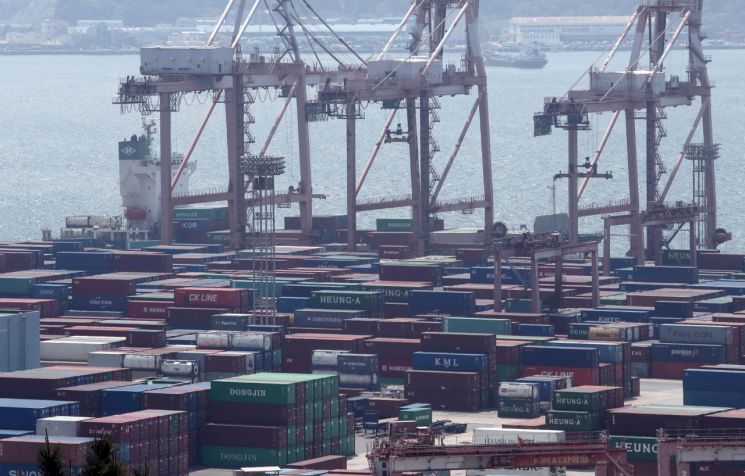
[Asia Economy Reporter Yu Je-hoon] Due to the impact of the novel coronavirus infection (COVID-19) crisis, air and sea freight rates, which are responsible for our export routes, are soaring to gold prices. The aviation and shipping industries, which were on the brink of survival due to COVID-19, are catching their breath, but the difficulties of export companies relying on them are also increasing.
According to the TAC Air Freight Index announced in Hong Kong on the 29th, as of the 26th, the air cargo freight rate on the North America-Asia route was recorded at $6.21 per kg. This is about 80% higher than the freight rate for the same period last year ($3.42 per kg). The recent surge in air cargo rates, which had been stagnant, is interpreted as due to the arrival of the seasonal peak in the fourth quarter. Generally, the fourth quarter is classified as a peak season with concentrated demand during year-end events such as Black Friday and Christmas.
The ongoing supply shortage caused by the suspension of large-scale international flights is driving this sharp increase in freight rates. According to the International Air Transport Association (IATA), as of August, belly cargo supply decreased by 67.0% compared to the previous year. Although this is an improvement from the previous month (70.5%), the supply-demand imbalance remains.
Sea freight rates, which handle 99% of domestic export routes, are also continuing their high-altitude march. The Shanghai Containerized Freight Index (SCFI) recorded 1469.03 as of the 23rd, up 20.16 points from the previous week. This is also the highest level in eight years since May 2012. In particular, the Asia-West Coast of the United States route reached an all-time high of $3,865 per FEU (a unit referring to one 12-meter container).
This is also because shipping companies proactively adjusted their capacity in anticipation of COVID-19 impacts. Since the economic reopening in the US and other countries began in earnest after the first half of this year, freight rates have continued to soar. The shipping industry also expects an increase in cargo volume as the year-end consumption season approaches.
The aviation and shipping industries expect this high freight rate trend to continue for the time being. A representative from a domestic airline said, "Basically, the recovery of belly cargo supply, which decreased due to the suspension of international flights, is slow," adding, "Next year's freight rates will be lower than this year, but for the time being, they will serve as the only source of revenue." A domestic shipping company official also said, "Global shipping companies have already grown through mergers and acquisitions (M&A), and remembering the chicken game they played at the time, natural supply-demand adjustments are expected to continue for the time being."
However, as this supply shortage phenomenon hits the entire logistics industry, export companies are wearing a gloomy face. This is due to the burden of logistics costs as well as the phenomenon of not being able to secure shipping slots on time. Because of this, related ministries such as the Ministry of Trade, Industry and Energy and the Ministry of Land, Infrastructure and Transport held a meeting the day before to discuss countermeasures. The government decided to deploy two temporary vessels operating direct routes from Busan to Los Angeles (LA), USA, on the 31st in cooperation with the domestic shipping company HMM, and to support freight rate stabilization by converting idle passenger aircraft, which are in a dormant state due to COVID-19, into additional cargo planes.
© The Asia Business Daily(www.asiae.co.kr). All rights reserved.
![User Who Sold Erroneously Deposited Bitcoins to Repay Debt and Fund Entertainment... What Did the Supreme Court Decide in 2021? [Legal Issue Check]](https://cwcontent.asiae.co.kr/asiaresize/183/2026020910431234020_1770601391.png)
















