[Asia Economy Reporter Changhwan Lee] An analysis has emerged suggesting that the proposed amendments to the Commercial Act, which include the separate election of audit committee members and restrictions on major shareholders' voting rights promoted by the government and ruling party, could negatively impact the corporate governance restructuring of major domestic companies. It is argued that these measures, being unprecedented corporate regulations overseas, need to be reconsidered.
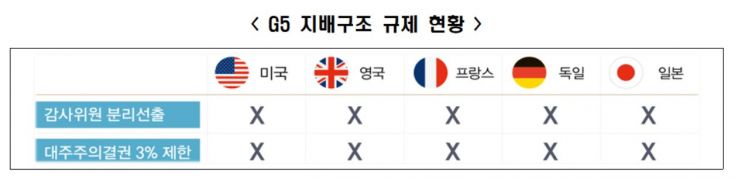
On the 29th, the Federation of Korean Industries (FKI) announced that after reviewing related laws in G5 countries such as the United States, the United Kingdom, Germany, France, and Japan, no legislative examples of separate election of audit committee members or restrictions on major shareholders' voting rights were found.
In major countries, it is common for audit committee members to be elected by the board of directors. If audit committee members are appointed by external forces, there is a risk of leakage of corporate secrets or core technologies due to their strong authority as directors and auditors. It was pointed out that mandating the method of electing audit committee members in the Commercial Act, as in Korea, is a regulation without precedent worldwide.
Limiting major shareholders' voting rights to 3% when appointing audit committee members is also unique to Korea, and it is analyzed that overseas hedge funds are using this as an effective means to attack the management rights of Korean companies.
In a situation where major shareholders' voting rights are restricted, if the government's amendment proposal to introduce separate election of audit committee members is also implemented, it would become possible for foreign institutional investor coalitions to place audit committee members on the boards of 23 out of the top 30 companies by market capitalization. It was added that the impact could be significant, especially when linked to the corporate governance restructuring of major companies such as Samsung and Hyundai Motor.
The multiple derivative suit system is also emphasized as a global standard not to recognize it because it denies the independent legal personality of subsidiaries. However, exceptionally, multiple derivative suits are allowed only in cases where it is difficult to recognize the independence of subsidiaries, such as in a 100% parent-subsidiary relationship. The FKI stated that this shows a significant difference from Korea’s attempt to apply multiple derivative suits to parent-subsidiary relationships exceeding 50% ownership.
Yoo Hwan-ik, head of the Corporate Policy Office at FKI, emphasized, "As seen in the cases of G5 countries, the global standard is not to excessively intervene in corporate governance regulations," and added, "It is necessary to abolish unprecedented governance regulations such as restrictions on major shareholders' voting rights and separate election of audit committee members, and to carefully review any new regulatory strengthening."
© The Asia Business Daily(www.asiae.co.kr). All rights reserved.

















