"Early Implementation of the Three Lease Laws... Stabilizing Jeonse"
Government Reviews Mid-to-Large Public Rentals and Equity Accumulation Housing
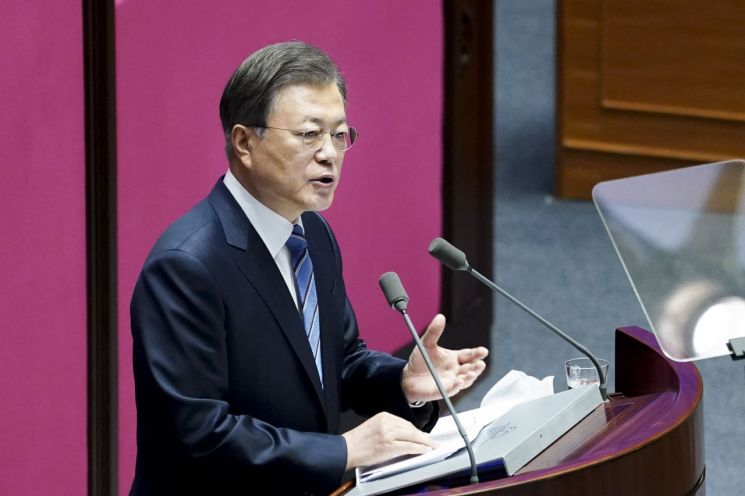 President Moon Jae-in is delivering the 2021 budget address at the National Assembly plenary session hall on the morning of the 28th. (Photo by Yonhap News)
[Asia Economy Reporter Moon Jae-won] President Moon Jae-in stated on the 28th that he will consistently pursue real estate policies. Despite side effects such as a sharp rise in jeonse prices following recent consecutive policy announcements, the intention is to continue with existing measures to stabilize the real estate market. The government plans to soon introduce measures to expand equity accumulation-type housing and mid-to-large public rental housing.
In his 2020 budget address at the National Assembly in Yeouido, Seoul, President Moon emphasized, "The government's determination to stabilize the real estate market, protect actual buyers, and suppress speculation is firm," adding, "We will firmly stabilize the jeonse market by early implementation of the three lease laws and supplying high-quality mid-sized public rental apartments."
This reflects the government's resolve to steadfastly pursue its real estate market stabilization goals despite public criticism and market instability regarding the real estate measures. In fact, although the government recently introduced strong measures such as the rent ceiling system and the right to request contract renewal, new record-high price complexes continue to emerge mainly in the metropolitan area, and the jeonse market is experiencing unprecedented turmoil, showing signs of instability.
The government is expected to announce plans next month to supply mid-sized public rental housing, as mentioned by President Moon. He also referred to "high-quality lifelong housing" at a senior secretaries and aides meeting in August. Currently, construction public rental housing supplied by the Korea Land and Housing Corporation (LH) is limited to up to 60㎡, which many consider too small, so it is expected to be expanded to around 85㎡ to increase demand for rental housing.
Including 85㎡ housing in construction public rentals requires additional investment from the Urban Housing Fund, and there have been reported disagreements with the Ministry of Strategy and Finance. However, since Minister of Land, Infrastructure and Transport Kim Hyun-mi and President Moon both mentioned mid-sized public rentals on the same day, it is analyzed that some agreement has been reached among government ministries.
Minister Kim said at the comprehensive audit of the National Assembly Land, Infrastructure and Transport Committee on the 23rd, "We are consulting with the financial authorities on expanding the size of public rentals to supply to the middle class, and we will announce specific plans in November." A Ministry of Land, Infrastructure and Transport official explained, "We are currently consulting with the Ministry of Strategy and Finance and preparing to announce it within November."
In addition, the government plans to expand the equity accumulation-type sale housing project. Equity accumulation-type housing is a type where residents acquire partial ownership upon moving in and gradually acquire the remaining shares over a long period, eventually obtaining full ownership of the house. Buyers acquire only 20?25% of the land and building shares at the time of sale and then acquire 10?15% evenly every four years after moving in, eventually owning 100% of the house after 20?30 years.
This can help low-income households who want to own a home but lack funds. On the same day, Deputy Prime Minister and Minister of Strategy and Finance Hong Nam-ki held a real estate market inspection meeting at the Government Seoul Office and said, "Equity accumulation-type sale housing is expected to become a new supply model that actively supports homeownership for future non-homeowners with actual demand."
However, the industry points out that mid-to-large public rental housing and equity accumulation-type housing are expected to be available only from 2022 to 2023 at the earliest, so they will be insufficient to immediately resolve the jeonse shortage. Since every new real estate measure by the government has caused side effects such as the "balloon effect," "jeonse shortage," and "concerns over underwater housing," there is considerable criticism that the existing policy direction needs to be reexamined.
An industry official explained, "The intention of equity accumulation-type housing is good, but considering the supply volume, it will be difficult to completely resolve the current jeonse shortage. Given the structure of acquiring shares over several years and the rental burden, it will not be easy to attract demand."
© The Asia Business Daily(www.asiae.co.kr). All rights reserved.

















