Local 4 Major Councils and Autonomy Decentralization Committee Conduct Public Survey on Local Autonomy Day
7 out of 10 Say "Decentralization Must Be Strengthened in the Post-Corona Era"
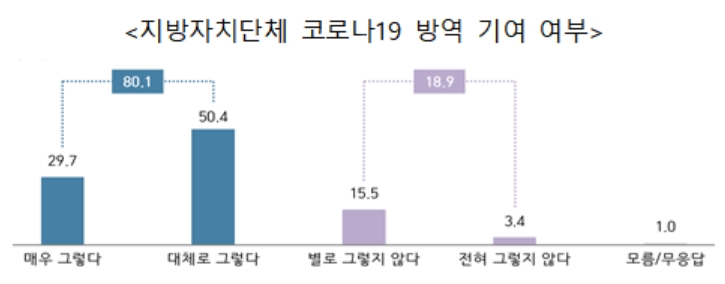
[Asia Economy Reporter Jo In-kyung] It has been revealed that 8 out of 10 Koreans evaluate that local governments contributed to the prevention of the novel coronavirus infection (COVID-19). Additionally, 7 out of 10 believe that local autonomy should be expanded to prepare for the post-COVID-19 era.
The four major local government councils?the Korea Association of Governors, the National Council of Chairpersons of Provincial Councils, the National Association of Mayors, County Governors and District Heads, and the National Council of Chairpersons of City, County, and District Councils?along with the Presidential Committee on Local Autonomy, announced the results of this public opinion survey on the 28th, conducted in celebration of "Local Autonomy Day" on the 29th.
This survey was conducted with 1,000 adults nationwide aged 18 and over.
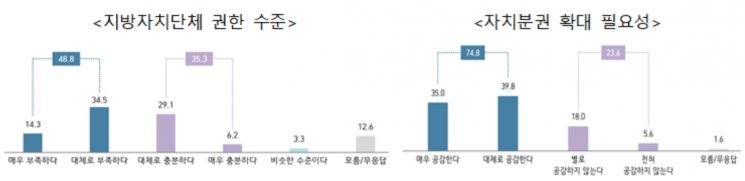
When asked about the level of authority of local governments, 48.4% of respondents answered that it was insufficient. The response agreeing that local autonomy should be strengthened in the post-COVID era was 74.8%.
Responses evaluating that local governments contributed to COVID-19 prevention reached 80.1%. It is analyzed that many citizens realized the importance of local governments' roles during the COVID-19 response process and sympathized with proactive administrative actions by local governments to ensure residents' safety through strengthening local autonomy.
Regarding the appropriateness of local governments' budget use in response to the COVID-19 spread, 62.4% responded that it was "appropriate," and the response supporting "strengthening fiscal decentralization" was 74.4%, higher than the 21.5% who answered "not necessary."
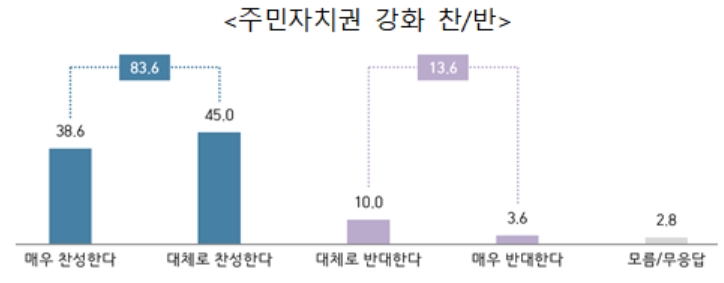
The response supporting strengthening residents' autonomy rights compared to the current situation was overwhelmingly dominant at 83.6%. This appears to reflect public support for expanding direct resident participation systems through legislation such as the enactment of the Residents' Ordinance Proposal Act.
The response supporting the need for a clear division of duties principle that distinctly separates the affairs and roles of the central government, metropolitan local governments, and local governments was also high at 83.8%.
Regarding the opinion that the ordinance enactment authority of local governments, which is currently restricted by central government laws, should be strengthened to promote policies that meet residents' demands and local circumstances, 76.9% responded "agree," which was higher than the 17.9% who responded "disagree."
Additionally, 72.9% of respondents supported assigning policy support professionals to local councils, and 55.9% agreed with granting local councils the personnel authority over local council staff currently exercised by local government heads. Regarding the call for the prompt passage of the full revision of the Local Autonomy Act, 70.2% sympathized.
The four major local government councils and the Local Autonomy Committee stated, "Through COVID-19 prevention, the reliability of local administration and the importance of local autonomy have been confirmed," and added, "Based on strengthening the authority and responsibility of local governments, we will grant practical roles and authority so that residents can participate as owners of their communities."
© The Asia Business Daily(www.asiae.co.kr). All rights reserved.



















