Electric Vehicles to Account for 50% by 2035, Remaining to Be Eco-Friendly Cars Like Hybrids
1 Million Fuel Cell Vehicles (FCVs) to Be Sold by 2035
[Asia Economy Beijing=Special Correspondent Jo Young-shin] The Chinese leadership is considering a 'carbon zero (0)' plan to reduce the proportion of new pure gasoline (internal combustion engine) vehicle sales to '0%' by 2035.
China will discuss climate and environmental issues, including this plan, at the '5th Plenary Session of the 19th Central Committee (5th Plenum)' held until the 29th.
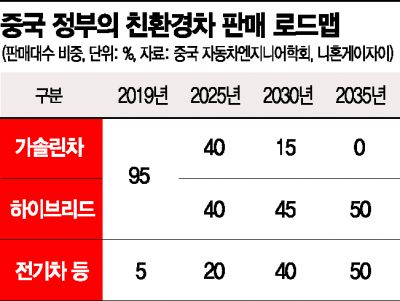
Japan's Nihon Keizai Shimbun (Nikkei) reported on the 28th, citing the China Society of Automotive Engineers' 'New Energy Vehicle Technology Roadmap 2.0,' that the Chinese leadership plans to ban the sale of pure internal combustion engine vehicles excluding hybrids and expand the proportion of new energy vehicles such as electric cars to 50% of new car sales by 2035.
Last year, gasoline and hybrid vehicles accounted for 95% of new car sales in China. Among these, the share of gasoline vehicles will be reduced to 0% by 2035, while hybrids will increase to 40% by 2025 and 50% by 2035.
Additionally, the proportion of electric vehicles, which accounted for only 5% of new car sales last year, will be expanded to 20% by 2025, 40% by 2030, and 50% by 2035.
Considering that China's annual new car sales volume was 26 million units (based on 2019), this means a market of 13 million electric vehicles will open.
It was also added that the Chinese leadership plans to sell 1 million fuel cell vehicles (FCVs) by 2035.
If the Chinese leadership's plan is implemented as is, pure gasoline vehicles will disappear from China after 2035.
Nikkei stated, "The United Kingdom, the European Union (EU), and the United States (California) have announced policies to ban the sale of new pure gasoline vehicles by 2035," and predicted that China's expansion policy for eco-friendly vehicles will have a significant impact on global automobile companies.
China's state-run Xinhua News Agency also announced on the same day that after the 5th Plenum, the Chinese leadership will take stronger policies and measures to achieve carbon neutrality goals.
Xinhua News Agency hinted that there might be a major announcement on environmental issues, stating, "At the UN General Assembly last September, President Xi Jinping announced the goal of achieving carbon neutrality before 2060."
China's Global Times also mentioned China's responsibility for global climate change on the same day.
Global Times reported, "As of the end of last year, carbon dioxide emissions decreased by 18.2% compared to 2015, ahead of the original plan," and "The 14th Five-Year Plan will be stronger than the carbon emission reduction policies of the 13th Five-Year Plan."
Some analysts suggest that China's bold carbon neutrality policy is aimed at the U.S. Donald Trump administration.
The explanation is that the strong eco-friendly policy was introduced to highlight the fact that President Trump has failed to play a leadership role in the international community on climate and environmental issues, such as withdrawing from the Paris Climate Agreement.
© The Asia Business Daily(www.asiae.co.kr). All rights reserved.
![User Who Sold Erroneously Deposited Bitcoins to Repay Debt and Fund Entertainment... What Did the Supreme Court Decide in 2021? [Legal Issue Check]](https://cwcontent.asiae.co.kr/asiaresize/183/2026020910431234020_1770601391.png)















