Final Decision at the Regulatory Free Zone Committee Meeting Chaired by the Prime Minister on November 13
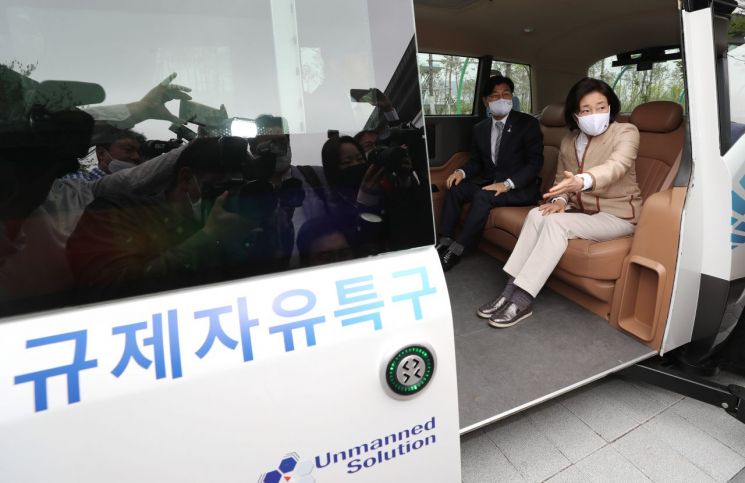 Park Young-sun, Minister of SMEs and Startups (right), is boarding an autonomous vehicle after concluding the communication meeting with special zone operators of the Sejong Autonomous Driving Demonstration Regulatory Free Zone held at Central Park in Sejong City on the morning of the 25th. Photo by Yonhap News Agency
[Asia Economy Reporter Kim Heeyoon] On the 28th, the Ministry of SMEs and Startups held a review committee meeting at the Korea Chamber of Commerce and Industry to designate the 4th Regulatory Free Zones in three regions: Gyeongnam, Gwangju, and Ulsan.
At the meeting, reviews were conducted on a total of four plans: three new plans including Gyeongnam's next-generation smart factory utilizing 5G, Gwangju's green energy energy storage system (ESS) power generation, and Ulsan's carbon dioxide resource utilization, as well as an additional plan for the Sejong zone designated in July last year for 'autonomous outdoor robot operation.'
Among the 11 local governments that applied for the 4th designation, 18 special zone projects were proposed across various new technology fields such as medical services, renewable energy, and mobility. The four special zone plans presented are characterized by focusing on digital fields (5G-utilized smart factories, autonomous outdoor robot operation) and green fields (green energy ESS power generation, carbon dioxide resource utilization), which will lead the Korean New Deal.
In particular, Gyeongnam's 5G-utilized next-generation smart factory special zone plan is significant as it was planned top-down in connection with central government policies, complementing the previous bottom-up approach that was biased toward specific sectors like bio and future cars.
Additionally, separate from the review agenda, the designation of a 'Safety Verification Institution for Regulatory Free Zones' was also reported. This aims to designate a safety verification institution for ongoing demonstrations after the completion of special zone projects, to facilitate legislative adjustments based on verification results, and to encourage relevant ministries to systematically revise regulatory laws.
The special zone plans reviewed on this day are scheduled to have their final designation decided and announced at the 'Regulatory Free Zone Committee' chaired by the Prime Minister on November 13.
Park Young-sun, Minister of SMEs and Startups, stated, “Regulatory Free Zones are a system that has shown remarkable results within one year of introduction, such as a 16% increase in local jobs and attracting investments exceeding 300 billion won,” and added, “We will continue to strive to discover regulatory free zones in the digital and green sectors, which are core to the Korean New Deal.”
© The Asia Business Daily(www.asiae.co.kr). All rights reserved.

















