Hannam, Cheongpa, Wonhyo, Huam Followed by Seogye-dong Also Pushing for Project Participation
Urban Regeneration Underway, So Low Possibility of Public Contest
Seogye-dong Promotion Committee "We Will Show Residents' Will for Development"
Requesting Inclusion of Public Redevelopment in Urban Regeneration in Alliance with Changsin-dong
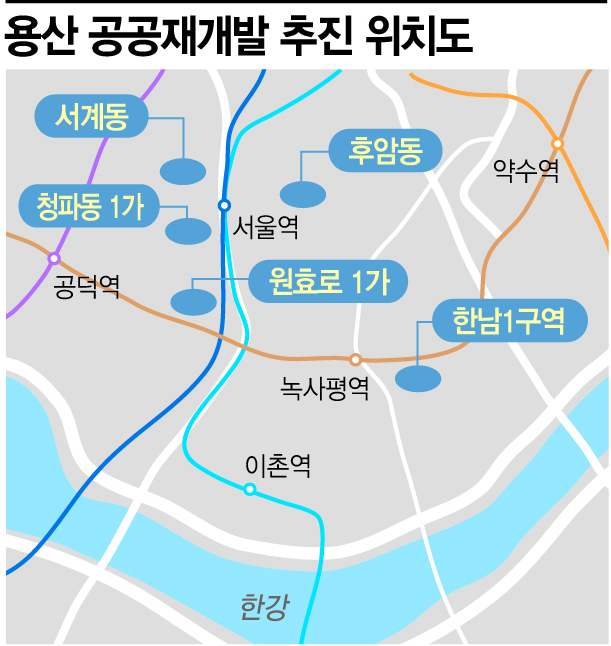
[Asia Economy Reporter Onyu Lim] Yongsan in Seoul is heating up with public redevelopment. Following Hannam 1 District, Cheongpa-dong 1-ga, Wonhyo-ro 1-ga, and Huam-dong, which were the first to participate in the pilot project application, the area around Seogye-dong on the west side of Seoul Station, a city regeneration area, is also pushing for project participation. While land prices have surged due to large-scale developments around the Yongsan railroad maintenance depot site, interest in public redevelopment has increased as redevelopment projects have stalled and residential environments have deteriorated.
According to the real estate industry on the 26th, residents of the Seogye-dong area in Yongsan-gu recently formed a Public Redevelopment Promotion Committee and are collecting consent forms for the pilot project application. Despite its excellent location adjacent to Seoul Station, Seogye-dong has been neglected in development. Unlike the front of Seoul Station, lined with large buildings such as Seoul Square, this area consists of sloped alleys densely packed with old houses, many of which still use traditional toilets, reflecting poor residential conditions. Although redevelopment momentum arose when it was designated as a New Town candidate site in 2007, it was removed from the New Town list in 2012 following amendments to the Urban and Residential Environment Improvement Act, and since 2017, city regeneration projects focused on improving residential environments have been pursued.
Seogye-dong residents see public redevelopment as a last chance. Public redevelopment is a redevelopment project promoted with the participation of public entities such as the Korea Land and Housing Corporation (LH) and Seoul Housing and Communities Corporation (SH Corporation). Participation in public redevelopment offers incentives such as increased floor area ratio, simplified approval procedures, and exemption from the price ceiling system for sales. The government’s policy is to shorten the project duration, which typically took over 10 years, to within 5 years.
However, even if Seogye-dong meets the resident consent requirements and applies for the public redevelopment pilot project, the likelihood of being selected as a pilot site is low. This is because the government plans to exclude city regeneration areas from public redevelopment to prevent overlapping budget execution and maintain policy consistency. Currently, public redevelopment targets are limited to areas where redevelopment zones have been lifted or are planned.
A representative of the Seogye-dong Public Redevelopment Promotion Committee said, "The redevelopment expectations increased due to the halo effect of Yongsan development in the 2000s, but indiscriminate policies by the Seoul city government and the central government have resulted in being designated as an unwanted city regeneration area." He added, "Without infrastructure expansion, residential improvement is difficult, so we will collect consent forms to show residents’ will for development." To this end, the Seogye-dong Public Redevelopment Promotion Committee plans to join forces with residents of Changsin-dong in Jongno-gu to request that city regeneration areas be included in the pilot project targets.
Meanwhile, besides Seogye-dong, four areas in Yongsan-gu?Hannam 1 District, Cheongpa-dong 1-ga, Wonhyo-ro 1-ga, and Huam-dong?have expressed their intention to participate in public redevelopment. As the stalled Yongsan International Business District development gains momentum with projects such as the 8,000-unit development on the railroad maintenance depot site, interest in public redevelopment is also rising.
Currently, Hannam 1 District has already submitted a pilot project application to Seoul City after obtaining resident consent. Initially, two project entities in Hannam 1 District intended to promote public redevelopment, but recently unified the project entity, raising expectations for project success. A Yongsan District Office official said, "After the application, the district office recommends areas with a residential maintenance index of 70 or higher to Seoul City, and there is no limit on the number of recommended areas per local government." Applications for the public redevelopment pilot project will be accepted until the 4th of next month. The city plans to review the plans and select project sites through a selection committee by March next year at the latest.
© The Asia Business Daily(www.asiae.co.kr). All rights reserved.

















