Worsening Management Crisis Beyond IMF Foreign Exchange Crisis
Growing Calls for Improvement and Supplementation of Working Hours System
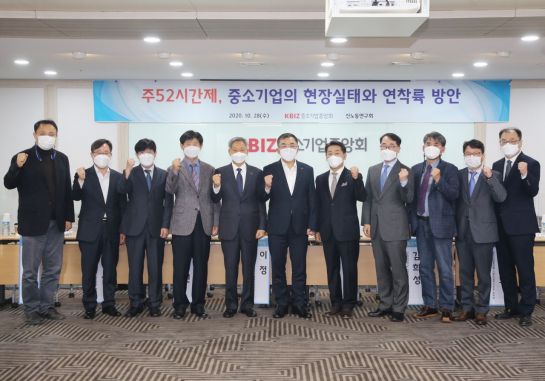 On the 28th, experts from various fields attending the seminar titled "Current Status and Smooth Transition Measures of the 52-Hour Workweek System in Small and Medium Enterprises" held at the Korea Federation of SMEs in Yeouido, Seoul, are urging improvements to the working hours system.
[Asia Economy Reporter Kim Daeseop] There is growing demand to postpone the grace period for the 52-hour workweek system until the COVID-19 situation stabilizes. As the grace period granted to workplaces with 50 to fewer than 300 regular employees is set to end by the end of December this year, opinions are emerging that measures are needed to minimize the damage to small and medium-sized enterprises (SMEs) severely impacted by the prolonged COVID-19 pandemic.
On the 28th, Professor Lee Jeong of the Graduate School of Law at Hankuk University of Foreign Studies stated at the seminar titled "Current Status and Smooth Transition Measures for SMEs under the 52-hour Workweek System," held at the Korea Federation of SMEs in Yeouido, Seoul, "SMEs are struggling with business deterioration worse than the IMF (International Monetary Fund) financial crisis, and many are barely surviving by relying on bank loans and government subsidies. There is a need to postpone the application of the system for SMEs until the COVID-19 situation calms down and business normalizes to some extent."
The seminar discussed various opinions on diagnosing problems and complementary measures related to the 52-hour workweek system, focusing on in-house subcontractors in the shipbuilding industry.
Professor Lee explained, "In the case of 'Other Transportation Equipment Manufacturing,' which includes in-house subcontractors in the shipbuilding industry, 56,406 workers are employed at workplaces where reduced working hours will be applied starting next year. Estimating the wage reduction due to the 52-hour workweek system, the average monthly salary in Other Transportation Equipment Manufacturing is expected to decrease by about 2.5%."
Researcher Hwang Kyungjin of the Korea Small Business Institute also expressed concerns about the problems arising from the introduction of the 52-hour workweek system for in-house subcontractors of large shipbuilding companies.
Researcher Hwang said, "In-house subcontractors facing the introduction of the 52-hour workweek system are worried about increased labor-management conflicts due to wage reductions, difficulties in recruiting new employees, and increased labor costs. As solutions, many opinions favored utilizing government and prime contractor support measures, hiring new employees, using the special extended work permit system, and maintaining fixed overtime pay to compensate for wage reductions."
Professor Kwon Hyuk of the Graduate School of Law at Pusan National University also emphasized in his presentation on "Smooth Transition Measures for the 52-hour Workweek System in SMEs" that "there is a need to extend the grace period for applying the 52-hour workweek system to companies with 50 to 299 employees by an additional 1 to 2 years."
Experts participating in the comprehensive discussion at this seminar also agreed on the necessity of improving the working hours system.
Lee Taehee, Head of the Smart Job Division at the Korea Federation of SMEs, said, "It is essential to expand the calculation period for the selective working hours system to at least three months to eliminate blind spots, following the tripartite agreement of the Economic, Social and Labor Council, which expands the flexible working hours system to six months."
Hong Jongseon, Team Leader of the Labor Policy Division at the Korea Employers Federation, said, "Considering that small and micro enterprises suffer from minimum wage increases and chronic labor shortages, it is necessary to reconsider the application timing of the 52-hour workweek system for workplaces with 5 to fewer than 50 regular employees scheduled for July next year."
This seminar was jointly hosted by the Korea Federation of SMEs and the New Labor Research Association. Seo Seungwon, Executive Vice President of the Korea Federation of SMEs, said, "There should be serious consideration of extending the grace period ending this year so that our companies are not excluded due to working hour restrictions when suppressed demand explodes after overcoming COVID-19."
© The Asia Business Daily(www.asiae.co.kr). All rights reserved.

















