Pompeo "Will Respond to All Threats from the Chinese Communist Party"
Esper "Possibility to Expand Sales of Fighter Jets and Drones to India"
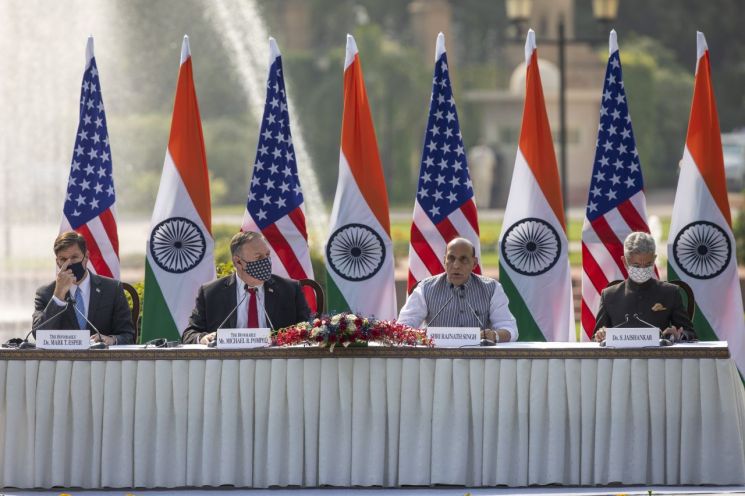
[Asia Economy Reporter Hyunwoo Lee] The United States and India have signed the Basic Exchange and Cooperation Agreement (BECA), a military pact for sharing satellite information and military geographic data, further strengthening military cooperation to build an anti-China front. India will be able to share U.S. military satellite information, which is crucial for operating U.S.-made missiles, fighter jets, and drones, while the U.S. has opened the door to exporting more advanced weapons to India in the future.
According to foreign media including CNN, on the 27th (local time), U.S. Secretary of State Mike Pompeo and Secretary of Defense Mark Esper held a 2+2 meeting in New Delhi with Indian External Affairs Minister Subrahmanyam Jaishankar and Defense Minister Rajnath Singh, signing the BECA agreement. This pact is the fourth military agreement between the two countries. Previously, they started with the General Security of Military Information Agreement (GSOMIA) in 2002, followed by the Logistics Exchange Memorandum of Agreement (LEMOA) in 2016, and then the Communications Compatibility and Security Agreement (COMCASA) in 2018.
Secretary Pompeo described the agreement as "cooperation to respond to the pandemic that started in Wuhan and to all threats posed by the Chinese Communist Party that endanger security," emphasizing strengthened cooperation with India to build an anti-China front. U.S. Secretary of Defense Mark Esper stated, "We will be able to expand sales of fighter jets and unmanned aerial vehicles to India," suggesting additional arms exports to India.
Arms trade between the two countries has surged sharply since 2008, exceeding $20 billion this year. According to the U.S. State Department, this year the U.S. exported various strategic weapons to India, including radar air defense systems, missiles and lightweight torpedoes, helicopters, naval guns, and C-17 transport aircraft. With this agreement, unmanned bombers such as the Predator (MQ-1) are also expected to be sold to India soon.
As the two countries share satellite and military geographic information, interoperability between their militaries is expected to be greatly enhanced. Especially for India, which experienced bloody clashes with China in the Himalayan border region in May and June this year, sharing U.S. satellite information is expected to significantly improve the operational capabilities of key strategic weapons such as fighter jets, drones, cruise missiles, and ballistic missiles.
India had been reluctant to sign the BECA agreement, considering its traditionally non-aligned diplomatic stance and concerns that strategic neutrality might be compromised despite persistent U.S. requests. However, following bloody clashes resulting in over 20 soldier deaths in border disputes with China this year and a significant rise in military tensions, India has actively moved toward signing the agreement.
Having joined the U.S.-led anti-China security forum Quad and now signing a military agreement with the U.S., India is expected to fully engage in building an anti-China front. After visiting India, Secretary Pompeo plans to visit Sri Lanka, the Maldives, and Indonesia. These countries have experienced economic damage from China's Belt and Road Initiative (land and maritime Silk Road projects) and territorial disputes in the South China Sea, strengthening anti-China sentiment. Attention is focused on whether they will join the U.S. in expanding the anti-China front.
© The Asia Business Daily(www.asiae.co.kr). All rights reserved.
![User Who Sold Erroneously Deposited Bitcoins to Repay Debt and Fund Entertainment... What Did the Supreme Court Decide in 2021? [Legal Issue Check]](https://cwcontent.asiae.co.kr/asiaresize/183/2026020910431234020_1770601391.png)















