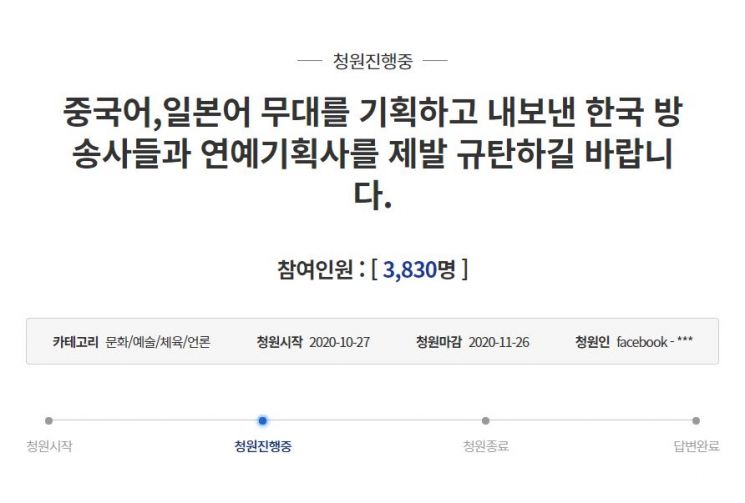
 A petition posted on the Blue House National Petition Board on the 27th condemning idols, their agencies, and broadcasting companies commemorating the "Anti-American Aid" campaign. Photo by Blue House National Petition Board
[Asia Economy reporters Seung-gon Han and intern Seul-gi Kim] Amid controversy over Chinese-nationality idol singers active in Korea commemorating the 70th anniversary of the 'Hangmi Wonjo' (抗美援朝, meaning "Resist America, Aid Korea") on social networking services (SNS), a petition condemning these idols, their entertainment agencies, and broadcasting stations has been posted. Experts pointed out that Chinese-born stars are in a position where it is difficult to express voices different from those of the Chinese public.
According to the Blue House's national petition board on the 27th, a petition titled "Please condemn Korean broadcasters and entertainment agencies that planned and aired stages in Chinese and Japanese" was posted that day.
The petitioner stated in the petition, "On October 23 and 25, respectively, SM Entertainment's multinational global group held comeback stages on KBS Music Bank and SBS Inkigayo," adding, "This group performed two songs, one of which mixed Korean, Chinese, and Japanese, and an unbelievable situation unfolded where Chinese and Japanese were broadcast on KBS, a public broadcaster, and SBS, a terrestrial channel."
They continued, "It is truly frustrating that on public broadcasting and terrestrial channels in the Republic of Korea, which has been liberated for less than 100 years, Chinese and Japanese can be heard openly," and "Moreover, on the morning of October 23, Chinese President Xi Jinping (習近平) asserted 'Hangmi Wonjo,' which distorts history regarding China's participation in the Korean War, and October 25 was Korea's Dokdo Day," expressing outrage.
Earlier, President Xi's speech at the 70th anniversary ceremony of the Hangmi Wonjo war defined China's participation in the Korean War as "suppressing the expansion of imperialist aggression," sparking controversy over 'historical distortion.'
In addition, Chinese-born K-pop idols such as Victoria of f(x), Lay of EXO, and Zhou Jieqiong, formerly of Pristin, posted messages commemorating Hangmi Wonjo on their Chinese SNS accounts, drawing public criticism.
In response to the situation, Professor Im Dae-geun of the Department of Global Cultural Contents at Hankuk University of Foreign Studies analyzed in an interview with YTN Radio's 'Hwang Bo-seon's Start of a New Morning' on the same day, "Although Chinese-born stars are based in Korea, they ultimately return to China and must be evaluated by the Chinese public," adding, "In such circumstances, it is very difficult to express voices different from those of the Chinese public and netizens."
Professor Im explained, "(Hangmi Wonjo) suppresses the fact that North Korea invaded South Korea and instead defines the participation of the United States and the United Nations (UN) in the Korean War as aggression," and "Because China has not been able to resolve internal issues such as the recent COVID-19 pandemic, trade conflicts with the U.S., and President Xi's consolidation of power, it appears to be mobilizing patriotic propaganda campaigns to address internal problems."
© The Asia Business Daily(www.asiae.co.kr). All rights reserved.

















