Moon Special Report 'Korea-China-Japan Peace Forum' Keynote Speech
Goh Yoo-hwan, Director of the Institute for Unification Studies, "North Korea-US Negotiations Will Not Be Easy Regardless of US Presidential Election Outcome"
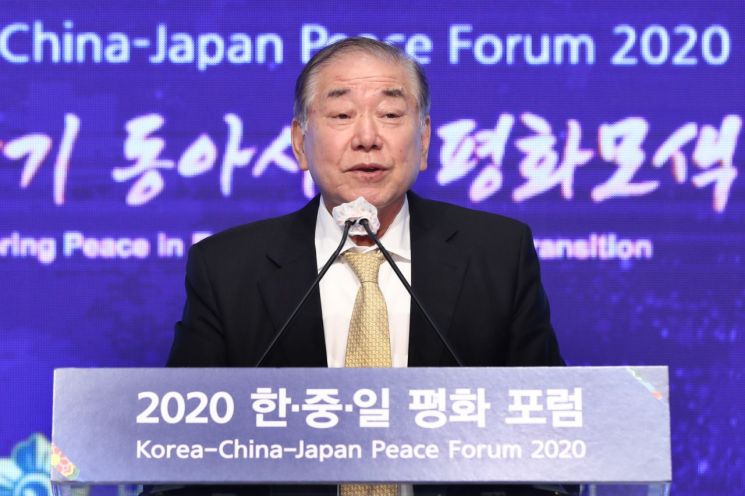
[Asia Economy Reporter Lim Cheol-young] Moon Jeong-in, Special Advisor to the President for Unification, Diplomacy, and Security, stated that denuclearization of the Korean Peninsula and the establishment of a peace regime must be pursued simultaneously, and that the starting point is a declaration to end the war.
On the 27th, Special Advisor Moon emphasized the importance of North Korea's denuclearization during his keynote speech at the "Korea-China-Japan Peace Forum" held at the Shilla Hotel, hosted by the National Unification Advisory Council, saying, "We must do everything possible to prevent a new Cold War from returning to the Korean Peninsula."
He further stated that before simultaneously pursuing denuclearization and a peace regime on the Korean Peninsula, an end-of-war declaration is crucial and that South Korea should take the lead. Special Advisor Moon said, "The simultaneous pursuit of denuclearization and a peace regime on the Korean Peninsula, as President Moon Jae-in has mentioned, is very important," adding, "The gateway to this is the declaration to end the war." He continued, "Peace is a process; the result does not come immediately," and said, "We must play a central role in promoting denuclearization and establishing a peace regime through the process starting with the end-of-war declaration."
He also stressed the need for proactive changes from North Korea. Special Advisor Moon said, "North Korea must take a proactive stance. Possessing nuclear weapons does not guarantee survival and prosperity," and added, "There should be inter-Korean dialogue between the end of the U.S. presidential election and the start of the new administration."
Additionally, Special Advisor Moon diagnosed that the intensification of U.S.-China conflicts has heightened concerns about the revival of a new Cold War. He explained, "The basis of the new Cold War is the U.S. attempting to contain China as it once contained the Soviet Union," and said, "There are talks about forming the security cooperation group Quad, the Indo-Pacific strategy is being discussed, and there are concerns about a new NATO targeting China."
He also expressed skepticism about the U.S. perspective on China. Regarding the U.S. logic that democratic countries must form alliances to contain China, Special Advisor Moon said, "I am skeptical about the legitimacy and rationality of this new Cold War framework," and stated, "I do not perceive China as an immediate and present threat."
At the forum, Ko Yoo-hwan, Director of the Korea Institute for National Unification and a presenter, predicted that North Korea-U.S. negotiations will be difficult regardless of the U.S. presidential election outcome. He said, "Even if Donald Trump is re-elected, unless the Trump administration changes its existing calculation of maintaining sanctions until 'final, fully verified denuclearization' (FFVD) and reluctance toward China's involvement, it will be difficult to resume peace processes and denuclearization exchange negotiations on the Korean Peninsula."
He also anticipated that if Joe Biden is elected, there is a high possibility of attempting bottom-up bilateral or multilateral negotiations. Director Ko analyzed, "There is a possibility of reconsidering Trump's top-down diplomatic approach and trying bottom-up bilateral or multilateral negotiations," adding, "While maintaining sanctions and pressure, the U.S. will try to persuade North Korea that denuclearization is necessary to alleviate its economic difficulties, and North Korea may propose nuclear arms reduction negotiations rather than denuclearization."
© The Asia Business Daily(www.asiae.co.kr). All rights reserved.

















