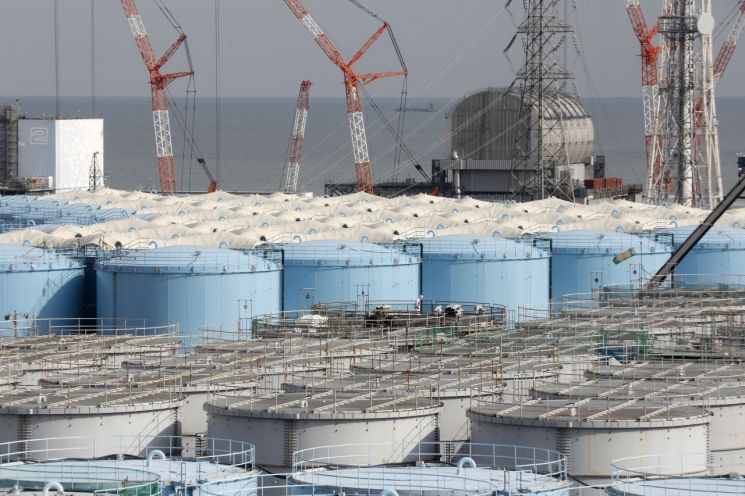
[Asia Economy Reporter Hyunwoo Lee] The Japanese Ministry of Economy, Trade and Industry reiterated its previous stance of wanting to reach a conclusion on the disposal of radioactive contaminated water from the Fukushima Daiichi Nuclear Power Plant as soon as possible, without specifying a clear timeline. This is interpreted as a step back from the decision to discharge the water into the ocean, in consideration of opposition from local governments within Japan, negative public opinion, and resistance from neighboring countries.
According to local media such as Jiji Press, Hiroshi Kajiyama, Japan's Minister of Economy, Trade and Industry, stated at a press conference following a cabinet meeting on the 27th that he wants to reach a conclusion on the disposal method of radioactive contaminated water from the Fukushima Daiichi Nuclear Power Plant "as soon as possible." When asked by reporters whether the disposal method might be decided within this month, he said, "The originally planned timing for the decision was around this summer," and added, "The government will take responsibility and conclude at an appropriate time."
Earlier, there were reports that the Japanese government would officially decide on a policy to dispose of contaminated water discharged from the Fukushima Daiichi Nuclear Power Plant by releasing it into the ocean through a cabinet meeting of related ministries on the same day. However, Minister Kajiyama denied this on the 24th, explaining that various measures are still being discussed. It is analyzed that the government has stepped back from the existing ocean discharge policy due to worsening public opinion within Japan caused by opposition from local governments around Fukushima, as well as resistance from neighboring countries such as South Korea and China.
Regarding opposition from neighboring countries, Minister Kajiyama said, "In the IAEA verification conducted this April, it was evaluated as reasonable," indicating he is not greatly concerned. However, he also stated, "We will cooperate with the IAEA and transparently provide related information to the international community," showing awareness of the opposition from neighboring countries.
The Japanese government has been feared to push forward with ocean discharge as the likely disposal method, based on opinions presented by an expert subcommittee under the Ministry of Economy, Trade and Industry in February, which cited lower costs and ease of implementation. However, the government has been withholding its position due to worsening public opinion within Japan. Earlier, a Yomiuri Shimbun public opinion poll conducted from the 16th to the 18th with 1,051 voters nationwide showed that more than 50% of respondents opposed ocean discharge, while only 41% supported it.
© The Asia Business Daily(www.asiae.co.kr). All rights reserved.

















