[Asia Economy Reporter Oh Ju-yeon] The KOSDAQ index has plunged to the 700 level. The index dropped by about 100 points within a month, and the loss rate of the KOSDAQ Leverage Exchange-Traded Fund (ETF), which ranked third in net purchases by individuals this month, has already exceeded 20%. The KOSDAQ Venture Fund, which had attracted attention due to the index rise and the recent public offering boom, was also found to have the lowest returns among theme funds. However, the KOSDAQ Inverse ETF, partially purchased by individuals, played a significant risk-hedging role during this sharp decline.
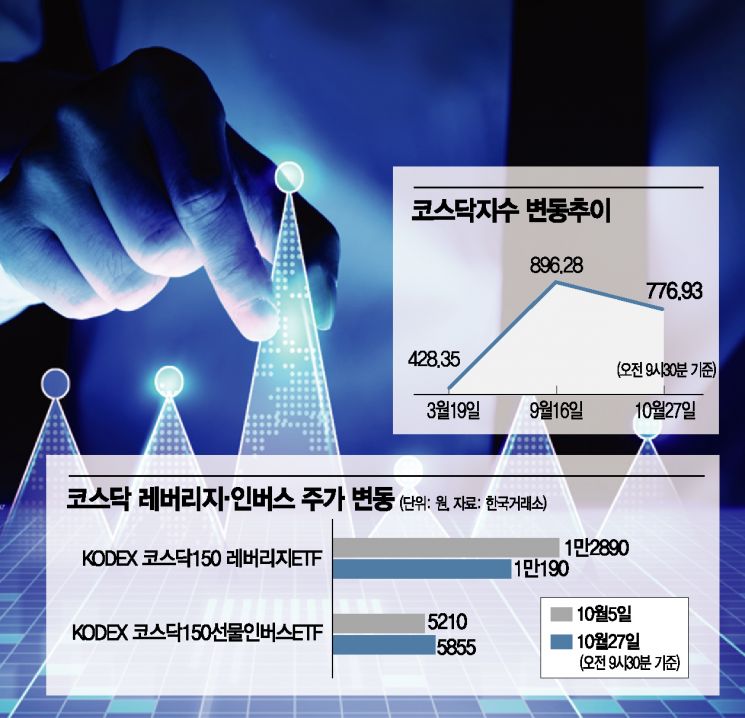
According to the Korea Exchange on the 27th, the KOSDAQ index soared vertically after the plunge caused by the COVID-19 pandemic earlier this year, rising 109.24% from a closing price of 428.35 on March 19 to 896.28 on September 16. Compared to the KOSPI, which rose 67.11% from 1457.64 to 2435.92 during the same period, the KOSDAQ showed a relatively steep upward trend. The role of individual investors was significant in enabling the KOSDAQ index to more than double.
The average daily trading value in the KOSDAQ market increased from 8 trillion won in March to 14 trillion won in September, becoming similar to the KOSPI market (14 trillion won). Considering that about 90% of the trading value in the KOSDAQ market typically comes from individual pockets, individuals have been the main drivers of the KOSDAQ index rise so far. Over the past month, the proportion of individual trading volume (buy + sell) in the KOSDAQ market accounted for 89% of the total, which is larger than the 61% share in the KOSPI market. Especially this year, as individual participation in the stock market became active, sectors with a high individual proportion such as pharmaceuticals, bio, and COVID-19 related stocks showed strength and led the index.
However, concerns have emerged that if the major shareholder capital gains tax requirements are adjusted from the current 1 billion won in individual stock holdings to 300 million won or more starting next year, personal sell-offs could flood the market ahead of the year-end, causing the KOSDAQ market to turn bearish recently.
Although individuals still purchased about 1.7 trillion won worth of stocks in the KOSDAQ market this month, the intensity weakened compared to the approximately 2.7 trillion won net purchases during the same period last month (1st to 25th). As institutions, anticipating a year-end bearish market, began to reduce their holdings in the KOSDAQ by realizing profits preemptively, the index fell from 873.50 on the 12th to 778.02 on the 26th. This month, institutions maintained a solo selling trend in the KOSDAQ market, net selling about 1.5 trillion won. Foreigners, along with individuals, net purchased about 91 billion won.
The KOSDAQ Venture Fund, which attracted attention as an alternative to public offering investments amid this year's KOSDAQ index rise, recorded a return of -2.44% over the past month, making it the second worst performer among theme funds after the Healthcare Fund (-3.49%).
The KODEX KOSDAQ150 Leverage ETF, which ranked third in net purchases by individuals this month with purchases worth 192.5 billion won as they expected the KOSDAQ index to surpass the previous month's high of 900 and rise again, recorded a return of -20.95% this month. On the other hand, the KODEX KOSDAQ150 Futures Inverse ETF, purchased as a hedging tool, posted double-digit returns during this decline. The KODEX KOSDAQ150 Futures Inverse ETF rose 12.38% from 5,210 won to 5,855 won as of the closing price on the 5th. Considering that individuals were also the largest buyers of the KOSDAQ Inverse ETF (31.3 billion won), it can be seen as having a strong risk-hedging nature.
In the securities industry, regarding the recent bearish market situation related to major shareholder taxation, analysts said that this is a pattern that repeats every year, so buying at low prices afterward will be effective. KB Securities researcher Lee Eun-taek said, "There is a pattern of selling pressure on small and mid-cap stocks related to major shareholder taxation at the end of each year," adding, "Selling pressure accumulates at year-end, and conversely, low-price buying begins one to two months after the selling occurs." He further forecasted, "Due to expectations of additional stimulus measures after the U.S. presidential election, the upward trend of the economic cycle is likely to be maintained."
© The Asia Business Daily(www.asiae.co.kr). All rights reserved.

![Clutching a Stolen Dior Bag, Saying "I Hate Being Poor but Real"... The Grotesque Con of a "Human Knockoff" [Slate]](https://cwcontent.asiae.co.kr/asiaresize/183/2026021902243444107_1771435474.jpg)















