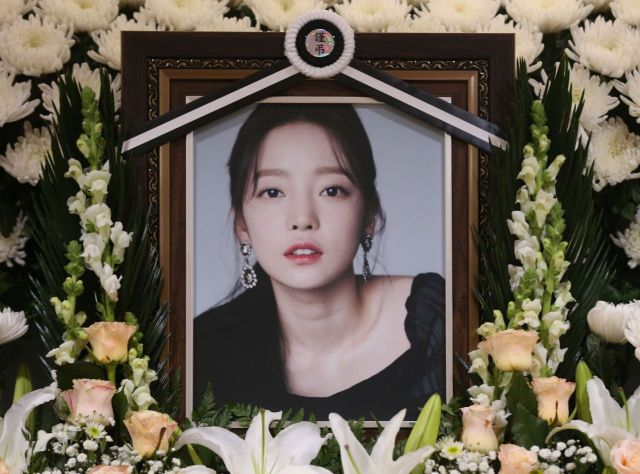
 The funeral hall set up for the late singer Goo Hara at Seoul St. Mary's Hospital on November 25 last year. [Image source=Yonhap News]
[Asia Economy Reporter Kim Yeon-ju] Amid renewed calls for restrictions on inheritance following a case where a biological mother who appeared after 28 years took her deceased daughter's insurance money worth hundreds of millions and inheritance, concerns have been raised that proper discussions on the so-called 'Gu Hara Act,' which limits inheritance rights of biological parents who neglect their child-rearing duties, have not been conducted.
According to the legal community on the 26th, a case occurred where a biological mother who appeared after 28 years took insurance money worth hundreds of millions and inheritance after her young daughter died of cancer. The sole heir, the biological mother, not only took all of the daughter's assets but also filed a lawsuit claiming that the bereaved family had paid hospital and funeral expenses using the deceased's credit card.
Seo Young-kyo, a member of the Democratic Party of Korea and the main proposer of the 'Gu Hara Act,' appeared on MBC Radio's 'Kim Jong-bae's Focus' on the 27th and said, "Many lawmakers in the National Assembly hold the view that we should approach the Gu Hara Act cautiously, so discussions have not yet taken place," adding, "The bill was discussed twice in the Judiciary Committee and then automatically discarded."
The 'Gu Hara Act' is a bill that restricts inheritance rights of biological parents who fail to fulfill their child-rearing obligations. The older brother of the late singer Gu Hara, who passed away last year, filed a legislative petition claiming that their biological mother, who had run away when Gu was young, was trying to claim Gu's inheritance.
Regarding this, Representative Seo said, "Gu Hara's older brother, Gu Ho-in, submitted a legislative petition through electronic petition with 100,000 signatures. Since there was public interest and demand, discussions were held, but the bill was automatically discarded," criticizing, "What is the National Assembly doing now?"
On why discussions have not progressed, she pointed out, "The Civil Code was established in 1958 and has hardly been amended since then," adding, "There is still a mindset of 'How can we touch the basic Civil Code and inheritance law?'"
She continued, "Although the legal community has a characteristic of not being able to amend existing laws, the concept of parents described in the Civil Code has changed," explaining, "When the law was made in 1958, cases of parents abandoning children were rare, and the divorce rate was low, but in 2019, there were 110,000 divorced households," and "There are also cases where children pass away before their parents."
She added, "In cases like Gu Hara, the soldiers of the Cheonan ship, and the children of the Sewol ferry disaster, it is impossible to express the wish not to leave inheritance to biological mothers or those who did not care for them, thinking that the children will leave first," and "(Also) stepmothers who cannot work and have taken care of nursing should be able to receive support."
© The Asia Business Daily(www.asiae.co.kr). All rights reserved.

















